2.23.2011

Protest graffiti in Libya

اكتب تعليقكبنغازي اليوم 23-2-2011
Via Wired's Raw File blog Twitter feed, which has been collecting Libya protest graphics. Translations, anyone?
اكتب تعليقك

Video: Explosive etching by Vhils


Via John Grider on Twitter, a look at Alexandre "Vhils" Farto's technique of using controlled explosions to make etchings on concrete.

Titian's topless Venus in Minneapolis gets graffiti bra


With another new foot of snow on the ground, it's mighty cold around these parts. But a graffiti artist decided to help out: The topless Venus on a billboard for the new Minneapolis Institute of Arts' show show of works by Titian is now sporting a spraypaint bra... along with the word "Brr!" MIA staff, writes the LA Times (which first reported the story), is "is highly amused.”

(Via Secrets of the City.)

Update: Bob Collins at MPR's NewsCut makes a point I should've: The alteration is likely a PR gimmick. After all, the photos at the LA Times (and the local tabloid, which ran a piece on this too) were provided by the exhibition's marketing firm.

Update: MIA PR director Anne-Marie Wagener emails to state that it's not a publicity stunt:
[L]ast Friday I saw the 'new' billboard image that was sent to me by one of our staff and it went around the museum. I didn't send it to any media at all. It took off all on it's own through social media really. We couldn't have created such a stunt anyway as we can't put words/copy over images of art, it's not allowed, especially when the art work is owned by some else, as it is in this case. Art museums can never 'deface' art images. I thought at first that it had been photo shopped it was so 'perfect' and had someone in Marketing call Clear Channel and they confirmed that it had been graffitied. Whoever did it did a good job ;)

2.19.2011

Day of Remembrance: Dorothea Lange's Japanese internment photos

San Bruno, California. Young evacuees at this assembly center are happy to get their pictures taken., 06/16/1942
Sixty-nine years ago, Franklin D. Roosevelt signed the executive order that led to the internment of Japanese Americans, forced migrations -- later referred to by Congress as "fundamental violations of the basic civil liberties and constitutional rights of these individuals" -- commemorated through today's Day of Remembrance. Photographer Dorothea Lange documented the forced evacuation of Japanese (and other Asian) Americans to camps; eventually, around 120,000 people were detained for the duration of World War II. Of those, 62 percent were American citizens. (A far smaller number of Germans and Italians were affected by the order as well.)

Hired by the War Relocation Authority, Lange (pictured at the top of the photo above) photographed life in Japanese-American neighborhoods and at processing centers and camps.

Quickly, the Library of Congress writes, Lange "found herself at odds with her employer and her subjects' persecutors, the United States government":

To capture the spirit of the camps, Lange created images that frequently juxtapose signs of human courage and dignity with physical evidence of the indignities of incarceration. Not surprisingly, many of Lange's photographs were censored by the federal government, itself conflicted by the existence of the camps.

In the book Years of Infamy, the late Michi Weglyn -- an American citizen sent to a camp when she was 15 -- wrote that "our government had in its possession proof that not one Japanese American, citizen or not, had engaged in espionage, not one had committed any act of sabotage." In fact, according to the Commission of Wartime Relocation and Internment of Civilians, internment was "motivated by racial prejudice, wartime hysteria, and a failure of political leadership."
Hayward, California. Farmer of Japanese ancestry is showing his identification card to a Wartime Ci . . ., 05/08/1942
Acknowledging that a "grave injustice was done to both citizens and permanent residents of Japanese ancestry by the evacuation, relocation, and internment of civilians during World War II," Congress passed the Civil Liberties Act of 1988, which paid restitution to those affected.

One of the most arresting works on the topic is the 2006 documentary The Cats of Mirikitani, in which filmmaker Linda Hattendorf takes in homeless New York artist Jimmy Mirikitani after 9/11 only to learn how, echoing anti-Muslim hysteria following the attacks, World War II internment ripped his family apart.

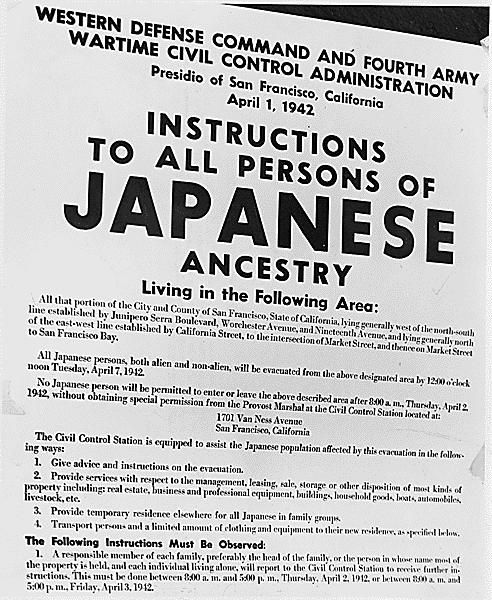
Here's text of the internment notices (click to enlarge):
Photos (top to bottom):

Dorothea Lange, "Hayward, California. Two children of the Mochida family who, with their parents, are awaiting evacuation bus. The youngster on the right holds a sandwich given her by one of a group of women who were present from a local Church. The family unit is kept intact during evacuation and at War Relocation Authority centers where evacuees of Japanese ancestry will be housed for the duration," 5/8/42, U.S. National Archives

Dorothea Lange, "San Francisco, Calif., April 1942 - Children of the Weill public school, from the so-called international settlement, shown in a flag pledge ceremony. Some of them are evacuees of Japanese ancestry who will be housed in War relocation authority centers for the duration," Library of Congress

Photographer unknown, "Lange photographing Japanese-American evacuees, "4/6/42, Library of Congress

Dorothea Lange, "Hayward, California. Farmer of Japanese ancestry is showing his identification card to a Wartime Civil Control Administration Control Dispatcher as he is about to board the special bus for Tanforan Assembly center," 05/08/1942, U.S. National Archives

Internment notice, Wikipedia

2.15.2011

Bits: 02.15.11


Raphaël Zarka, Riding Modern Art, 2007

• The Indianapolis Museum of Art, which has "152 acres of gardens and woodland," outlines its environmental stewardship work, and how it measures its carbon footprint.

• Kentucky Rising activists, including poet Wendell Berry, ended a four-day sit-in protest at the Kentucky governor's office yesterday afternoon, emerging from the building to a crowd of 1,000 people. Highlighting the destructive practice of mountaintop-removal mining, Berry vowed to keep pressure on the governor, who's up for reelection. He said, “We came because the land, its forests, and its streams are being destroyed by the surface mining of coal, because the people are suffering intolerable harms to their homes, their health, and their communities.”

• Read Wendell Berry's poem, "Manifesto: The Mad Farmer Liberation Front."

• Michael Bloomberg's family foundation is making $32 million in grants to arts organizations around New York City; 250 small and midsized art groups in operation for at least two years have been invited to apply.

• Chinese artist Ai Weiwei has cancelled his first retrospective in mainland China. AFP reports that the show, scheduled for the Ullens Center for Contemporary Art in Beijing, was canned after its organizers told Ai the show was "politically sensitive." Ai has long been a critic of China's communist government, and has paid the price: he's been arrested, beaten and jailed, and in November his studio was razed. "The timing is sensitive and politically they feel it is not suitable at the moment," he said.

• Italian collecitve IOCOSE has futzed with Ai Weiwei's Sunflower Seeds, an installation of 100 million porcelain sunflower seeds in Tate Modern's Turbine Hall, to create Sunflower Seeds on Sunflower Seeds: On Jan. 31, they left real sunflower seeds in with Ai's replicas, apparenlty shooting some of the seeds in with slingshots.

• Vintage book cover: Secrets of the Shopping Mall, apparently a horror book, via Brian Ulrich.

• Banksy's Exit Through The Gift Shop is up for an Oscar, prompting questions about how or if the incognito artist will accept his trophy. Amid the hubub: a sighting of a new Banksy piece in LA, and a new mini-documentary on the artist.

• With Crashvertising -- what Bruce Sterling calls "wry and smirking European anticapitalist intervention-art," Italy's Kook-Artgency sends a team "immediately to the spot, showing an advertising campaign on large scale posters and giving away safety vests with a brand’s logo to all the people involved in the road accident. Furthermore, 'a special warning triangle with your brand message is located near the cars,' and 'gadgets or other advertising stuff are given away to people in the area.'"

Mentalgassi's giant camera street-art in Spain


Berlin-based wheatpaste team Mentalgassi, last seen at Eyeteeth here, was in Spain late last year for GETXOPHOTO, and left a few contributions around Getxo (about 14 km from Bilbao).

2.14.2011

B Movie: A Film About the Art of Banksy


Via Laughing Squid.

Bits: 02.14.11


Kunsthofpassage Funnel Wall, a raingutter musical instrument in Dresden, Germany

• American Airlines in-flight magazine revisits the Miss Rockaway Armada's Minneapolis launch in 2006 (I'm interviewed) as a preview of Swimming Cities' upcoming project on the Ganges in India. Here's my look at the Swoon-led project just before the flotilla of sustainable rafts launched on the Mississippi a few blocks away nearly five years ago.

Passive Aggressive Vending Machine by Yarisa Kublitz: Put in a coin and your selected piece of china will crash to the bottom of the machine.

• Gun street art + stop sign = alarm in Atlanta. (Thanks, Maryn.)

• Minneapolis calls for art: FEAST (Funding Emerging Art with Sustainable Tactics), due Feb. 18; and Northern Lights, which is curating the nuit blanche (i.e. dusk-to-dawn) site-specific festival Northern Spark on the Minneapolis riverfront June 4-5; deadline Mar. 7.

• The Walker design department posts fliers from the late '60s and early '70s for shows by The Who, Led Zeppelin, Muddy Waters and others.

• An amazing gallery of German aerial photography.

• Secrets of the City visits with sculptor Kinji Akagawa.

Shatner's doing a metal album.

Kentucky Rising: Poet Wendell Berry, others protest mountaintop-removal mining at KY guv's office


Daniel Shea, Hell's Gate, from his 2007 Appalachian photo series "Removing Mountains"

Today is day four of a sit-in in the Kentucky governor's office by 76-year-old poet Wendell Berry and 13 other Kentucky Rising activists who are calling for an end to harsh mountaintop-removal mining. The group is urging Gov. Steve Beshear to "lead by ending mountaintop removal, by beginning a sincere public dialogue about creating sustainable jobs for our hard-working miners, by putting the vital interests of ordinary Kentuckians above the special interests of an abusive industry." In his 2011 State of the Commonwealth speech, Beshear decried "Washington bureaucrats" over what he calls the "arbitrary and unreasonable regulations on the mining of coal." "Get off our backs," he said of the EPA.

Writes Berry: "[O]ur protest is against methods of mining that are abusive. We do not oppose mining per se. Our purpose is to protect our land and water. And we most certainly bear no ill will against those who work in mines."

Authors Michael Pollan and Bill McKibben have been vocal in support of the activists. McKibben:
It's about time that people said: 'No more business as usual, if that means leveling the mountains of southern Appalachia.' And it comes as no surprise that Wendell Berry is in the forefront, as he has been for an entire generation. When the rest of the nation sees the person we most associate with Kentucky taking a stand like this, we pay attention."
Last summer, Berry ungifted his papers to the University of Kentucky, his home state, after it decided to name its basketball players' dormitory after the coal industry.

Today is I Love Mountains Day, when activists are marching to the Kentucky capitol in protest of the mining procedure.

2.12.2011

Broken Crow to do mural at Mexican City toy museum


After making murals in Gambia in October, John Grider and Mike Fitzsimmons of Minneapolis' Broken Crow have their next international trip planned: They just confirmed they'll be heading to Mexico City from March 1-11 to do a gigantic mural at MUJAM, el Museo del Juguete Antiguo Mexico (the Antique Toy Museum Mexico). The museum is run by 65-year-old Roberto Shimizu, the son of Japanese immigrants who imported toys and food into the country. Filmmaker Albo Mora Roca writes that Shimizu "deliberately located his museum in a working-class neighborhood, Colonia Doctores, a place people go to buy stolen car parts. He calls it 'a live museum for living Mexicans.'" Shimizu's son Roberto, Jr., helps with art programming, holding a twice monthly event called Collec, in which painters, comic artists and designers sell their works on an empty floor of the museum.

Grider says Broken Crow is planning artmaking trips to the UK and to Anchorage, Alaska, this summer, as well as throughout rural Minnesota where they'll be painting barns. He estimates the pair has created around 100 murals, including 15 in the Twin Cities (here's two: 1, 2) seven in New York, and 30 in international cities including London and Paris. Above, a shot from their Gambia trip, courtesy of Christin Crabtree Grider. Below, Roca's documentary on MUJAM.

2.10.2011

Object du jour: Frank Gaard's Minneapolis Society of Fine Arts Snowshovel (1969)


In an email, Minneapolis-based artist Frank Gaard explains this seasonally appropriate readymade from 1969:
I got the snowshovel when I first moved here from California in 1969. It was standard issue for renters in Minneapolis Society of Fine Arts buildings.

I thought it was pretty ironic. The fellow in the photo broke his arm that following summer; the title of the Duchamp readymade was In Advance of A Broken Arm. It seemed as if the readymades could be anywhere, made from anything. It was a skill-less art, no craft, just slight knowledge of contemporary art.

2.04.2011

Blog: Born This Way


Isaac, age 7, Karratha, Western Australia, 1995

This is sweet: A blog highlighted by NPR of snapshots submitted by readers "that capture them, innocently, showing the beginnings of their innate LGBT selves."

Certified Steve Martin encounter


Via Reference Library, it makes me think I should try to contact Martin about this.

2.03.2011

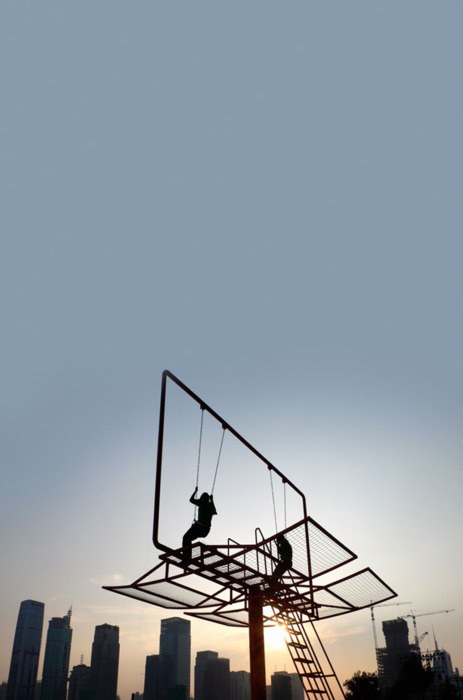
Didier Faustino's swingset billboard


Architect Didier Faustino's Double Happiness, an "urban reanimation device" installed as part of the Shenzhen-Hong Kong Bi-City Biennial of Urbanism and Architecture:
Double Happiness responds to the society of materialism where individual desires seem to be prevailing over all. This nomad piece of urban furniture allows the reactivation of different public spaces and enables inhabitants to reappropriate fragments of their city. They will both escape and dominate public space through a game of equilibrium and desequilibrium. By playing this “risky” game, and testing their own limits, two persons can experience together a new perception of space and recover an awareness of the physical world.
Via PlaceboKatz.

The Words Don't Fit the Picture


Ron Terada, The Words Don't Fit the Picture (installed outside the Vancouver Public Library), photographed by Kenny Louie. (H/t Maryn McKenna.)

2.01.2011

Bits: 02.01.11


002, Gerco de Ruijter, from Baumschule (2008-2010)

• "How abstract can a landscape become while remaining a landscape?" Gerco de Ruijter asks. His reply is a series of "32 photographs of tree nurseries and grid forests in the Netherlands" called Baumschule. BLDG BLOG has more.

• An upside of the rotten economy: a resurgence of DIY, interventionist and reuse-oriented architectural projects.

Google Art Project: "Explore museums from around the world, discover and view hundreds of artworks at incredible zoom levels, and even create and share your own collection of masterpieces."

• A professor, sued by an author over an academic book review she thinks is defamatory, is now in court in Paris. Writes Joseph Weiler, Editor-in-Chief of the European Journal of International Law: "As I entered the Tribunal de Grande Instance de Paris, the French Old Bailey, my lawyer whispered: ‘Emile Zola was tried here.’ Vive la difference: This was no Dreyfus Affair but the stakes for Academic Freedom and liberty of expression are huge."

Wilco is founding its own record label, dBpm, to release future Wilco records (including the band's next one, due out late this year). Distro will be by ANTI- Records, which put out Mavis Staples' Jeff Tweedy-produced release.

• "Bohemian Rhapsody," ukelele version.

1.31.2011

Art Sled Rally 2011


Yesterday was the fourth annual Art Sled Rally in Minneapolis' Powderhorn Park. Cold feet cut my visit short, but luckily plenty of photographers were on hand to chronicle the races. Check out shots by Sean Smuda and Ren. As Taylor Carik tweeted yesterday, the event is "like a middle finger to winter. A small and polite middle finger, but middle finger nonetheless."

Above, my shot of a cop car sled arriving at the park.

Paired: Sawblades by Mounir Fatmi and Dan Funderburgh


Mounir Fatmi's Between the Lines -- saw blades "with calligraphy inscriptions of texts from the Surah or Hadith, evoking the beauty of God or man's capacity, or desire, to obtain knowledge" -- and wallpaper artist Dan Funderburgh's My Name Is A Killing Word, a work on painted and etched foamcore.

Earlier: Paired: BP graffiti and Huang Yong Ping's Amerigo Vespucci

Video: Minnesota public artist Kinji Akagawa


TPT's MN Original profiles educator, sculptor and public artist Kinji Akagawa. His work Garden Seating, Reading, Thinking has been in the Minneapolis Sculpture Garden since its founding in 1988.

Read my essay on Kinji, "How Care Manifests the World," written when he was named 2007 McKnight Foundation Distinguished Artist.

Minneapolis street art: Phil Jones' Random Acts of Design


Guerrilla street signs have been popping up in South Minneapolis recently touting everything from free hugs for hippies (a tree holds the sign in notoriously lefty Powderhorn Park) to lost ninjas ("Have you seen him? Probably not. Because then you would be dead"). These "Random Acts of Design" are the work of freelance graphic designer and recent transplant to Minneapolis Phil Jones.

Check out more of his interventions on his blog or his Flickr page, and this Wednesday look for an interview with Jones at Secrets of the City.


1.26.2011

Bits: 01.26.11


• Two years ago last week -- on the day Barack Obama was inaugurated as president -- Minneapolis artist Broc Blegen traveled to Washington to unveil his inflatable sculpture, The George W. Bush Monument. With President's Day coming up, you can get your own; Blegen writes that the work is "available in a limited edition at an affordable price (compared to other monuments) - complete with a customizable inscription so you can honor the President however you wish!"

• Long ago a curatorial intern in the Walker Art Center's Visual Art department -- before working her way to gallery director/curator at REDCAT in LA -- Clara Kim has been hired back by the Walker. She starts in Minneapolis Aug. 1.

• Two interesting posts by John Thackara at Design Observer: One on 73-year old French farmer Pierre Rabhi, founder of the International Movement for Earth and Humanism; another on Milan's new "service ecology" development plan.

• LA Times writer Christopher Knight tweets: "It's worrisome when an art museum's show-title names a movie star but not the artist." The show: LACMA's Elizabeth Taylor in Iran featuring photographs by Firooz Zahedi.

• Trailer: Among others, sculptor Kinji Akagawa will be featured on the next edition of MN Original, which begins airing on TPT stations Thursday night.

• "Superflex's Flooded McDonald's becomes reality in Brisbane."

• From Vandalog, urban robots in Venezuela by Flix.

Premakes: Trailers for modern movies -- like UP, The Empire Strikes Back and Ghostbusters -- had they been made in the '40s, '50s and '60s.

1.05.2011

Bits: 01.05.11


Will Steacy, Mold 10, used with permission

• Works from Will Steacy's series "A Human Stain" (found photographs recovered in New Orleans after Hurricane Katrina) and "A Silent Affliction" (moldy interiors in the same city) make up many of the images in the title sequence of HBO's Treme.

• Because he's not rich enough: Artist Jeff Koons has sent a cease-and-desist letter to San Francisco's Park Life, a gallery and shop, for selling balloon-dog bookends. The letter, SFist reports, asked the shop to stop selling and advertising the projects, then "return them to some mutually agreed upon address, [and] tell Koons how many have been sold and disclose the maker of said bookends." Koons, of course, didn't invent balloon animals, although he's represented them in large-scale sculptures. (Via Jennifer Yin on Facebook.)

• Artists and a handful of veterans brought projectors to the exterior of the MOCA Geffen Contemporary Monday night to protest LA MOCA director Jeffrey Deitch's whitewashing of a mural commissioned by street artist Blu that depicted coffins draped with money. Hyperallergic has the story.

• Video: Hennesy Youngman helps you "PURSUE YOUR ART WITHOUT TREADING THE GROUND THAT THAT CRACKA BRUCE NAUMAN ALREADY TREAD." NSFW. (Via Kirk McCall via Kara Walker on Facebook.)

• Works by F. Scott Fitzgerald were supposed to enter into the public domain this year --- 70 years after the St. Paul writer's death -- but thanks to the Sonny Bono Copyright Term Extension Act we've gotta wait. Via Secrets of the City.

• RIP Worldchanging.com.

12.21.2010

Bits: 12.21.10

Shopping Cart Xmas TreeShopping cart Christmas tree in Emeryville, Calif., by Anthony Schmitt. Photo: danielsjf, Flickr, used with permission

• Artist/experimental geographer Trevor Paglen talks surveillance on Studio 360. Via C-Monster.

• Not all Catholics buy into divisive anti-art (and anti-intellectual) rhetoric like that of Bill Donohue of the Catholic League: When national bishops' conference president Archbishop Timothy Dolan came to Donohue's defense on the archdiocese's blog, both commenters and the group Catholics United decided to have their say. (Good luck commenting: Both of All three of mine were rejected.)

• Jerry Saltz pens a letter to congressional Republicans about where they can take their censorship of David Wojnarowicz's work next: through the full span of global art history on display in the Met's collection.

• Grief as absence and presence: Artist AA Bronson's photo of his partner Felix in bed shortly after his death from AIDS -- the work Bronson unsuccessfully tried to pull from the NPG's Hide/Seek show in protest of the Smithsonian's removal of Wojnarowicz's video -- is a haunting book-end to Felix Gonzeles-Torres' 1991 black-and-white billboard showing an empty bed, his tribute to his lover, Ross, who died from AIDS (as did Gonzales-Torres, five years later).

NPR's "Best Album Covers of 2010" includes one for S. Carey by Minneapolis photographer Cameron Wittig, whose work is now on view at Black Blue in St. Paul. Here's more of his music photography, which includes cover photos for albums by Andrew Bird, Haley Bonar, and others.

• Apropos of nothing: Go (re)read some Wendell Berry.

• Well, that's not exactly getting into the holiday spirit, is it?

12.16.2010

Mpls.TV's year-end list: Best local signage

I'm not a big fan of year-end lists (although I have a winner if I do the year's worst local art tweets list I was thinking about), but Mpls.TV offers my kind of list: "best local signage" (via MNspeak). My two favorites:

12.14.2010

Walker sets screening dates for Wojnarowicz's "Fire in my Belly"

The Walker Art Center just tweeted its screening times for David Wojnarowicz's Fire in my Belly: Check it out daily in the Lecture Room from 11:30-noon Dec. 16-31, and every Thursday night from 8:30-9 pm.

Slideshow: St. Paul artists David Rich and Paulette Myers-Rich


Secrets of the City visits with artists David Rich and Paulette Myers-Rich at their St. Paul home/studio. David's an abstract painter and MCAD professor who's got a new monograph out, while Paulette is a bookmaker, photographer, printer and winner of the 2009 Minnesota Book Awards Book Artist Award. Their home, a live-work space just a few blocks from the High Bridge in St. Paul, is a converted mechanic's shop that's now filled with printing equipment, David's large-scale paintings, books, bongos and plants. Kelsey Johnston interviews and takes the pictures.

Warhol Foundation threatens to pull funds over NPG pulling Wojnarowicz work

Missed this from yesterday: The Warhol Foundation, which kicked in $100,000 for the National Portrait Gallery exhibition Hide/Seek: Difference and Desire in American Portraiture, says it'll yank funding if the gallery's parent organization, the Smithsonian Institution, doesn't put David Wojnarowicz's video work Fire In My Belly back on display. NPG pulled the work after some Republicans in Congress and the rightwing Catholic League claimed it was "anti-Christian."

Walker Art Center to screen censored Wojnarowicz work

The Walker Art Center will screen Fire in my Belly, the late David Wojnarowicz's video work that's at the center of controversy after the Smithsonian's National Portrait Gallery removed it from an exhibition at the urging of conservative Christian groups and legislators, according to a blog post by its director, Olga Viso. Pending the OK from the artist's estate, the piece -- which drew the ire of the Catholic League for an 11-second clip showing a crucifix with ants crawling on it -- will screen daily later this week.

Viso, director of the Smithson's Hirshhorn Museum and Sculpture Garden before coming to Minneapolis, also puts the Walker squarely in support of artistic freedom and in opposition to NPG's actions in removing the work, which she writes "captures [Wojnarowicz's] anger and struggle with the death of a lover and his own H.I.V. diagnosis."

After traveling to Washington to see Hide/Seek : Difference and Desire in American Portraiture, the exhibition that included Fire in my Belly, she applauded the National Portrait Gallery for a "groundbreaking, scholarly exhibition and supporting the curators’ well argued thesis that a powerful artistic and cultural legacy has been 'hidden in plain sight for more than a century'" -- that is, work dealing with America's changing attitudes toward sexuality.

But she goes on: "Yet the NPG’s and Smithsonian’s surprising decision to remove a key work from the exhibition a month after its opening undermines this thesis as well as the premise and curatorial integrity of the exhibition in alarming ways. Indeed this action serves to sublimate or 'hide' the very thing the exhibition attempts to make visible."

She continues:

Three years after my departure, I am saddened to find a very different Washington, one informed by fear, intolerance, and silence, and a different Smithsonian, one that has perhaps lost touch with some of the core principles and spirit of its establishment. Founded in 1846 to increase and diffuse knowledge, the Smithsonian was created by the U.S. Congress as a trust instrumentality of the nation to be administered by an independent governing body and leader. This structure was created in part to prevent an institution envisioned as a beacon for research, debate, and the advancement of knowledge from being subject to the winds of political change, partisanship, and special interest. So important was this value that the Congress debated for nearly a decade prior to the Smithsonian’s establishment how to best ensure scholarly objectivity.

I am, of course, deeply disheartened by the Smithsonian’s recent actions and join my colleagues at the Association of Art Museum Directors and the Warhol Foundation, on whose boards I also serve, in their statements of disapproval and condemnation. Since time immemorial, artists have questioned the predominant modes of thought in our society and pushed the bounds of conventional thinking to inspire reflection, debate, and ultimately advance culture. As stewards and supporters of our cultural legacy, it is essential for institutions like the Walker and, indeed all citizens, to support the independent voices of artists and the value of creative and artistic freedom. It has never been more important to speak out and openly for the freedom of expression.

The Walker joins a slew of other museums that are showing the banned work -- SFMOMA, the New Museum, the Wexner Center for the Arts, the Hammer, the Wadsworth Atheneum, among many others -- giving the piece far more exposure than had the Catholic League and legislators like John Boehner not called for censorship. While Modern Arts Notes states that's it the smaller and the more progressive institutions that led the way on bringing this exposure (Transformer Gallery in Washington was the first to screen the piece, with bigger institutions following later), I'm proud that the Walker has taken a stand.

Details on this week's Fire in the Belly screenings will appear on the museum's website soon. Wojnarowicz's 1990 lithograph Four Elements, from the Walker's collection, will be on view in the exhibition 50/50: Audience and Experts Curate the Paper Collection, which opens Thursday.

Update: The Walker will screen the video daily, starting this Thursday and continuing through the end of the month. Times here.

Image: David Wojnarowicz, Untitled (face in dirt), c. 1990

12.09.2010

Bits: 12.09.10


Sze Tsung Leong, Zhongshan Lu I, Xinjiekou, Xuanwu District, Nanjing, 2004

• Counterpunch's Jimmy Johnson, writing that "we should consider Wikileaks to be a literacy organization": "Something secret has to develop more forms of secrecy in order to keep itself secret, thus the classified universe, in the words of geographer Trevor Paglen, 'tends to sculpt the world around it in its own image.' How, after all, can a secret be transparently discussed?"

• Must-read: Hip-hop historian Jeff (Can't Stop Won't Stop) Chang co-writes an American Prospect piece with the Center for American Progress' Brian Komar about how culture needs to lead in the push for progressive change. (Via Davey D.)

• Related: Exiled Iranian artist Shirin Neshat tells attendees at the TEDWomen conference that in the West, culture runs the risk of becoming mere entertainment. An Xiao, who was there, tells Hyperallergic that Neshat "explained that art and culture are a form of resistance, and that she envied Western artists for not having to think about resistance in their work."

• Essay: Diane Mullin, associate curator at the University of Minnesota's Weisman Art Museum and former Minneapolis College of Art and Design/Jerome Fellowship director, on how "the persistent consternation such fellowship shows provoke may be the fault, not of the artists, jurors, or program directors, but of the mode of and perhaps even the inclusion of the exhibition itself."

• Tyler Green breaks news that the National Portrait Gallery commissioner James T. Bartlett has resigned in protest of the Smithsonian’s removal of David Wojnarowicz’s A Fire in My Belly from the Hide/Seek: Difference and Desire in American Portraiture exhibition. As a leaked Smithsonian memo suggests, it's not the only sign of internal tension over the institution's handling of the work, which rightwing groups have claimed is "anti-Christian."

Jabari Jordan Walker interviews Eyeteeth pal Matt Olson of Minneapolis design firm ROLU for 01 Magazine on all that he and partner Mike Brady do: landscape design, blogging, furniture design, art commissioning...

• On the occasion of the arrival of my Danzig-style Werner Herzog t-shirt, Taylor sends a link to an exhaustive gallery of Hüsker Dü gig posters (here's 1984). Which filmmaker fits the font? (He suggests Uwe Boll.)

• Speaking of metal and visual culture: The Minneapolis Egotist points out the Map of Metal, which lets you navigate through kinds of metal I've never heard of (mathcore?) Earlier: Diagram of heavy metal band names, and an interview with Christophe Szpajdel, the "Paul Rand of metal."

12.08.2010

Army Men: Kristine Potter's 'The Gray Line'

Kristine Potter, Untitled, 2009

Of all the photos in Kristine Potter's "The Gray Line" series, this is the one I keep coming back to. From this untrained photographer's perspective, it at first seems imperfect: improperly exposed or inadequately accounting for the sun's glare. But this lighting is everything. As war can do, it fades out the individual identities of the men who are engaged in fighting. It underscores the soldiers' skill at camouflage and represents a core aspect of the soldiers' jobs: Violence. And it blurs the line between earth (under which these men may be buried if killed in the line of duty, a very real risk) and sky (where the soul ascends after death, as some religious traditions posit).

Potter, whose work is on view at Daniel Cooney Fine Art in New York through Dec. 23, comes from a family that has seen many of its men, although none in the current generation, serve in the military, so she grew up in a culture of orderliness, hierarchy and patriotism, writes Women In Photography. Yet in adulthood, her feelings about the military have become more complex, dealing with broader issues of power and violence, as well as the personal and complicated psychologies of soldiers, who hold toughness, anxiety and vulnerability at the same time. This shot, moreso than Potter's others, seems to embody that complexity.

@MuseumNerd does Minneapolis

Experiencing the Twin Cities art scene with out-of-towners, as I did with the anonymous (and remarkably prolific) art tweeter @MuseumNerd a few weekends back, reminds me how good we've got it here. Today @MuseumNerd shares some of his/her best local museum moments with Secrets of the City, including a visit to see the Walker's profound and surprising live-performance installation by Eiko and Koma with me ("it was probably a religious experience for the non-religious visitors") and trips to the Minneapolis Institute of Arts, the Pavek Museum of Broadcasting, SOOVAC (now showing the work of 17-year-old artist Sarah Nakano), and elsewhere.

Check it out at Secrets of the City, which is doing some nice arts coverage under new owner Taylor Carik (disclosure: Taylor and I, who I met years ago when he emailed asking me to weigh in on this art-related topic, frequently drink beer together).

Thanks to Barry Hoggard of Culture Pundits for the intro to @MuseumNerd.

12.07.2010

Chiang Mai street stencil: Fish with gas mask


This shot, by Flickr user eb78, looks an awful lot like the one I posted awhile back, but has slight differences. I'm told the piece is painted over the kind of wall paintings identifying schools in Thailand (although it could also be a marking from a telephone company). Here's another such school ID.

12.06.2010

Bits: 12.06.10


Barilla Jacket, made from recycled packaging by Katell Gélébart of Art D'Eco Design

• The Association of Art Museum Directors' rebuke of the Smithsonian for censoring a David Wojnarowicz video work at the National Portrait Gallery -- the group blamed "unwarranted and uninformed censorship from politicians and other public figures, many of whom, by their own admission, have seen neither the exhibition as a whole or this specific work" for the removal of the work -- is at odds with a statement by Ford W. Bell, president of the American Association of Museum, who believes yanking the work was the right thing to do.

• Washington City Paper: "Two activists were detained by police on Saturday at the National Portrait Gallery after showing David Wojnarowicz's A Fire in My Belly on an iPad inside the museum. Both activists were ejected and subsequently banned for life from any Smithsonian Institution facility."

• Weak: The Smithsonian explains, "We removed [A Fire in My Belly] from the exhibition Nov. 30 because the attention it was receiving distracted from the overall exhibition, which includes works by American artists John Singer Sargent, Andy Warhol, Jasper Johns, Annie Leibovitz and Georgia O’Keeffe."

• NYT critic Holland Cotter dubs filmmaker Peter Greenaway's multimedia Leonardo's Last Supper installation, on view at the Armory, a "big, expensive, technological-bells-and-whistles-to-the-max dud." You have until Jan. 6 to see how much it sucks. (I'm kidding, Mr. Greenaway, sir.)

• "T-shirts are the new galleries": Support Hyperallergic by buying one of these reader-designed shirts (congrats to designer Duncan Alexander).

• While not a new idea, the Minneapolis Institute of Arts' Art ReMix program really works. My favorites from yesterday's visit: Thomas Struth's large-scale photo of the Köln Cathedral, featuring Gerhard Richter's pixelated stain-glass windows, atop the museum's grand staircase, and a Kehinde Wiley painting in the baroque room.

• Unfortunate stock photography of the day: CNN, in a story about same-sex marriage, included a Getty Images stock photo of anti-Prop 8 buttons, not noticing -- as one Redditor did -- an explicit image (NSFW) on one of the buttons. Now the story shows a recropped version of the shot.

Bill "Calvin & Hobbes" Watterson's college drawings.

12.05.2010

Slideshow: St. Paul artists Allen Brewer and Pamela Valfer


Secrets of the City's ongoing Sunday series focusing on Twin Cities artists continues with a look at the work of husband-and-wife couple Allen Brewer and Pamela Valfer. Brewer's an illustrator, who recently had a solo show at the Burnet Gallery at the Chambers Hotel in downtown Minneapolis, while Valfer is a mixed-media artist working, most recently, with recycled mink stoles, drawing and taxidermy. (Here are some of my shots of a visit to her studio earlier this year; look for video of our conversation soon.) As always, Kelsey Johnston offers an engaging interview.

Un-logo-fy: Jeff Crouse's Unlogo replaces corporate brands in video

You know how the networks often digitally superimpose ads onto sports stadium billboards for TV viewers? For his newest project, artist Jeff Crouse is working to do the opposite: His web service Unlogo "gives people the opportunity to opt out of having corporate messages permanently imprinted into the photographic record of their lives." Presented at this year's 01SJ Biennial in San Jose, it's an augmented-reality "corporate-identity filter" that recognizes and either blocks or replaces brand logos on videos and cellphone photos. In a prototype version (see video below), he's replaced logos in footage he shot at a mall with the faces of the CEOs of the companies behind the brands.

Crouse based the project on work he was doing for paying clients and took inspiration from art projects like Steve Lambert's Add-Art (which replaces web ads with art) and the software platform Artvertiser, which does the same thing with billboards. His project is open-source, and he's "training" Unlogo to recognize more and more logos; he plans on adding a way for online users to submit logos for inclusion. Eventually, he expects to have an online service where users can upload their own videos to have them "un-logo-fied." An iPhone app will allow users to replace logos in cellphone photos with an image of their choosing.

Listen to an interview with Crouse. If you'd like to support the project, go to the Unlogo Kickstarter campaign.

Unlogo Intro from Jeff Crouse on Vimeo.

12.04.2010

Video: David Wojnarowicz on political art and arts funding

Three years before he died from AIDS in 1992, video artist David Wojnarowicz spoke about political art, arts funding and the furor over Robert Mapplethorpe's art. Nearly 20 years later his work is at the center of a censorship controversy that suggests issues he discusses here are still with us.

Via Andria Hickey on Facebook.

Video: Is Wojnarowicz's censored video really ‘anti-Christian’?

Christopher Knight at the LA Times takes up the question in a piece that resonates with this Catholic art enthusiast. As you recall, the Smithsonian's National Portrait Gallery caved to pressure exerted by Republican politicians to pull a video work (below) by the late David Wojnarowicz because it included a short clip showing a crucifix with ants walking on it. The rightwing Catholic League -- which has a long history of blasting artists who dare address the topic of Christianity, including Nigerian-English artist Chris Ofili's portrait of the mother of Jesus which included balls of elephant dung, and Renee Cox, who depicted herself in a Last Supper photo as a nude, female, African American Jesus -- dubbed the piece "hate speech" in a characteristically snotty release.

Knight writes, in part:
...Objectively speaking, an artist bent on making an anti-Christian diatribe would not spend just 15 seconds of a 30-minute video making it. Those images instead serve another function: To rebuke the same self-righteous moralism of those who are attacking the Smithsonian now.

Ants and bugs are an age-old artistic symbol that laments the frailty of human beings and earthly existence. As Ecclesiastes puts it: Vanitas vanitatum omnia vanitas -- “Vanity of vanities; all is vanity.” Ant-covered flora, bodies and animals turn up in everything from still life paintings in the largely Protestant 17th-century Netherlands to the silent Surrealist film, “An Andalusian Dog” (1929) by the Spanish director Luis Bunuel and artist Salvador Dali, a conservative Catholic.

In the Wojnarowicz video, the vanitas theme plays out on a crucifix not as a religious slur, but as a lament for earthly failures among those who should know better at a time of epic tragedy. Small wonder that some who failed then take offense at being reminded of it now.
Knight notes that only one of the politicians and religious groups outraged by the piece have actually seen it. Thanks to the internet, we needn't rely on the opinions of allegedly anti–"nanny state" GOPers to screen content for us: P.P.O.W. gallery, which represents the artist's estate, posted the full work, which does have some content which may be challenging to some, on YouTube, but users flagged it as offensive, so it was yanked. But now the gallery has hosted it elsewhere and makes it available on its website. Transformer Gallery in Washington is also showing a seven-minute version of the work.

As with the furor over the Corcoran canceling a Robert Mapplethorpe show in 1989 -- activists ended up doing a guerrilla slideshow on the exterior wall of the Washington museum, raising the work's profile even more -- efforts to quash exposure of Wojnarowicz's work already seem to be backfiring, drawing far more attention to it than had Bill Donohue's Catholic League not squawked so loudly. (Of course, the regularity of such squawking raises questions whether fundraising for the League is a major factor.) Regardless, I suspect that true Catholics have faith strong enough to endure an 11-second clip showing ants on a crucifix -- and some will likely come away enriched by the experience.

A Fire in My Belly, David Wojarowicz, via P.P.O.W. Gallery. (Note: A shorter edited version was to be on view at the National Portrait Gallery.)

Video: Artist Wafaa Bilal installs camera in the back of his head


CNN looks at Iraq-born artist and NYU photography professor Wafaa Bilal's new project, in which he embeds a camera in the back of his head. For his project "The 3rd I," the camera will take photos once every minute, around the clock for a full year. They'll be transmitted to Mathaf: Arab Museum of Modern Art (which commissioned the project) in Doha, Qatr for the exhibition, Told / Untold / Retold: 23 stories of journeys through time and place, which opens Dec. 30. Happening just as Americans are in an uproar over privacy at airport checkpoints, he says he hopes the work will contribute to a dialogue about surveillance. But he also hopes to take the subjectivity out of photography, and acknowledges that much of what's transmitted to Qatr from the cable emerging from the circular camera on the back of his head will be mundane.

CNN makes a brief comparison to the helmet-cams war correspondents have used in places like Bilal's home country. While he doesn't seem to have such overt intentions, it does fit the (ahem) scope of past works like his "shoot-an-Iraqi" project Domestic Tension (2005), in which he was contained for one month in a cell-sized room where people could -- in-person or online -- shoot at him with a remote-control paintball gun.

And earlier this year, Bilal got his back tattooed with dots representing deaths of both Iraqi civilians and American soldiers in Iraq and a map roughly depicting where they died. Text accompanying video documentation of the project states that Bilal's brother Haji was killed by a missile at a checkpoint in their hometown of Kufa, Iraq in 2004.

Of Told / Untold / Retold, curators Sam Bardaouil and Till Fellrath told Nafas Art Magazine, "Today's artists are in constant transmigration across a diversity of cities and locations, yet never escaping redundant geographical labels through which their work is misconstrued. They are in perpetual metamorphosis, in a state of 'in-betweenness.' These journeys occur not only in place, but also in time."

Then, as if to reference Bilal's camera captures of what he's passed by, they added, "When you move and leave things behind, you remember, recollect and reconstruct, but you also reorient and redirect yourself. These are all acts into which time is intricately weaved."