1.31.2007

Molly Ivins is dead.

A blow to the progressive community...
Molly Ivins, whose biting columns mixed liberal populism with an irreverent Texas wit, died at 5:30 p.m. Wednesday at her home in Austin after an up-and-down battle with breast cancer she had waged for seven years. She was 62.

Ms. Ivins, the Star-Telegram’s political columnist for nine years ending in 2001, had written for the New York Times, the Dallas Times-Herald and Time magazine and had long been a sought-after pundit on the television talk-show circuit to provide a Texas slant on issues ranging from President Bush’s pedigree to the culture wars rooted in the 1960s.

"She was magical in her writing," said Mike Blackman, a former Star-Telegram executive editor who hired Ms. Ivins at the newspaper’s Austin bureau in 1992, a few months after the Times-Herald ceased publication. "She could turn a phrase in such a way that a pretty hard-hitting point didn’t hurt so bad."

A California native who moved to Houston as a young child with her family, Ms. Ivins was diagnosed with breast cancer in 1999. Two years later after enduring a radical mastectomy and rounds of chemotherapy, Ms. Ivins was given a 70 percent chance of remaining cancer-free for five years. At the time, she said she liked the odds.

But the cancer recurred in 2003, and again last year. In recent weeks, she had suspended her twice-weekly syndicated column, allowing guest writers to use the space while she underwent further treatment. She made a brief return to writing in mid-January, urging readers to resist President Bush’s plan to increase the number of U.S. troops deployed to Iraq. She likened her call to an old-fashioned "newspaper crusade."

"We are the people who run this country," Ms Ivins said in the column published in the Jan. 14 edition of the Star-Telegram. "We are the deciders. And every single day, every single one of us needs to step outside and take some action to help stop this war.

"Raise hell," she continued. "Think of something to make the ridiculous look ridiculous. Make our troops know we’re for them and are trying to get them out of there. Hit the streets to protest Bush's proposed surge."

She ended the piece by endorsing the peace march in Washington scheduled for Saturday. 01-27 "We need people in the streets, banging pots and pans and demanding, "Stop it, now!' " she wrote.
Read more at the Star Telegram.

"Baghdad Cindy": "Get out in the streets" to oppose war

After six weeks of boot camp and four weeks of training to be a Humvee mechanic, 24-year-old Army specialist Casey Sheehan was sent to Iraq. Within days he was dead, killed in combat along with seven others when his battalion was attacked outside Sadr City. In the nearly three years since, his mother, Cindy Sheehan, has gone from a lone voice of dissent camped outside George W. Bush’s ranch in Crawford, Texas, to a revered and reviled figurehead of a now-massive movement to withdraw American troops from Iraq.

Dubbed Baghdad Cindy by the pro-war right, Sheehan's name alone can spark outrage among conservatives who, as Bill O'Reilly said, believe her dissent "borders on treason." Sheehan visited St. Joan of Arc Catholic Church last night and met with a far friendlier audience. She was introduced by Sen. Becky Lourey, who also lost a son in Iraq, before addressing a crowd of nearly 1,000 people. She discussed a new take on patriotism (“Matriotism is love of humanity first.”), her dislike for Hillary Clinton, and the strategy of counter-recruitment, or “countering the lies” told to high-schoolers about the military. “If we dry up their cannon fodder,” she says, “we dry up their war.”

Before the talk, she granted me an exclusive interview. Given her role as a lightning rod for right-wing ire and her high profile protests and actions, including a meeting a year ago with Venezuelan president Hugo Chavez (she says she’ll do the same if invited by Iran’s Mahmoud Ahmadinejad), I was surprised by her calm demeanor and quiet voice. Wearing a sweater with the word "Peace" silkscreened on the front and with heavy eyelids, she seemed tired, almost sad—but far from combative; she'd save that for the St. Joan of Arc stage. Every morning and every night, she says, she still thinks of Casey, whose memory gives her "laser beam focus on her mission" — bringing U.S. troops home from Iraq. Here's what she had to say:

It seems your activism has shifted. Casey was killed April 4, 2004, so it’s been nearly three years since his death. In the nearly two years since you started your vigil outside the Bush ranch in Texas you've been arrested several times. Is that civil disobedience a strategy to raise the profile of your cause, or did it just happen?

I’ve been arrested seven times now, and it’s only been planned twice. The other times—like when I was arrested at the State of the Union last year for having what they call a protest t-shirt—that was a total shock. I had no idea. But the other times it was just when people tried to take my rights from me or inhibit my rights. I just refused to let them takes my rights away from me.

Early on, you were a voice in the wilderness. Some of us were with you, but very few people supported you in Congress. How does it feel to have more people on the same page?

It feels a little less lonely than it did at first. At first I was a voice crying out in the wilderness because I was so far ahead of everybody else. And there were amazing peace activists that I partnered with and they mentored me along the way. Since three-quarters of the country is with me now, and a lot of people in Congress and the Senate, it feels a lot less lonely. I feel like a lot of the pressure has been taken off of me.

Who were some of those mentors and what did you learn from them?

What got me out speaking is when I joined Military Families Speak Out. It wasn’t really a group for grieving parents; it was for people who have loved ones in the military. They actually got me speaking. I joined them in July of 2004. In January 2005, I founded my own organization, Gold Star Families Speak Out, which is for people who have lost loved ones in war. During the 2004 campaign I went down to Florida to campaign against George Bush, and I spent a lot of time with Medea Benjamin from Code Pink. Ray McGovern has been a really, really good mentor. He’s really grounded, so it’s been good to be good friends with him. And since I’ve been doing this, especially at Camp Casey, some people have become re-involved who have given me a lot of wisdom, like Joan Baez and Daniel Ellsberg… Believe it or not, Jane Fonda has given me a lot of wisdom from her experiences being "Hanoi Jane" — and now I’m "Baghdad Cindy." So she’s given me a lot of tips on how to handle negative criticism. So, yeah, I’ve had a lot of really amazing people who have really inspired me. During Camp Casey I got to know the other founder of Code Pink, Jodie Evans, and she’s been such a great advocate for me, and such a support system.

Speaking of negativity, how do you respond to military families or those who’ve lost children in Iraq but need to believe they died for something good?

Actually, I’m never confronted personally by those people. I think they have a right to believe what they want. This is America. I don’t have any more right than they do to believe or be any more active in a way they feel is right in their heart. I really think a lot of the parents who believed in it at first, and their child was killed, just like the rest of the country, have gone through a metamorphosis. When I set out at Camp Casey in August 2005, not even 50 percent of this country was against the war and against George Bush. Now it’s changed to 67, 70 percent, depending on what polls you look at. That transcends all demographics. That’s Republicans. That’s old people, young people, military families, active-duty military. I was just in Los Angeles over the weekend and a Marine came up to me and said, “Cindy, I just want you to let you know there are more of us on your side than you would even believe.”

You’re familiar with the Appeal for Redress movement? Last time I checked more than 1,200 active-duty military had signed a legal petition calling for an immediate withdrawal from Iraq. Given the size of the military, if that many people speak out, it’s only a drop in the bucket. But, given military culture, it may suggest there are a lot more that are remaining silent.
Probably for every one that signed it, there are a hundred who haven’t been exposed to it, who haven’t heard of it, or who want to sign up but they’re fearful. When I hear that 72 percent of active duty soldiers in Iraq say they want to come home and they don’t understand what we’re doing there, I think, wow, if 72 percent that will admit it, it must be 85 or 90 percent who feel it. Because it’s a different culture. It’s definitely a different culture.

What’s it like being asked to speak at the same St. Joan's podium where activists like the late Sister Rita Steinhagen [who protested the School of the Americas] and Gloria Steinem have spoken?

One day I was sitting on my friend's porch in Los Angeles with Tom Hayden and Daniel Ellsberg, and we were talking about politics and talking about the war. And I was like an active participant in this discussion with these two legendary historic men. And they actually cared about what I was thinking. As for celebrity, I barely think about it. These people are my friends. I’m friends with people I actually worshipped, like Jackson Brown and Crosby Stills Nash and Young and Willie Nelson. And political people like Daniel Ellsberg, who saved millions of lives by what he did but regrets not doing it sooner. But it’s just another day. I wake up every day thinking about my son. I wake up every day thinking about the people in harm’s way for lies. I have this laser-beam focus on my mission, and that’s what helps me be grounded…

It must be interesting being friends with people like Joan Baez and Jackson Brown, but then remember that you know them through this tragedy that happened in your life.

That’s why it hasn’t gone to my head, because I’ll be doing something really amazing and meet really amazing people but then think, wow, I wouldn’t even know you if my son wasn’t dead. It does put a moderating effect on my life.

Right-wing talking heads have been pretty brutal about you, saying you're really here for fame. Ann Coulter said of you that the left really needs to learn how to mourn and referenced the Paul Wellstone memorial.

Ann who? Who’s that you’re talking about? It kind of rhymes with Hitler? [Laughs] I totally don’t give them any countenance. If she thinks I’m in it for fame, she’s in it for money. I think people like that want to project the way they are onto me. I’m not responsible for their illnesses. I’m only responsible for myself and what I do in my heart every day. And I don’t have to answer to any of them. If I can go to bed every night with a clear conscience—the only person I have to answer to is myself.

You're often portrayed in the media as being extreme—you recently met with Hugo Chavez and said you’d meet with Iran’s president, two men the right says hate America. Is saying that a form of rhetoric, or do you see these men as kindred spirits?


First of all, of course, they don’t hate America, and if they hate George Bush, they might have good reason. As I told president Chavez, it’s not very effective to call each other names. They should sit across the table—or sit next to each other like I did with him—and talk. Hugo Chavez certainly doesn’t hate me. In fact, he admires me, and there are billboards of me in Venezuela. I think we need to model this kind of behavior, that talking is something we need to do. We’re not at war with Venezuela. We’re not at war with Iran, yet. I think by talking and going to these countries [we find] these people aren’t boogeymen and women. They’re people just like you and me. And if we allow our leaders to bomb them, we’re going to be killing innocent people for no reason. The leaders might not be people we want to follow or agree with, but they have millions of innocent people in their beautiful countries. I’ll go anywhere and talk to anybody if has a chance for [bringing] lasting peace. I think people who are opposed to that have let the other people be demonized. That’s what I’m trying to do: undemonize people. I’ve even tried to undemonize George Bush when I go around the world. Just saying he’s a human being like you and I. He’s not a good human being, but he’s a human being, just like you and I.

What about strategy? What can those who oppose the war in Iraq do?

Even though I think these issues transcend politics — they’re not partisan political issues — we have to work in the system we have to solve them. The Occupation Project is a program where people will go into Congresspeople’s offices on the week of Feb. 4 and stay there until they agree to vote no on the funding for the war. I think it’s going to take massive nonviolent civil resistance. Part of the country's not there yet, but I’m tired of being the only one who goes to jail for peace, and I think that’s what it’s going to take: everyone caring so much that they’ll put their bodies on the line for peace.

As the anti-war movement, we’ve done a good job of convincing America that this war is wrong. From Camp Casey on, the paradigm in this country has changed dramatically. I think we’ve convinced about as many people as are convincible. Everybody else who is still with him, he could do just about anything and they’d still be with him. Now it’s our job to convince this 70 percent. We don’t see 70 percent of people out on the streets. We need to get out in the streets; we need to get into congresspeople’s offices. If they can’t do that, letters work really well. Every congressperson tells me that letters and phone calls work really well. And I’m all for counter-recruitment. That’s stopping children from joining the military. Being in front of recruiting offices. Going into high school campuses. Being a counter to the military that goes into campuses all the time.

The new ad campaign for the National Guard is interesting because it’s saying, basically, “They’ll call me up when they need me, and in the meantime I’ll get a good education.” Everyone knows they need you now—they need bodies--but the ads don’t say that.

If you join, you’re going to Iraq. That’s for sure. But they’ll tell them they’re not. Almost everybody I’ve talked to who’s joined in the past two years was told they wouldn’t have to go to Iraq. As soon as they finish basic training, they’re on their way to Iraq. So, it’s a lie. Veterans and military families are really good at counter-recruitment. American Friends Service Committee is really good. ConscientiousObjector.org is really good for counter-recruitment materials, to counter the lies the recruiters tell.

So when will you get a good night’s sleep? When will you rest?

I’d almost sell my soul to the devil for a good night’s sleep. I haven’t had one of those for a long, long, long, long time.

[Cross-posted at Minnesota Monitor.]

1.30.2007

Photo of the day

[via]

Times UK on Signifier/Signed

The Times Online gives a little plug for the autograph project:

Paul Schmelzer is on a strange mission: to gather autographs from celebrities. But the famous people he accosts are asked to sign only his name, not their own. More than 70 people have agreed, and the signatures are on show at signifiersigned.com.

1.29.2007

Utne Re-Reader: A "progressive brand" reclaims its roots--and name

Given how media shakeups have been racking up headlines of late--from the sales of both metro dailies to editorial oustings at City Pages and The Rake--it's no surprise that progressive stalwart Utne has kept a low profile about change of its own. With its November/December 2006 issue, the magazine quietly rolled out a new tagline and a new--or, rather, old--name. Its cover once again bears the title it did when it was founded 23 years ago, Utne Reader. And "Understanding the next evolution" has been replaced with the simpler, "Thinking ahead."

Editor in chief David Schimke says the decision has a lot to do with another big change, last spring's sale of the magazine to Ogden Publications, the Kansas-based company that prints Grit, Steam Traction, and Mother Earth News, among others. With so many other upheavals, including two new editors in two years and a complete redesign of the publication last year, he says he didn't want to confuse readers or suggest that the sale had altered the essence of the magazine.

In fact, the change signals a return to the very heart of where Utne Reader began.

While Utne Reader remains "one of the top recognized progressive brands," according to Schimke, the standalone Utne never caught on.

The revised masthead signals a shift away from Utne's lifestyle focus of recent years. When Eric Utne retired from the magazine and his wife Nina took over, she concluded that in an internet age, the function of culling the best of alternative media might not be as relevant, so she dropped Reader. But Schimke and the new owners had a different idea. "Because of the internet, there’s even more need to cull, digest and filter," Schimke says. "And it seems like nobody in print is applying journalistic standards to the stuff that's turning up." The full title references the magazine's informal motto from years back: "The Reader's Digest of the alternative press."

Refocused, the magazine will also tackle political issues more directly and reduce the personal growth emphasis of recent years. Schimke says the old theme of "good news for bad times," used in Utne's publicity materials, will take on a "news that matters" feel, focused on giving exposure to under-represented ideas and news.

"We don't want to be just another progressive magazine," he says. "We want to use the alternative press to create an engaging conversation. We don't want to be didactic. We want to draw from libertarian sources, from liberal sources, from conservative sources.”

He adds that of the two places readers usually find Utne on a newsstand--beside Yoga Journal or next to Harper's--he'd prefer ending up beside the famed political magazine.

Utne Reader has seen its share of financial ups and downs, but these days its story seems a bit more like that discarded publicity slogan: its stability after the Ogden sale is a case of "good news for bad times." Bucking industry trends, Utne's subscriptions are holding steady at 225,000 and newsstand sales have increased slightly to 40,000 copies per issue.

"Given all possible scenarios, we couldn't have hoped for a better situation," he says of the Ogden sale. "They believe in the magazine, and if anything, they want us to be more aggressive and more topical. Of all the media upheaval in the last year, locally, I think we fared the best. I don’t want to gloat about it. In fact, I'm humbled by it. But the owners are smart. They get the magazine. And they're willing to give us the time to establish ourselves again."

[Cross-posted at Minnesota Monitor.]

1.28.2007

Announcing Signifier/Signed

I've been quietly building my autograph project--in which I've been getting celebrities like Yoko Ono, Bruce Sterling, and David Sedaris to sign "Paul Schmelzer"--into a standalone site, but now that Digg, Neatorama, and Yahoo Picks have linked to it, I'll offer a more public welcome. Inspired in part by Noam Chomsky's signing of my name, I titled the project Signifier, Signed, and so far I've got 30 or so signatures online, plus ephemera (Mikhail Baryshnikov's brush-off, pornstar artist Annie Sprinkle's words of encouragement, a post-it from Paul Wellstone). More to follow, and eventually a new non-Blogger design. Please check it out, and Digg it if you see fit. (It's on Reddit somewhere too, but I can't find the link.)

No idea what I'm talking about? Click here.

Above: my name as signed by the late, great Sen. Paul Wellstone.

1.27.2007

A Girl Like Me

In 1954 researcher Kenneth B. Clark did a test: he asked African American kids to choose which doll they liked better, a black one or a white one. Overwhelmingly black kids chose white dolls. The test was instrumental in Brown v. Board of Education, the Supreme Court case that overturned school segregation.

Unfortunately, as 17-year-old filmmaker Kiri Davis found out last year, little has changed. As part of a film project at Reelworks, she set out to recreate the test, finding that 15 of 21 black children she interviewed picked the white doll as the "nice" one:
“And why does that look bad?”

“Because she’s Black,” the little girl answers emphatically.

“And why is this the nice doll?” the voice continues.

Because she’s White.”

“And can you give me the doll that looks like you?”

The little girl hesitates for a split second before handing over the Black doll that she has just designated as the uglier one.
Minneapolitans: Davis' A Girl Like me screens continuously in the Walker Art Center's Lecture Room throughout March as part of the Women With Vision film festival.

1.26.2007

Pilotless airplane! Pilotless airplane! Pilotless airplane! Drone! Drone! Drone!

The San Francisco Chronicle, after captioning a photo of an airplane a "pilotless drone," got a livid phonecall from a defender of the English language who waxes lunatic about the "prolix," the "tautology" of such an error. Smartly, they podcast the message. [mp3]

NikeWomen billboard jam

Old-school billboard liberation in Munich, via Wooster Collective.

In smoggiest city, transit chief drives a Hummer

One condition of Steve Lopez's interview with LA transportation chief Jaime de la Vega: Don't ask about his Hummer.

In the American city most notorious for smog and gridlock, the transportation expert drives an oversized military vehicle?

Lopez, an LATimes columnist and editor of the paper's Bottleneck blog, couldn't abide by the condition, but de la Vega wouldn't answer any of his questions about the SUV. The mayor's press secretary said the vehicle was a personal choice and offered this feeble defense: "It's smaller than a Yukon." Ironically, on de la Vega's wall is a quote by Rosa Parks: "Every person must live their lives as a model for others."

Via Streetsblog.

1.25.2007

Tagged: The 5 Things Meme

I usually don't go for such things, but since André at placeboKatz tagged me, I'll indulge in the blog version of the chain letter: the five things meme. I'm supposed to reveal five things you don't necessarily know about me, and then tag five others who should do the same. Here goes:

777, the number of the klutz: I've sprained my ankles seven times each and, more disturbingly, I've had seven concussions (more than double the total averaged by NFL players). Pretty routine stuff--involving balls or things with wheels or running at the pool--there's only one stand-out: my most recent concussion occurred on my 21st birthday. Having enjoyed my first night of legally procured alcohol, I duck into an alley to pee, not realizing that the place had been flooded and turned into an ice rink. Thump. (To answer my brother's question, yes, I zipped up first.)

I named my dog after "the most important intellectual alive." A 10-year-old, brown-spotted border collie/sheltie mix, he's named after the linguist and activist Noam Chomsky, whom I met once. I was waiting in line after a fundraiser, and when my turn to say hello came, the insightful question I'd rehearsed--about East Timor or neoliberal economics (or whatever)--evaporated and I heard myself blurting: "I NAMED MY DOG AFTER YOU!" Smoove.

How I started writing: I never had grand ambitions to write when I was young. (In one of those oft-repeated family stories, I told my parents I wanted to be "a pickle tester" or "potato chip eater.") I spent a semester abroad in London during college, and when I met up with my vacationing parents in Ireland, I couldn't shut up about Little Venice, London's houseboat enclave on Regent's Canal. At Dad's suggestion, I posed as a writer, gaining access to boats like Uzezena ("hot lady" in Croatian, apparently), the award-winning garden/boat created by a pair of retired P&O shipping line buddies, and the Dutch sailing vessel that was home to bohemians just returned from a pan-Asian road trip in a Russian military vehicle they'd painted pink. It took awhile, but I got that first article published, in the magazine British Heritage.

It takes guts: I once spent an entire day driving 170 miles with Walter, the elderly man whose sole job was to remove deer carcasses from the highways of Central Wisconsin. The newspaper story I wrote on it, "King of the Road(kill)," chronicled his work, from the difficulties in hoisting a headless body onto the bed of his '72 Dodge Adventurer (sometimes people keep the head for a trophy, he explained) to hauling the battered corpses to the dump or, if fresh enough, a game farm where bobcats would dine on them.

I've never had a nickname. Unless you count my brothers' attempts to make "Walnut" stick. Thankfully, it didn't.

And now I tag:

Kathleen Fasanella
Joy Garnett
Colin Kloecker
Alec Soth
Brian Ulrich (Brian's 5 Things)

1.24.2007

A birthday present:

"Kerry will not seek the White House"

All dressed up...

It's my birthday, so I'm putting on my best suit and getting out of here. See you after the party.

Found sculpture

"A police officer lights a bonfire of confiscated rifles at the Lake Tanganyika stadium in Kigoma, Tanzania. Some 2,000 guns were surrendered last year under a program to rid the country of illegal weapons."

Sussing The Splasher

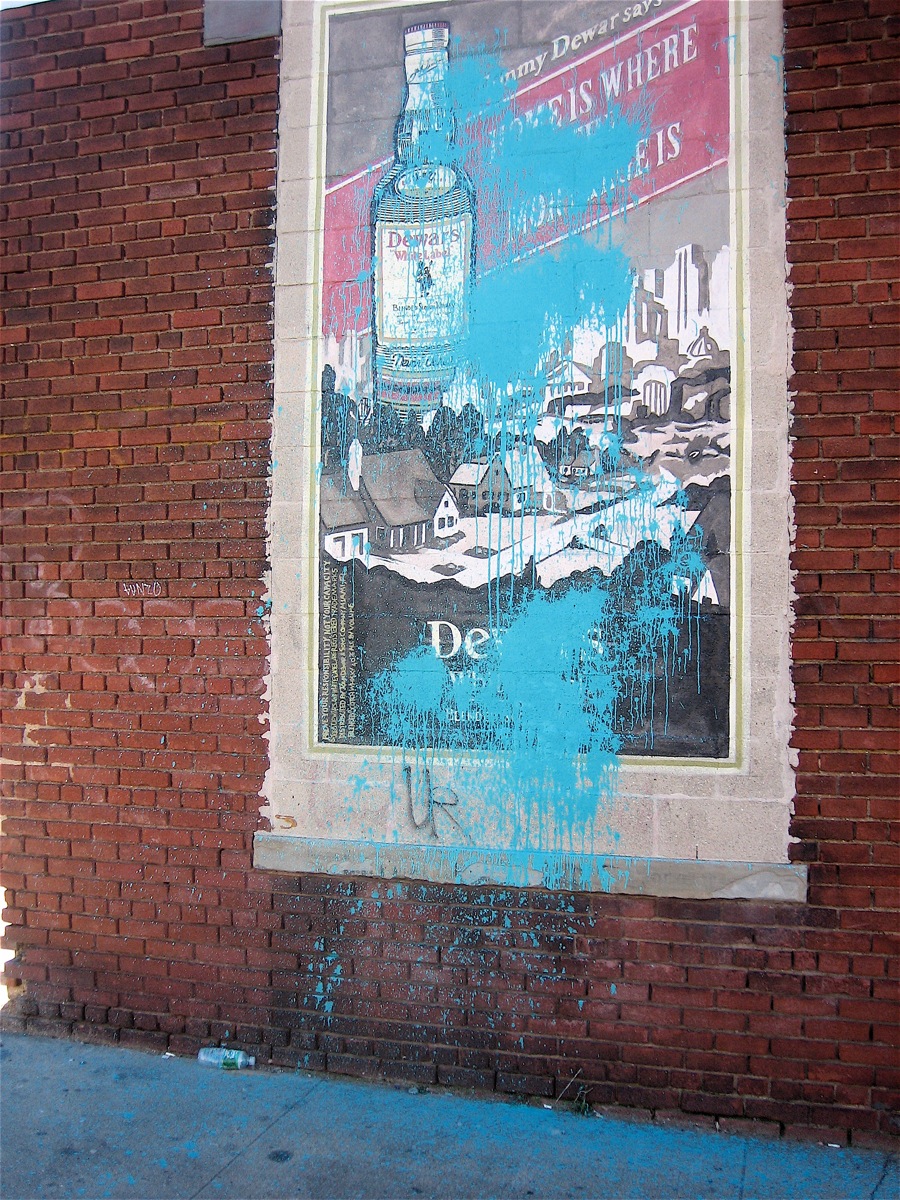
In New York, a person or group dubbed "The Splasher" has been getting plenty of attention for dousing street-art works with paint, then wheat-pasting posters beside them decrying their creators as "advance scouts for capital." The NYC street-art crowd is up in arms about the destruction of their work and doesn't want people like me giving attention to vandals.

And that's understandable. Their work can be seen, in many cases, as reclamation of the streets. One could argue that Swoon's intricate papercuts glued to a wall beautify and add unexpected wonder to the grime and ceaseless uniformity of the city. While their interventions are illegal, at least the motive in many cases is addition -- to add a question or a surprise or perhaps just a testament to their own creative impulse. Splashing paint on them is an easy and destructive -- i.e. subtractive -- act.

We could explain the Splasher's work in art historical terms -- the Dadaists acts of destruction, Jackson Pollock's drip paintings, the Francis Alÿs work where he punctured a can of paint in a museum and made an ambling dérive through the neighborhood, dripping all the way, and ended up nailing the empty container to the gallery wall. We could even consider the destructive acts of Lucio Fontana (who defied the picture plane and embedded performance into his work by slicing through a canvas), the Destruction in the Arts movement, even Duchamps' urinal and the many copycats who've emulated his work to literally or figuratively take a piss on the sanctity of art institutions or the preciousness of art.

Such readings seem far too generous for work that smacks of an over-wrought art-school prank. The critique is too easy, taking only a few seconds to accomplish and with little personal risk, and it opts for mean-spiritedness, not mischief, unlike the Dadaists its manifesto references. At the bottom of each wheat-pasted poster that accompanies paint blasts is a warning (which those who've seen the posters first-hand say is bogus): "The removal of this document could result in injury, as we have mixed the wheat paste with tiny shards of glass."

Given this, the Splasher's anti-art sentiment reads as anti-artist. And why target (or suggest you're targeting) the safety of artists if your real beef is with commodification? Why not take on the ads that have engulfed our public spaces? (Although, apparently a commissioned Dewar's mural was hit.) Isn't it more deplorable that communal spaces are sold, without our consent, to market deodorant or the latest Fox series to us? Or is that part of the point: Shepard Fairey's Obey, Swoon's paper pieces, are they just brands? Ads for the next gallery show or the line of posters and boxer shorts (in Fairey's case) that get a marketing boost from the perceived street-cred of their makers? Such arguments seem valid, but they're deflated a bit by the irony of the Splasher's use of Dada to decry the bourgeois nature of street art.

On the other hand, maybe street artists should relax a bit. They're creating unsanctioned works in public space: modifications -- or complete destruction -- are bound to happen, and that's the flow of the city. Art pieces get covered or blasted by truck exhaust or tagged by gang graffitists. Cities are all about this kind of accretion and erasure. One of the Splasher's posters mentions a Dadaist print made using a smashed clock, which, rather than sparking a wave of clock-smashing, jacked up the value of the print. If his or her critique is about the museologizing of art, that's not a bad point: street-artists too worked up about the destruction of their work might reconsider the tenuous canvas they're using.

In the end, though, I think the critique is hokey. Too outraged, self-righteous, and, well, flaky. I cynically expect this person to eventually come forward--ta-da!--and reveal himself as an artist making what he considers an incisive critique. If that happens, there'll surely be a gallery show, complete with a bound book and an essay likening the modified street art to an exquisite corpse or referencing Situationist tracts. The Splasher, then, will be hoping to get a paycheck, like those he criticizes, through the "fetishized action of banality" and "an alienated commodity." Which will simultaneously deflate and underscore his entire point.

Update: Visual Resistance has a nice (and far less measured) response, plus a series of images of works by Swoon, Os Gemeos, and others that have been damaged.

And: From Wooster Collective, "NYC's True Graffiti Problem."

1.21.2007

Woofer.

Marketed as "functional kitsch," the Woofer speakers by Sander Mulder of the Netherlands-based design house Buro Vormkrijgers. Of the 600 Euro speaker set, he says, "If you’re a true design lover, you wouldn’t be caught dead with such a statue.” Inspired by a flea market stall selling ceramic animals and a question no one could answer--why bass speakers are called woofers and treble speakers tweeters, he began sketching. The result: two speakers, each with a woofer and a tweeter in the same oval, inside a polyester resin dog body. He assures, "No animals were harmed in the making of these speakers."

1.20.2007

Who's counting? Stats blur Strib's redesign story

Early this week, Rake media writer Brian Lambert published an e-mail sent to City Pages' "letters" address by Monica Moses, Executive Director of Product Innovation at the Star Tribune and the manager of the paper's redesign, seeking to "correct some of the biggest leaps of logic in City Pages' recent coverage of the Star Tribune sale."

While the subject line read "NOT FOR PUBLICATION," Moses' note to CP editor Steve Perry wasn't private: she cc'd eight others on the communique, from columnists and reporters like Doug Grow and Rochelle Olson to former editor Anders Gyllenhaal. The tone of the several-email exchange bordered on downright snotty, generating a heated comment thread at the Rake's online property, MNSpeak, and a follow-up post by Lambert.

But while the back-and-forth banter has drawn attention, little has been said about Moses' mathematics.

Calling it "tiresome" to correct what she says are factual errors in City Pages' coverage, Moses explains to Perry why her words weren't meant for public consumption:
[Y]our publication has not proven itself to be honorable in accepting criticism and looking at facts that don't fit a preconceived, predictable, cynical, narrow portrait of the Star Tribune. Your motives are not pure. You can't be trusted to do the right thing with the information.
Perry's response: "I've always heard that you were a first-rate suck-up."

Perhaps Moses' sensitivity comes from her role overseeing the paper's cover-to-cover redesign, launched October 2005 (above, the Star Tribune, before and after). Some tie readership trends to the new look, and, in sharing hopes for what ownership by Avista Capital Partners might mean, an unnamed Strib reporter gave City Pages this stinging assessment of Moses' project: "There's some hope that they'll reverse the dumbing-down trend from the redesign. Maybe they'll recognize the need for depth and investigative reporting and stop the comic-book aspect of what our newspaper has become."


In one of the emails to Perry, Moses, who said she couldn't go on record because she's not an official Strib spokesperson, backed up the readership statistics she supplied Perry with confident assurance: "I have absolute faith in my argument."

One such statistic she offered:

Readership increased 2.3 percentage points, or 6 percent in the six months following the redesign, according to Scarborough Research.
Not understanding readership calculations, nor how 2.3 percent equals 6 percent, I e-mailed Moses, and she replied with this clarification: "2.3 is the number of percentage POINTS. On a 30-some original readership rating, the gain of 2.3 points amounts to 6 percent."

OK, but a statement in her official Star Tribune bio states something else altogether:
In the six months after the remake, readership rose 4.4 percentage points, according to Scarborough research -- the first such increase in six years.
Asked about this, her reply, which seems to arrive not from absolute certainty (but, perhaps, absolute faith), was: "I think 4.4 refers to daily and 2.3 refers to Sunday."

A few hours later, Moses emailed again, providing text "from our archives citing Scarborough research." The May 9, 2006 Strib article she included does little to clarify her conflicting statistics. According to the Audit Bureau of Circulations, the article states, in the six months ended March 2006 daily circulation fell 2.9% and Sunday circulation fell 7.4% (the piece also mentions growth of Pioneer Press circulation by 6 and 3.6 percent for daily and Sunday editions for the same timespan).

The story did, as Moses says, reference a 4.4% increase in readership, but that figure only applied to adult readers of the weekday version. Its source? Not Scarborough Research--which isn't mentioned at all--but Ben Taylor, Star Tribune senior vice president for marketing and communications.

[Cross-posted at Minnesota Monitor.]

1.19.2007

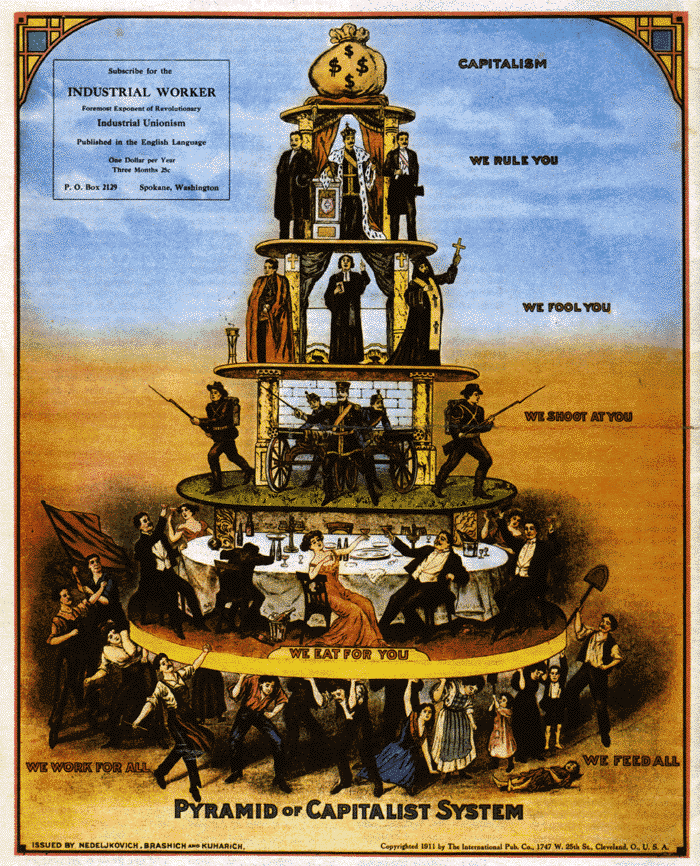
Capitalism: A Pyramid Scheme


This amazing illustration was produced in 1911 for the Industrial Workers of the World by Nedeljkovich, Brashich, and Kuharich. While blunt, it definitely merits closer examination.

Via a.poretic.

Free Banksy!

Banksy has made several of his most famous images available as free downloads. Note from the artist: "Prints look best when done on gloss paper using the company printer ink when everyone else is at lunch." (Via MeFi.)