Showing posts with label artswriters. Show all posts

5.28.2009

Bits: 05.28.09


Martha Rosler, Invasion (2008)

• Tyler Green writes on the timing of the Hirshhorn's acquisition of Martha Rosler's photomontage series, The Gray Drape, about Americans' disengagement with the war in Iraq. It coincides with news that Dick Cheney ordered interrogators at Guantanamo to find links between al-Qaeda and Iraq "despite CIA reports that there were only sporadic, insignificant contacts between the militant Islamic group and the secular Iraqi dictatorship." Green writes, "Rosler's photomontage can be read as revealing how our blindness to and then our national disinterest in Bush-era torture led us into Iraq." Update: The Iraq photos Obama won't release allegedly show U.S. soldiers raping prisoners at Abu Ghraib.

The Artvertiser is "an urban, hand-held, augmented-reality project exploring on-site substitution of advertising content for the purposes of exhibiting art. [Its] software is trained to recognise individual advertisements, each of which become a virtual 'canvas' on which an artist can exhibit images or video when viewed through the hand-held device." [via]

• "Scream at the economy." In the spirit of Munch, call in and share your "desperate and instinctive expressions of survival, warnings of danger, cathartic affirmations of power, explosions of anger and despairing utterances of anxiety and hopelessness." The resulting recordings will be transformed by six composers into a work, "Screamer," which will be "performed in front of relevant financial institutions." [via]

• The deboulonneurs are back: French culturejammers (or "unscrewers") have published their manifesto -- dedicated to reducing the visual pollution of advertising -- in English and are planning an as-yet-unspecified action in Paris on May 29.

• Tri-cycle: Bicycle bulfighting [via], a lovely 1965 ciclo-cross poster, and a jailbirds' Tour de France.

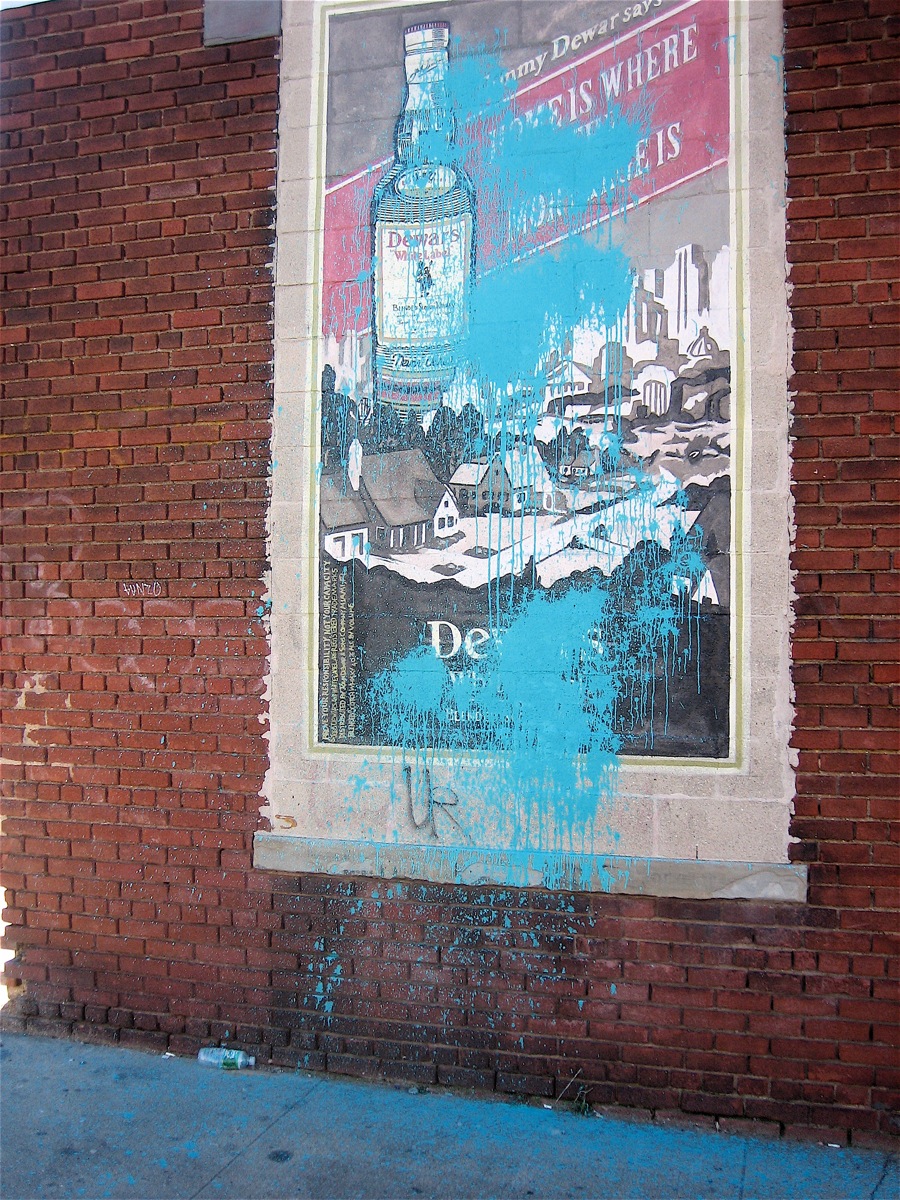
Turning empty billboards into urban abstract art... with paintball guns.

Turning empty newspaper boxes into guerrilla flowerboxes. (An earlier version's here.)

Finalists have been announced in the Good50x70 socially conscious design contest. Click on "Gallery" items here.

• Your moment of Border Collie doing squats.

2.24.2009

Art21: Chakkrit Chimnok's banana-leaf utopia


Chakkrit Chimnok at a Chiang Mai Cafe. Photo: Paul Schmelzer

My latest from Art21:

Chakkrit Chimnok dreams of a "banana world," a utopia in which overlooked or discarded items -- specifically, the ubiquitous banana leaves that litter the streets in his home city of Chiang Mai, Thailand -- can become the material for a renewed world. Chimnok's recent forays into this idea (or ideal) transformed the ever-present leaves into clothing modeled after western haute-couture.

"One day I was sitting in a banana garden, when a banana leaf fell on me," he told me last year. He picked it up and felt it: It was smooth and flexible, unlike the dried leaves many locals get rid of by burning. Senses piqued, he began paying attention to how the leaves had different characteristics, depending on where he found them, their age and the level of humidity where they grew.

He says he was struck by how perfect banana trees are. Both the fruit and the flowers are edible, and the leaves -- as his explorations would later prove -- could be made into apparel. Chimnok (pictured above) enrolled in a clothing-design class, taking 60 hours of instruction on sewing and pattern-making, and then set out to make functional objects, including a space suit and a dress (sized for his parents), handbags, boots and tennis shoes.

This functionality is questionable -- as the leaves dry, they become too brittle for regular use -- but he appreciates the various layers of symbolism as well. He's taking gentle jabs at both Thai and western cultures. To often brand-conscious Thai people, he offers fashions from one of the country's most plentiful, banal and unbranded materials. He patterns his ensembles after western styles, forgoing patongs and flip-flops for western-style skirts and shoes, in order to put the designs both within the vocabulary of fashion but also starkly opposed (the hard, crunchy leaves also stand in contrast to the silk textiles for which Thailand is best known). "We always have the sense that the west looks at us as the third world," he told me.

While his message addresses international audiences -- it was featured in the 3rd Fukuoka Asian Art Triennale 2005 and was shortlisted for the 2008 Signature Art Prize by the Singapore Art Museum -- it is, in essence, local. In his artist's statement, he writes, "Following the west is viewed as part of the destruction of community culture." His art is a celebration of the local, he says, even if it showcases one of that environment's more overlookable features.
Chakkrit Chimnok, "Body – Imagination – Dried Banana Leaf," 2006. Courtesy of the artist.Photo: Courtesy the artist

But he's not Thai-centric about it. During the project's showing in Fukuoka, Japan, he promoted a local variation of recycling. By the end of his three-month residency, he was showing at a fashion show the 20 kimono-inspired garments he'd created -- from bamboo leaves.

2.23.2009

Seeds not revolution: My first Art21 post on art and social change


Michael Rakowitz's paraSITE

I'm guest blogging at PBS's Art21 blog this week on art and social change, and my first post lays out some of my thinking, including my growing belief that although art might not have the power to radically change the world, its unique role can be in planting seeds. Here it is:

This weekend I went to an opening at The Soap Factory, a scrappy and often-excellent nonprofit art space a block or so off Minneapolis’ riverfront. The description of the work, a Clive Murphy installation called Almost Nothing, was intriguing enough to draw me there: he’d filled the entire space with a series of air-filled tubes created from black plastic garbage bags, mimicking the architectural geometry of the space—which, as its name states, was once a soap-making factory, reeking of lye.

But when I arrived, the piece immediately struck me as so much hot air. Here’s my progression of thought: it’s February in Minnesota. This building is virtually unheated. We’re facing twin catastrophes of economic downturn and human-made climate change. And this guy’s art requires electric air blowers to drone constantly on whenever the gallery’s open?

Murphy's work is what it is—a project influenced by “radical architectural proposals from the sixties” and inflatable carnival games that examine “themes of hierarchy, inter-relationality, and meaning formation”—and I don't knock it for that. But it isn't what I've been looking for lately: contemporary art with immediacy, that pragmatically or poetically addresses the challenges we face today. Not all art needs to do that, but it's what I'm looking for. Something more along the lines of another inflatable-bag art project: paraSITE, in which artist Michael Rakowitz collaborated with homeless people to construct temporary inflatable housing designed to leech warmth from heat outtakes from apartment buildings.

In considering “political” art—especially in a non-election year, especially facing the economic and environmental problems we do—I’m reluctantly coming to believe that art doesn’t have the power I once believed it did for bringing about social change.

Perhaps it’s creeping cynicism. As a journalist covering the Republican National Convention in St. Paul this fall, I saw magnificent, irreverent and funny artworks – from full-fledged contemporary artworks (including Ligorano/Reese’s The State of Things, gigantic ice letters spelling out the word DEMOCRACY, which melted away on the capitol lawn as time passed, or Suzanne Opton’s Soldiers billboard series) to creative protest signs and hilarious chants by nonviolent demonstrators (“You’re hot, you’re cute, take off your riot suit!”). Still, the police crackdown was powerful, unrelenting and sometimes violent—and, if hearing from Republican delegates on the convention floor is any indicator, protesters’ messages didn’t seem to register. The art was dismissed as mere protest.

My doubts also have to do with responses to my oft-asked (and admittedly naïve) question, “Can art change the world?” As an editor at the Walker Art Center and at Adbusters Magazine, I posed the question to a number of people: critic Robert Storr; artists Rirkrit Tiravanija, Sam Durant, and Thomas Hirschhorn; Artforum editor Tim Griffin and independent curator Hou Hanru, to name a few. While they all said they hoped it had that kind of power, few wholeheartedly agreed it did.

But from some of these same people, I found hope for smaller incremental change—one heart (or mind) at a time, perhaps.

During a residency at the Walker, Art21 artist Guillermo Calzadilla told me his take. Art, unlike protest, is difficult to pin down, he said, and therein lies its power. Overt agit-prop is easily to spot, categorize, and therefore dismiss wholesale by opponents of the message it carries. But art is something… else. Something nebulous and multidimensional and hard to get one's brain around.

Before we can dismiss it, we have to figure out what it is.

12.28.2008

Artist of the Year: Trevor Paglen


As artist's tools go, Trevor Paglen's are unusual: a camera with a 7000mm telescope lens, FOIA requests, a log of airplane N-numbers. An experimental geographer at UC Berkley, Paglen makes art that is equal parts social science and conceptual art, but geared toward a more political task: capturing fleeting glimpses of the U.S. military's "black world."

Hidden behind razor wire, these secret projects—which account for around $30 billion of the government's annual budget—can be gleaned through the few interfaces between the "black" and "white" worlds, whether it's the fences surrounding sites like the Tonopah Test Range or public filings by CIA front businesses. In Torture Taxi, Paglen's book about CIA "extraordinary rendition" flights, he quotes from Arthur Conan Doyle's first novel. "From a drop of water a logician can infer the possibility of an Atlantic or Niagara without having seen or heard of one or the other."

One project, a wall covered with code names for thousands of recent black ops, suggests the size of the body of water Paglen's peering into—not to mention its murkiness. With little to go on, we're left to guess what jobs operations like "Rugged Vortex" or "Rivet Rider" are charged with. A similar series presents framed signatures, like that of Colleen Bornt, a board member of Premier Executive Transport. The handwriting is wildly different each time, which is fitting since she's a ghost, a fictional employee of a CIA front company created to conduct torture flights.

The most compelling glimpse "inside" is through Paglen's collection of black-op uniform patches. To be worn only in classified facilities (but not classified themselves), these 100 emblems are a mash-up of pop culture references, military machismo, and secret-society mumbo-jumbo, bearing references to everything from an Insane Clown Posse album cover to the 1972 porn film Behind the Green Door. The patch for a squadron of planes that ran nighttime deliveries between aerospace contractors and secret sites shows a moon and a question mark, with the embroidered acronym "NOYFB"—None of Your Fucking Business.

The closest Paglen gets to more aesthetic contemporary art is with his photos of military bases. Shot across scalding desert from as far away as 20 miles, the photos become abstractions, part Gerhard Richter painting, part Bigfoot sighting. "The classic iconography of mystery is things that almost make sense," Paglen tells me, "but it's crucial they don't make sense.

"They're blurry. They're indistinct," he says, underscoring the main point in his work: "I can tell you what you're seeing, but you shouldn't trust me, either."

My contribution to City Pages "Artists of the Year" issue.

3.13.2008

Consuming Imagery: An audio slideshow with Brian Ulrich

After the attacks of Sept. 11, 2001, Americans were urged to shop to keep the economy strong, advice that wedded patriotism to shopping. The suggestion sent Chicago-based photographer Brian Ulrich to the stores, but not to buy: he began documenting America's peculiar and complicated culture of shopping at malls, thrift shops and big-box stores. A featured artist in the new Walker Art Center exhibition Worlds Away: New Suburban Landscapes, Ulrich took both surreptitious and art-directed shots of the spaces and faces, not to mention the rarely seen back rooms, of our consumer landscape.

In January, Brian and I, friends since we met through Adbusters magazine years ago, discussed his three-part, multi-year Copia project. While his work offers a critique of -- "and maybe a warning" about -- overconsumption, it also arises from empathy, a we're-all-in-this-together acknowledgement of the commercial world we live in.

Here's a 12-minute audio slideshow of our phone conversation:


Consuming Imagery: Brian Ulrich Interview from Eyeteeth on Vimeo.

3.09.2008

sunairi

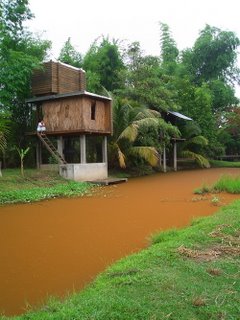
In our last night in Chiang Mai, we gathered with artists and friends on the sixth floor of our guest house, a rooftop space not yet installed with windows or walls. With a dozen liters of Singha and a bucket of ice brought over from a friend's bar, our after-hours party was powered by tinny music streaming from a Powerbook and a slideshow of images from "the land," the sustainability project/art community some 30 km away near Sanpatong. We stayed at the land one night, sleeping in a bamboo tower made by an artist/massage therapist duo under mosquito netting and waking to the chatter of geckos and birds, the caws of roosters and the occasional ox grunt.

With us on the roof were two artists who are part of the land's One-Year Project 2, American Alex ("Lek," in Thai) Wang and Norwegian Marius ("Madu") Notvik. As photos of farming, fishing, trips to the market and shared meals popped up, one of the two made a comment to this effect: It's so beautiful I hardly recognize it.That's the thing about the land. It's one thing to experience it and entirely another to witness it through mediation. Seeing photos, you can get a romantic view of the place, and it is romantic, in a way. International artists mix with Chiang Mai locals to discuss art and Vipassana meditation, to grow rice (the excess goes to an orphanage for kids with AIDS in Sanpatong), build experimental housing, and test new ideas (Madu is building a wood-fired oven, while Lek is making a chicken coop island which will float on one of the ponds).

But the pictures don't convey the dry heat, the painful pinch of the relentless fire ants, the stink of buffalo poop, or the slippery slime of the klong, a drainage canal kept clean enough for bathing by powerful currents.

None of this is bad; it's just... real. Having stayed there -- and enjoyed myself thoroughly -- I know understand what curator Karen Demavivas meant when she wrote that the land is an “ephemeral utopia of cracks, leaks, buffalo waste, termites, big red ants, rainy seasons and mold, a whirl of decay and renewal."
The question that seems important to off-site critics is whether the project itself "is art" or not. Sure, the concept of the land is a compelling one -- how art can model solutions for sustainability, community, and, in the case of Kamin Lertchaiprasert's meditation, spirituality -- and it's been written about by everyone from Artforum's Tim Griffin to, well, me. But on the ground, the question feels less relevant. The land is a community, first and foremost. And the planting and cooking and brainstorming seem more about living than high-minded ideals about aesthetics or artistic concepts. Whether it is art or whether the community that shapes it sparks future art isn't a point I'm especially concerned with parsing.

What I enjoyed the most about being at a place made famous in part by art stars like Rirkrit Tiravanija, Atelier van Lieshout, Superflex, Philippe Parreno and Francois Roche, was the utter lack of art-world gloss. And my admiration, to be frank, is less for those great artists who pop in, as I did, for a few days, than to the local artists who maintain the place, physically and intellectually, through farming and regular Friday night art talks. In the end, I'm glad, though, that the project falls under the label "contemporary art." While the term sometimes umbrellas values and people I'm not especially fond of, this endeavor is one by good, talented people who strive to imbue art with the very best of ideals.
See more images from "the land" at our Chiang Mai Flickr set.

4.20.2007

Pogoshovels and Victory Gardens: Amy Franceschini at Gallery 16

The rhetoric of war loses meaning when the enemy's "last throes" are announced years before actual victory, and when the citizen "war effort" involves a presidential plea for more shopping.

So it's refreshing to see artists picking up the shells of apparently discarded terminology and refilling them. Case in point, Amy Franceschini's efforts to revive Victory Gardens, the citizen-maintained gardens of World War I and II that grew some eight billion pounds of food nationwide. On our last day in San Francisco this week, we dropped by Gallery 16 to see a show by Franceschini, a nice counterpoint to her work on view in SFMOMA's current 2006 SECA Art Award show.

A founding member of Free Soil and Future Farmers (she also contributed interviews to the book Land, Art: A Cultural Ecology Handbook and collaborated on the follow-the-money website They Rule), Franceschini's work melds activism, graphic design and community organizing. And gardening. For her Victory Gardens 2007 project, she created a system for San Franciscans to seed their own gardens in backyards, rooftops, and vacant lots through the help of seed banks, training, materials, and the ancillary publicity her art can bring. (Her pogo shovel, a Duchamp-meets-Beuys symbol of the fun of gardening, could be seen as emblematic of the project's goal of connecting pragmatism and play.)

Like Beuys or Tiravanija, Franceschini's work is environmental but also inherently process-based, a fact former (and future?) Green Party mayoral candidate Matt Gonzalez picked up on in a San Francisco Chronicle article (he helped Franceschini get the project off the ground). "Art is not all oil and canvas; it can be about the transformation of an idea," he said. "An artistic idea, which is like a political act, is now re-characterized as art."

Her G16 show features used (and restitched) gloves in pristine museum frames, seed bag labels, and a system the artist and Michael Swaine devised to recycle gray water and harvest rainwater for agricultural use (left). Her section of the SFMOMA show included the Bikebarrow, a flat-green bicycle fused with a wheelbarrow front, allegedly to be ridden by "secret gardeners."

The Victory Garden project has signed up gardeners at plots located in each of San Francisco's three microclimates (sun belt, fog belt, transition belt). Each garden team leader received a starter kit (delivered by a VG2007 tricycle), plus a lesson and follow-up instruction on harvesting and seed-saving. Three gardens is a great start, but well short of San Francisco's World War II Victory Garden production, when 200 gardens were maintained in Golden Gate Park alone.

But as VG2007 web site states, victory isn't about total domination but about connecting communities to each other and to their natural surroundings. It also defines "victory" in terms of "independence from corporate food systems," a definition of freedom presumably at odds with the one used by those prosecuting the war in Iraq.

Related: Practical propaganda: Amy Franceschini reinvents the Victory Garden

1.24.2007

Sussing The Splasher

In New York, a person or group dubbed "The Splasher" has been getting plenty of attention for dousing street-art works with paint, then wheat-pasting posters beside them decrying their creators as "advance scouts for capital." The NYC street-art crowd is up in arms about the destruction of their work and doesn't want people like me giving attention to vandals.

And that's understandable. Their work can be seen, in many cases, as reclamation of the streets. One could argue that Swoon's intricate papercuts glued to a wall beautify and add unexpected wonder to the grime and ceaseless uniformity of the city. While their interventions are illegal, at least the motive in many cases is addition -- to add a question or a surprise or perhaps just a testament to their own creative impulse. Splashing paint on them is an easy and destructive -- i.e. subtractive -- act.

We could explain the Splasher's work in art historical terms -- the Dadaists acts of destruction, Jackson Pollock's drip paintings, the Francis Alÿs work where he punctured a can of paint in a museum and made an ambling dérive through the neighborhood, dripping all the way, and ended up nailing the empty container to the gallery wall. We could even consider the destructive acts of Lucio Fontana (who defied the picture plane and embedded performance into his work by slicing through a canvas), the Destruction in the Arts movement, even Duchamps' urinal and the many copycats who've emulated his work to literally or figuratively take a piss on the sanctity of art institutions or the preciousness of art.

Such readings seem far too generous for work that smacks of an over-wrought art-school prank. The critique is too easy, taking only a few seconds to accomplish and with little personal risk, and it opts for mean-spiritedness, not mischief, unlike the Dadaists its manifesto references. At the bottom of each wheat-pasted poster that accompanies paint blasts is a warning (which those who've seen the posters first-hand say is bogus): "The removal of this document could result in injury, as we have mixed the wheat paste with tiny shards of glass."

Given this, the Splasher's anti-art sentiment reads as anti-artist. And why target (or suggest you're targeting) the safety of artists if your real beef is with commodification? Why not take on the ads that have engulfed our public spaces? (Although, apparently a commissioned Dewar's mural was hit.) Isn't it more deplorable that communal spaces are sold, without our consent, to market deodorant or the latest Fox series to us? Or is that part of the point: Shepard Fairey's Obey, Swoon's paper pieces, are they just brands? Ads for the next gallery show or the line of posters and boxer shorts (in Fairey's case) that get a marketing boost from the perceived street-cred of their makers? Such arguments seem valid, but they're deflated a bit by the irony of the Splasher's use of Dada to decry the bourgeois nature of street art.

On the other hand, maybe street artists should relax a bit. They're creating unsanctioned works in public space: modifications -- or complete destruction -- are bound to happen, and that's the flow of the city. Art pieces get covered or blasted by truck exhaust or tagged by gang graffitists. Cities are all about this kind of accretion and erasure. One of the Splasher's posters mentions a Dadaist print made using a smashed clock, which, rather than sparking a wave of clock-smashing, jacked up the value of the print. If his or her critique is about the museologizing of art, that's not a bad point: street-artists too worked up about the destruction of their work might reconsider the tenuous canvas they're using.

In the end, though, I think the critique is hokey. Too outraged, self-righteous, and, well, flaky. I cynically expect this person to eventually come forward--ta-da!--and reveal himself as an artist making what he considers an incisive critique. If that happens, there'll surely be a gallery show, complete with a bound book and an essay likening the modified street art to an exquisite corpse or referencing Situationist tracts. The Splasher, then, will be hoping to get a paycheck, like those he criticizes, through the "fetishized action of banality" and "an alienated commodity." Which will simultaneously deflate and underscore his entire point.

Update: Visual Resistance has a nice (and far less measured) response, plus a series of images of works by Swoon, Os Gemeos, and others that have been damaged.

And: From Wooster Collective, "NYC's True Graffiti Problem."

8.03.2006

Pirate Utopia: Miss Rockaway in Minneapolis

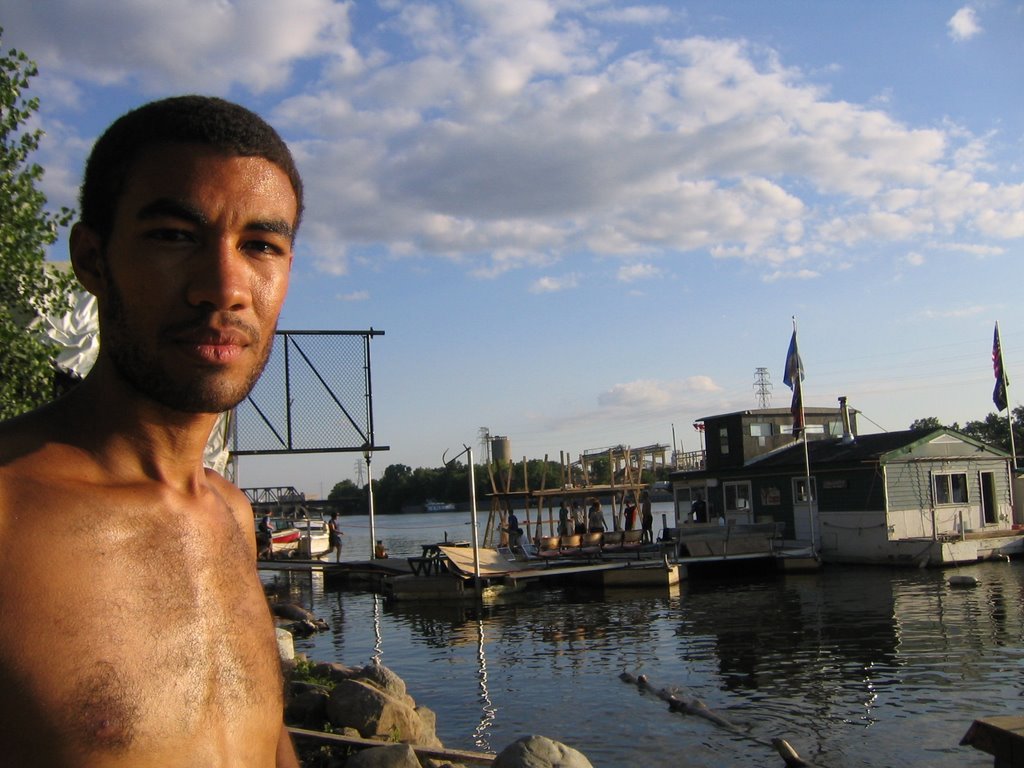
The Miss Rockaway Armada couldn't have asked for a more apt staging ground for building and launching their multi-boat flotilla of sustainably powered crafts: a beautiful rocky beach spanning the properties of four homes. Looking out to the right is the Lowry Avenue bridge and, just beyond it, the smokestacks of Xcel Energy's Riverside Plant, the tenth worst-polluting site in Minnesota. Straight across is a scrap yard that crushes and packages rusty relics of cars, scrap, and heavy machinery. Down the street is a superfund site (as Ellery, a crew member remarks, "that’s superfund with a D not superfun like a party.").

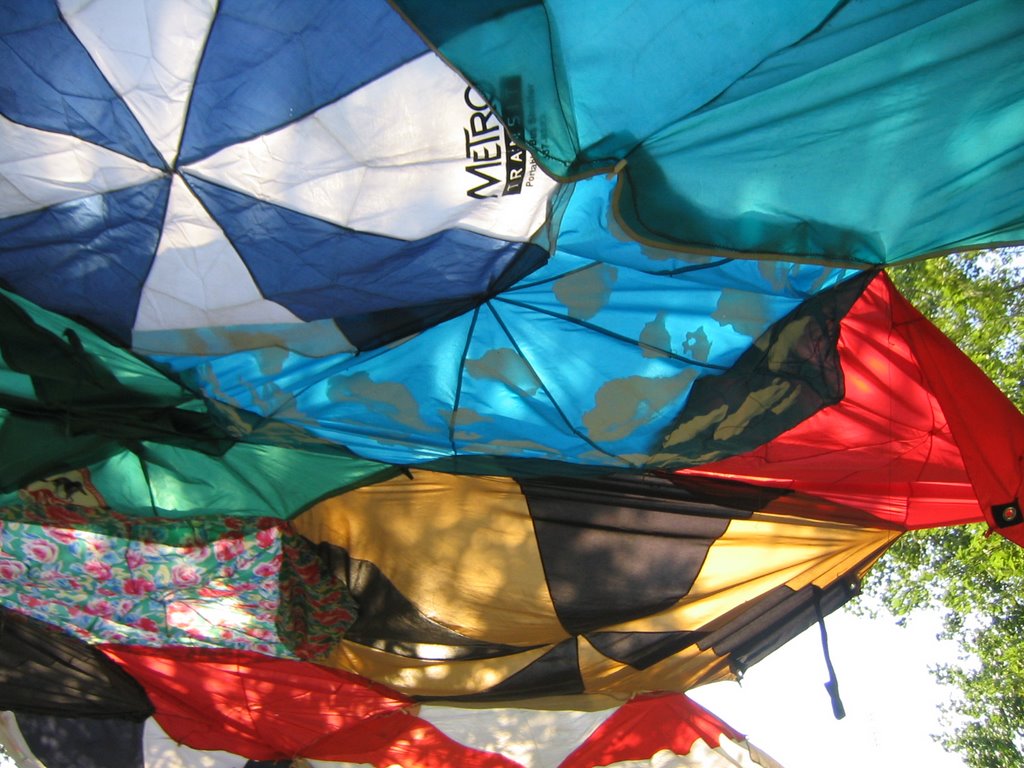
But their impromptu society of 30 artists and activists from San Francisco, Seattle and New York does feel "superfun like a party." The group has been in town for a few weeks, building the functional and whimsical elements of their armada -- from barrel rafts to be powered by VW engines run on biodiesel to a custom-painted sound-system by the Barnstormers art collective, a sail made from discarded umbrella fabric to decorative panels by NYC street artist (and project cofounder) Swoon. Their goal: to float down the Mississippi from Minneapolis to St. Louis -- and, for some, New Orleans -- stopping to camp, give performances and demonstrations, meet people, and raise awareness of alternative ways of living and powering our lives.


Here's what Santiago, a Trinidadian New Yorker, had to tell me about the project and its participants:
What we are is urban, anarcho-environmentalist evangelists. We’re spreading the word of this new different way of life. It’s fair and even and vaguely ungendered — or less gendered than regular society. It’s sustainable to the extent we can be. It’s full of energy and exciting and DIY, and, yeah, we like to do things that seem impossible… It’s not political in the traditional sense of the word, but it’s political in the larger sense, in that we’re trying to create a social landscape here that’s unique from that of the norm.

Art critic Jerry Saltz says this great thing, something to do with the moment of awe in the history of art, where-by in the very beginning, when people were god-fearing for the most part, they made images of the gods and painted them in their chapels and churches, and they were looking up. After a couple of hundred years, people realized that the land existed and that the land was powerful. Shipping began and commerce began, and they discovered indies. They started looking outwards, they started looking at the land, and that was the reason for making art — looking out and seeing that. But it’s sort of come to this place now where it’s personal, and the moment of awe in art and in life, like this, is the interdependent relations between people. That’s what our time of history is defined by…. [River rafting] is the prototypical American thing to do, and as much as we disagree with the politics of the government that’s in power — I’m not saying we all do, but we disagree with certain aspects of the society we live in — but the thing we’re doing is as American as cars, apple pie, grandmothers…
But it's far from typical. Participants have come from various art collectives, from the activist art groups the Madagascar Institute and Visual Resistance to the radical marching bands Infernal Noise Brigade and Rude Mechanicals Orchestra, and backgrounds (Kevin works in an after-school program at an elementary school in New York, while Rebecca is studying public-interest law at CUNY).

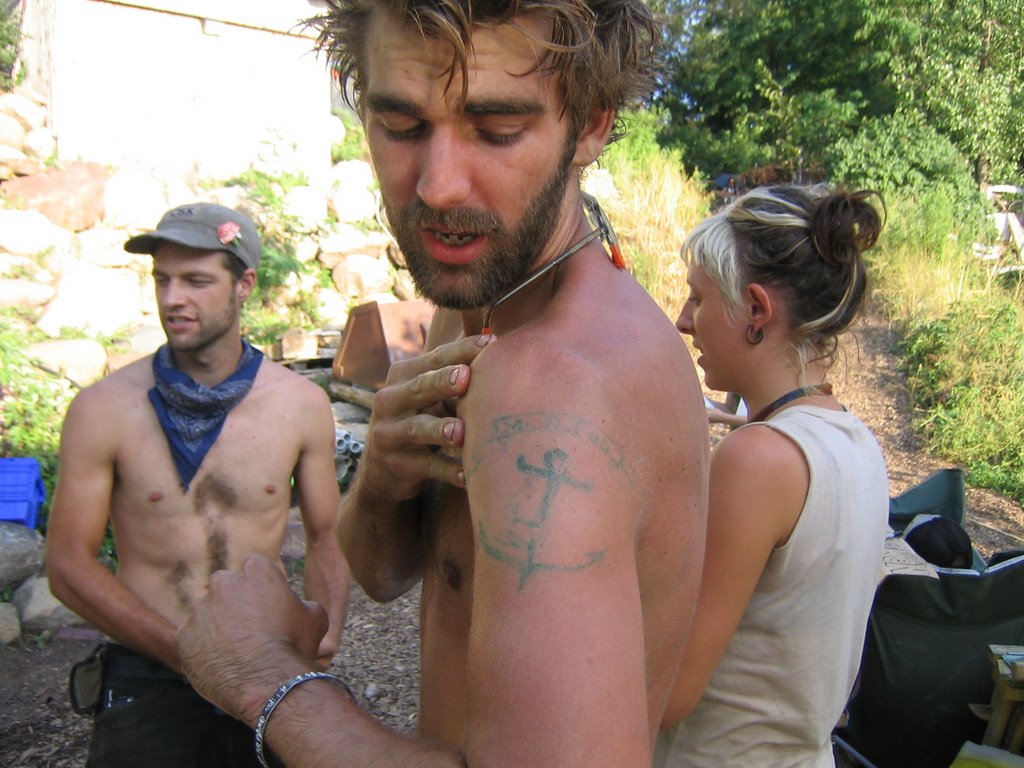
What they all seem to share: a sense of community, fun, radical politics, and a degree of cultural autonomy. Kevin, whose bare torso is shaved to reveal an appropriately anchor-shaped patch of fur, says he was drawn to the project both through his affiliation with Visual Resistance and the Toyshop Collective and out of a desire to see parts of the country he's unfamiliar with via a new mode of transit.

“I’ve traveled in so many ways. I used to hop freights for years, I’ve hitchhiked. I’m used to subsisting on a very low income, and traveling by water is a new thing I haven’t done," he says.

But as I notice several flags flying above the boathouse at their host site -- one NASCAR, one Dale Earnhart, an American flag and the Minnesota state seal -- he adds, "I’m not particularly interested in going with the assumption that there’s an average mainstream culture, that people are just watching TV and not interacting with their surroundings, because I think that would be incredibly presumptuous. I want to go into it with an attitude of openness… People are people, and I’m sure there’s a lot of culture of self-subsistence along the river. And I always go into situations with a perspective that there’s something I can learn from it.”

That spirt of openness is held by just about everyone I met. As is a spirit of ingenuity.

Crew member Nick explains the personal appeal of the project: "I build a lot of weird, strange things for theater and for opera and the fashion industry, and I saw this project and saw the model, and I thought, this is completely impossible, and I want to be a part of it. I want to see how far this can actually go. I’m constantly amazed at the leaps and bounds forward."

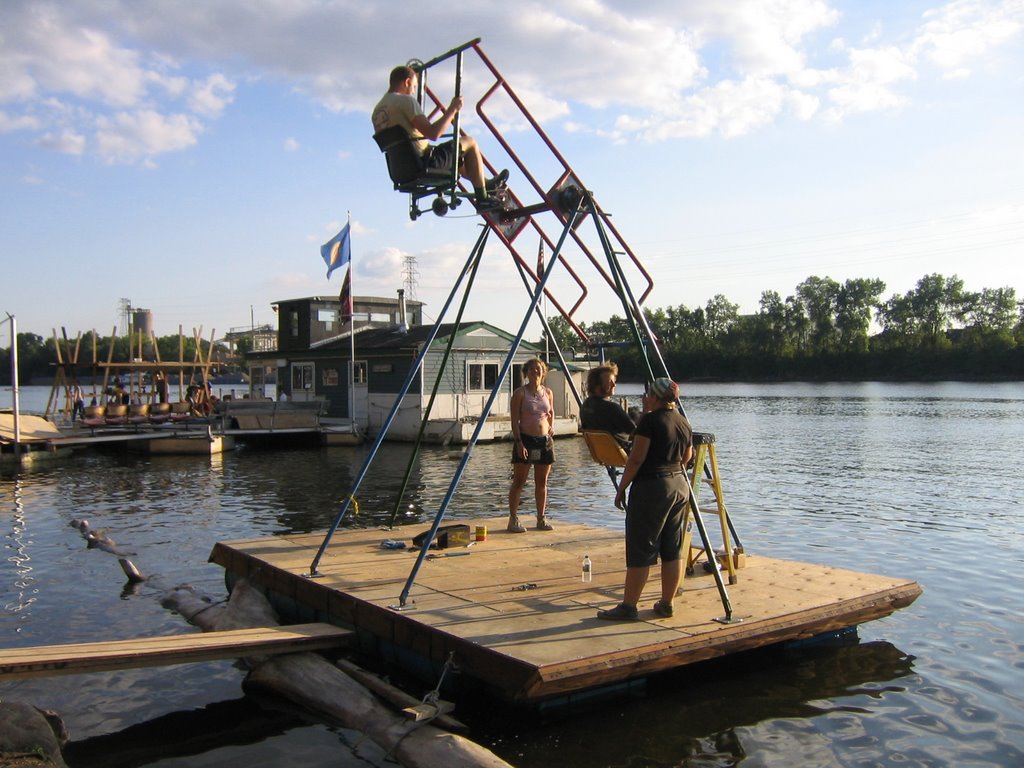
True, the series of "15,000 steps" they've taken -- from a hugely successful art auction/fundraiser to modifying technologies for boat engines and last night's successful test of a just-for-fun bicycle ferris wheel that'll float behind the armada -- is pretty amazing. For a bunchy of "ragamuffins" (as Santiago jokingly calls the group), they're definitely organized.

Gillian sees links between her work with the band Infernal Noise Brigade and her involvement with Miss Rockaway: "I think it’s good to prove that people with radical politics can still be really organized. We have really tight uniforms and we march well and our songs are really good and we’re really organized, but we still have radical politics… I respect the way [armada participants] look at art and the world and that relationship, and how resources are used and reused and preserved, and the general idea of fun and celebration being a political statement, as well."

The ultimate inspiration is the pirate utopias of the Barbary Coast, as well as the voyages of The Floating Neutrinos, who famously sailed across the Atlantic in a scrap raft. Going the length of the Mississippi should be a comparatively easier ride -- one I wouldn't mind taking myself. To follow the progress of this "Floating Temporary Autonomous Zone" (as Kevin calls it), stay tuned here or visit the Miss Rockaway blog.

Images [top to bottom]: Santiago, umbrella sail, Kevin, detail of Swoon's art, Nick with Sharpie tattoo, bicycle ferris wheel.

7.21.2006

Open-Ended Utopia: The Art of Rirkrit Tiravanija

Ever since Sir Thomas More coined the term utopia in the 16th century, visions of the perfect society have included matching jumpsuits, glass-domed biospheres, or remote islands where harmonic living is realized by placidly grinning beings. But as history has jumped the rails of that idyllic path, if it was ever on it in the first place, can we even imagine today what utopia might look like? Artist Rirkrit Tiravanija can, but he doesn’t create the kind of dreamy art you might expect. He transforms galleries into kitchens that serve up free pad Thai. He turns museums into low-power radio stations, a replica of his New York apartment, a functioning mechanic’s shop, and a studio where “street TV” is broadcast to the neighborhood. He builds chrome-plated kitchen consoles, theatrical stages out of plywood and 2x4s, and replica modernist homes from glass and steel, then invites people in to do... whatever: rehearse with their band, sleep, eat, listen to a DJ, debate topics of the day, read. And he plays informal host at an off-the-grid rice farm in Thailand that’s art only insofar as it fits his definition of the genre as “a space for possibilities.” This kind of art—in which the artist cedes creative control to the people who “complete” the work—looks suspiciously like chaos. And what’s utopian about that?

Everything, says Tiravanija. “I think these previously modeled utopian conditions have always been in a kind of conformity of ideas, which is to say that somehow everyone should become one cohesive structure, one cohesive consciousness, and that would bring with it a sense of freedom,” he explains. Instead, he sees utopia as “understanding difference” and “being able to exist in chaos. To live within a chaotic structure.” He adds, “Chaos for me is life, is change, is moving, we are always living within it.” This sensibility comes as much from his family history— he’s Thai and was raised Buddhist—as from his geography: a diplomat’s son, he was born in Buenos Aires and has lived a nomadic life, making his home in Ethiopia, Canada, the US, Germany, and Thailand.

You could say his art is all about building “chaotic structures.” Then again, it’s about lots of things; his work is so open-ended and departs so radically from the art market’s orientation toward precious objects, that it’s earned many labels, many—like utopian or chaotic—that only tell part of the story. But one that’s stuck, for better or worse, is French theorist-critic Nicholas Bourriaud’s “relational aesthetics,” the idea of judging the social relationships sparked by an artwork instead of merely considering the object. A 1992 exhibition, one that first earned him international attention, exemplified this notion. It was a deceptively simple gesture: after moving the contents of the storeroom at a New York commercial gallery into the main exhibition hall, he turned the room into a social space where he cooked two pots of curry—white and red—for whomever showed up to eat. Echoing Marcel Duchamp’s sentiment that “It’s not what you see that is art; art is the gap,” the only objects left to document the performance were plates dotted with remnant rice, leftover ingredients, a used cook stove, and dirty utensils. The gap between objects, where arguments ensued and bellies were filled, jokes were made and curry spilled, remains mysterious and un-ownable.

Such ethereal art can be understood through the lenses of Thai culture (where familial bonds are reinforced at mealtime) or Tiravanija’s memories (his grandmother had a cooking show on Thai TV), but it’s also informed by his study of Western avant-garde practices and its rich history of institutional critique by Dadaist trickster Duchamp, “social sculptor” Joseph Beuys, and others. By preparing food in a gallery, he inverts some of art’s revered standards. He converts an environment of white walls and whispers into a realm of scent, steam, and sometimes raucous dialogue.

He turns the venerated artist, a high priest of culture, into a humble, apron-wearing servant. And most remarkably, he creates art that, for the most part, can’t be bought or sold, punning with the very idea of the “art consumer.” (Even with these critiques, he remains an art-world favorite: his numerous accolades include the 2004 Hugo Boss Prize, a prestigious honor that comes with a $50,000 check and a solo show at the Guggenheim). As a result, his art is always alive and – because he’s not really controlling its outcomes—unpredictable. “I often work against ways of being museologized,” he says, “of becoming dead in a sense.”

Tiravanija’s most ambitious project is just such a living endeavor. In 1998, he and artist Kamin Lertchaiprasert purchased a rice farm in Sanpatong, a village 20 minutes outside Chiang Mai, Thailand. With no electricity or running water, it’s a clean slate on which to create a dynamic community for an ever-changing cast of farmers, local students, and international artists. It was founded “with anonymity and without the concept of ownership ... to be cultivated as an open space, though with certain intentions towards community, towards discussions and towards experimentation in other fields of thought.”

The pair never intended "the land" as art, but given the vague nature of what it is—an open framework in which things can happen – and the involvement of well-known artists like Tiravanija, Tobias Rehberger, Peter Fischli and David Weiss, Philippe Parreno and others, how could it not be viewed as such? Still, Tiravanija likens the land to something else, “an empty table top that people bring different projects to. They can bring [something] to it, use the top, leave things there or take them away, but it’s basically an empty table.”

Like Tiravanija’s work elsewhere, nearly all the projects to come off this table are functional. Several 2x4-meter stilt houses have been built, including one for Tiravanija that has levels dedicated to each of the “three spheres of human need”: community and sustenance, reading and meditation, and rest. The Danish art group Superflex has installed a system for collecting biogas for cooking fuel from the manure left by the land’s roving water buffalo. Artist Prachya Phintong has designed a fish farm to utilize the water sur- rounding two rice fields maintained by a farmer known as Professor Wei and area art students (rice not used by the community can’t be sold for profit, Lertchaiprasert insists, and is donated to village families living with AIDS). The Netherlands’ Atelier van Lieshout developed a composting toilet system, and artists Philippe Parreno and Francois Roche built a “battery house” called Hybrid Muscle. A futuristic hall for hosting community events, its exterior is covered with plastic “leaves” that hold 20-ton concrete blocks; as buffalo harnessed to a pulley system and a dynamo lift the counterweights, their muscle energy is converted into electrical power.

Vision and whimsy abound at the land—Rehberger’s house was inspired by his favorite German dish, lentil, noodles and broccoli, and Superflex’s biogas system stores fuel in eye-popping orange balloons—but they’re always intercut with both ethereal spirituality and pragmatic reality. As curator Karen Demavivas writes, it is an “ephemeral utopia of cracks, leaks, buffalo waste, termites, big red ants, rainy seasons and mold, a whirl of decay and renewal ... Injected with a Buddhist sensibility, it strives to be a micro-utopia of conscious, daily acts that propagate an equanimous life in the present for the betterment of a community and, more broadly, society.”

While Tiravanija shies away from that last part—the saving the world bit—he reiterates that the land, like all his work, is ultimately social: “We’re not interested in making a sculpture park. We’re much more interested in conditions of living.”

Originally published in the Canadian magazine Geez, Issue 3, Summer 2006.

5.02.2006

Pragmatic Experimentation: An interview with Cameron Sinclair

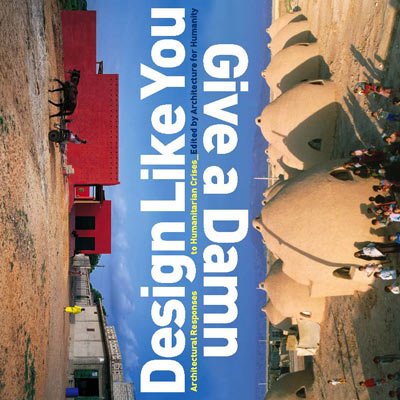
Nearly drowned out by the strains of Dookie-era Green Day and the Barenaked Ladies, three of us were at the table trying to talk: me; my brother Peter, a green designer and founder of Vivus Architecture; and the British-born founder of Architecture for Humanity, Cameron Sinclair. Designer of the Year nominee at the Design Museum in London, author of the new book Design Like You Give a Damn: Architectural Responses to Humanitarian Crises, and winner of prestigious $100K TED Prize, Sinclair met us at a sports bar near his Minneapolis hotel in the University of Minnesota's Dinkytown. "We’re in a college dive bar, music blaring in the background," he says. "You could say you’re recording from Scranton, Pennsylvania." No disrespect to Scranton, but our sub-high-brow meeting place ended up fitting, because Sinclair's work as one of humanitarian architecture's foremost proponents combines the high-minded with, well, the real. His work as fundraiser, designer, and relief organizer has taken him to Ghana, Sri Lanka, South Africa, and Biloxi, Mississippi, where he and other architects working under AFH's aegis have created collaborative designs for communities rebuilding after natural disasters. And, yes, many of those meetings, like ours, occurred in the evenings over beer.

Following are excerpts from our interview, which appears in the book, Land, Art: A Cultural Ecology Handbook (Cornerhouse, December 2006), published this winter by the Royal Society of Arts' Arts & Ecology program. Also, an account of our get-together appeared in The Rake.

On art and the media:

Paul: In addition to architecture you’ve done some art interventions, and I’m wondering if you think the designs you’re doing now have an interventionist dual purpose, both housing people and making a point about how we need to house people?

CS: I’ve been teaching at the university here in Minneapolis, and I always try to make my students do agitprop projects. Actually, the role of the architect is a political one. You make a conscious choice whether you’re going to do a project or not do a project. You can say, “It’s really a shame what happened down in the Gulf Coast, but I don’t really want to get involved in that.” I actually do an art project once a year, an art project for myself, just to keep my creative juices going… Just as I was coming out of college, I did a project dealing with homelessness in New York. I had located the housing to block the Statue of Liberty, and the idea that when the city took responsibility of its homeless, it’d get it’s view of Liberty back, because there was this idea of “bring us your huddled masses yearning to be free.” And here we are in New York and there were 60,000 people on the streets. So I think you as a designer have the opportunity to come up with a pragmatic and innovative sustainable response, but at the same time there’s kind of an air of tongue-in-cheek about it, that you can make this cultural criticism...

"There’s no room for utopian dreamers,
but there’s definitely room for pragmatic experimenters."

I just did an art piece in LA. A group of artists were given clocks. You had to change a clock, and I actually took out the clock and plugged in a security camera, and hidden in the face was a camera. On the face, I replaced it with some imagery of housing a year after the tsunami. And when you’re looking at this imagery you actually see yourself in the TV camera. Part of the point was about 24-hour news, and in the news cycle, a disaster is only there for the first couple of weeks. And until a new disaster comes along, it’s like the flavor of the month. Then suddenly there’s a new disaster and people forget about those who are affected by the tsunami or Katrina or Kashmir. The media is treating disasters as entertainment. I can’t tell you the number of times I’ve had media outlets asking, how bad have the families suffered. They’ve suffered enough for us to film them? Would it make good television?
On global warming:
CS: I’ve talked to a couple of people who live in cities and they were saying, “Just imagine the economic losses that’s going to happen in cities like Vancouver and Seattle and all these waterfront properties that’ll go under water.” And then you take cities in China and India where you’re going to have 100,000,000 people who are going to lose their houses in the next 30 years, and where are they going? How are we dealing with them? So you’ve got that happening as well, you’ve got systemic issues of global warming. But you’ve also got population boom. In developing countries, currently there are very few people that are making a lot of money. And as you have this separation between the rich and the poor, as you have this much larger, poorer community growing and the wealth of a country held by very few people, that creates civil unrest. So what you’ll find over the next 30 years, because of lack of access to basic sanitation, healthcare, schooling, and even shelter, we’re going to end up in situations of war. Security is going to be threatened based on things we’ve never even conceived. Forget oil—

Peter: Water.

CS: Yeah, water is going to be a big thing. Darfur, a lot of that has to do with access to water. Darfur used to have a huge lake, a huge resource. And in 15 years, it’s completely dried up. So that means that farmers have had to move away from the arid areas to try and find areas where they can grow their crops, so now you have warring factions pushed into one area, one region. It’s happening all over the place. There are nomadic tribes that are being pushed off desert areas just because there’s been a temperature increase by one or two degrees. We don’t feel it here. If anything, we’re like, “Oh great, it’s going to be nice and warm!’
On practical dreaming:
Peter: Is there any room for architectural experimentation in Architecture for Humanity, or does everything have to be tried and true? How do you justify experimentation on someone’s life style?

CS: It depends what you’re experimenting. Because we’re working with communities where we’re like a team--we’re not designing for them; there’s a partnership. We discuss options, and occasionally you get people who are actually very creative, who want you to experiment. They’ve just been in a concrete block house that was completely destroyed by the tsunami and it killed half their family. And you come along and say, “We can do what you had before, or we can design this new house which looks at doing a core system,” which is a project that was done in Sri Lanka, “which will wash water through and won’t cause a loss of life and the structure will remain up.” If you’re experimenting in a way that improves their lives and also will have a level of disaster mitigation--it’s not experimentation like, “I want to do this inflatable city and if a wave comes along, we just let the balloon go and we all escape up into the air.” There’s no room for utopian dreamers, but there’s definitely room for pragmatic experimenters.
For more information, visit AFH's Minnesota chapter. For pictures, check out AFH's Flickr site. Sinclair is also the keynote speaker at PUSH 2006 on June 13. I'll be live-blogging the conference at Off Center.

Thanks to Land, Art editor Max Andrews for permission to excerpt the interview here.

9.27.2005

Tacheles: Creative autonomy, Berlin-style.

Kunsthaus Tacheles, just blocks from where the Berlin Wall once stood, now houses a vibrant international arts community. View from the rear.

Berlin's Oranienburger Strasse is a curious street. Definitely in a hip part of town, it's dotted with high-end shoe stores, new glass-front condos, sidewalk bistros, and stores that sell exorbitantly priced handbags and women's jeans. A restaurant we noticed seemed to epitomize the neighborhood: surrounded by palm trees (in Berlin?), an open-air dining area has been covered by a canopy of red beach umbrellas. Underneath, tiki torches illuminate a half dozen or so stone Buddha statues from Thailand and cafe tables where a diverse, good-looking, and obviously fashion-conscious bunch of diners titter in hushed tones over what I can only guess are expensive meals. Despite this razzle-dazzle, we were drawn across the street by a big white sign with black letters spelling "Kunsthalle."

Interior view of a main stairway. Despite graffiti-plastered windows, the artist-policed space has cleaner bathrooms than most rock clubs I've been to.

We'd stumbled upon Berlin's not-so-secret art squat, Kunsthaus Tacheles. A building with a storied history—it started out as a kind of proto-shopping mall in the early 1900s, was taken over first by the Nazis, then by the Communists. And when the Berlin Wall, once located just a few blocks away, came down, the building became the home to a host of German and international artists, many the sons and daughters of Communist revolutionaries from Cuba, the Soviet Union, and China. Today, the building has the outward appearance of disuse—a bomb-pitted facade of gray stone covered with graffiti, stencil art, and stickers, and windows darkened from the inside by more graffiti. But inside is a vibrant, diverse, anarchistic (i.e. leaderless) art community. The building hosts a cinema, a performing arts space, 30 studios (made available to artists, who are selected by an outside curatorial panel, for only the cost of utilities), two indoor and two outdoor bars, exhibition spaces, two galleries facing Oranianburger Strasse, and a high-power projector that screens video art on an adjacent building every night of the week. Artists from Japan, China, the Middle East, and the UK, among other places, curently occupy the studios; probably Tacheles' most famous tenant is recording artist Peaches, who's been there for two years.

The Offenbar on the top floor offers a distant view of the Berliner Dom. It's name ("open bar") comes not from free booze—damn.—but from the fact that windows blown out in World War II were never replaced.

Tacheles is a Jewish word that roughly translates to "speak truth." Martin Reiter, an Austrian artist who's been a part of the community since 1994, told me that the name was first used by a punk band that rehearsed in the space, but, given its proximity to Berlin's main Jewish neighborhood and the activist views of many of its artists, it seemed a fitting name for an autonymous art community.

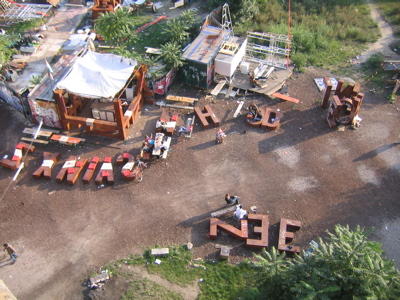
The Offenbar overlooks an outdoor space that includes makeshift bars, seating made from rusty signage letters, a ping pong table, and a tent village set up by a master African carver.

But, as I first approached the building, I have to admit I was skeptical of its autonomy. With so many trendy restaurants and new buildings as its neighbors, how independent could these artists really be? Were they just maintaining enough edge to keep the tiki-hut diners intrigued, just trying to create the illusion of danger that fuels so much of commerce? The more I heard from Reiter, a frizzy-haired painter, robot-maker, and video artist, the more suprised I was at just how autonymous the house is. As he tells it, the building was close to being demolished in the early '90s, so close that holes were bored to place dynamite. But artist-squatters intervened, physically, to prevent its destruction. After the wall fell, the neighborhood, like much of the city, was in chaos. Residents of East Berlin were pouring into the west, power companies had no idea where their grids extended and how to serve so many new citizens. Which all gave Tacheles' artists free reign. For four years, the house had free water and electricity, unbeknownst to the city.

Martin Reiter in the Offenbar

Over the years, Tacheles and the city have managed a kind of peace: the city of Berlin, realizing that the art house has stablized and lead to the gentrification of the neighborhood, let it be and have even funded it at times. Tacheles is extremely involved in land-use issues in the neighborhood and tries to be a good citizen. Today, Tacheles is a non-profit organization, pays no rent, and its building has been designated a historic landmark, so it can't be destroyed. It's far from Utopia, Reiter says, since factions within the house have different visions for it, but the model—a delicate balance between anarchy and civic-engagement, pragmatisim and dreaming, culture and commerce—is definitely one to admire. And the fact that it's situated in Germany's highest rent neighborhood, alternative culture pressed face to face with commercial enterprise, makes it all the more sweet.

8.15.2005

Can art change the world?

Sam Durant, We Are All Outlaws in the Eyes of Amerika
The current issue of Adbusters continues a long-running investigation on the role of art in social movements. If art can bring change for the common good, how does it work—as a slow burn or an explosive agent? As art editor of the issue, I asked curators and artists from around the world some deceptively simple questions about the social function of art and its potential for catalyzing change. My favorite interview was with Chinese-born, Paris-based curator Hou Hanru, who suggested that directly oppositional art—the in-your-face anti-Bush poster, for instance—may have less lasting power than works that engage the events of the day from a greater distance. Of-the-moment language only lasts as long as it's relevant, he seemed to be saying, but the more metaphysical works of, say, Joseph Beuys or David Hammons continue to intrigue and spin off meaning beyond their immediate context. (Which is not to suggest Hou meant that the art of resistance can't be just as powerful as any other kind of art. Just different roles in terms of immediacy and effect.)

In the spirit of resource-sharing, here are a few of the quotations, some of which don't appear in the print issue:

Robert Storr, critic, curator, artist, Rosalie Solow Professorship of Modern Art at NYU:
I don't think art can change the world. There are moments in history—in the 1930s and the 1920s and since—where very direct address of general social problems by artists has had something of an effect. It's hard to say what it was or how to quantify it, but it's undeniable they spoke for the times and people knew it. There are other times when merely the presence of a voice of dissent or a kind of questioning in public for which art is also a vehicle can do a lot.

I'm also of the view that sometimes people who should be socially active take refuge in art and make art as an alternative to being involved in the sort of nuts and bolts (and oftentimes boring) business of organizing and voting and demonstrating. I think we've been through a period where a lot of people have very sophisticated political ideas based on a whole series of postmodern thinkers but actually they do almost nothing, and they have avoided the full implications of having a political understanding of the world by having such a good rap. I don't know how many students I've spoken to, taught, and dealt with who can tell you all about the crisis of late capitalism but in fact have never done anything political in their lives, or very little, and who can tell you all about what's wrong with other people's political practice but haven't made any mistakes yet… There's a dimension in which a lot of political postmodernism is a kind of shadowboxing, and I think that that is something really to be questioned.
Jennifer González, Assistant Professor in the History of Art and Visual Culture, University of California–Santa Cruz:
I think we desperately need the term art, because it's incredibly useful. Art is a conceptual category that allows for something that's not already defined. So, unlike the notion of the commodity, art allows people to do a lot of different kinds of things that in other parts of culture they wouldn’t be allowed to do: experiments, investigations, formal innovations, mixings of materials, etc. I would say the category art has an incredibly important social function to play...

...Art is about as dangerous as literature. But you could also say: it's about as dangerous as philosophy, which means it’s about as dangerous as Marxism… It’s dangerous in the way literature is dangerous: it raises ideas, it changes minds. ...You can never predict in what ways it will change minds or change culture, which is one of its strengths. Neither can you predict whether a political philosophy will change cultures. What did Adam Smith know when he was writing? Did Marx know what would happen with his writings?
Tim Griffin, Editor-in-chief, Artforum:
For the past 10 years or more, the experience economy—the idea that there is an intangible source of wealth that rotates on notions of branding, of appealing to emotions, of actually making the consumer your product and thereby obtaining some purchase on consciousness itself—creates a situation where art, since emotion and thoughtful interaction have comprised its traditional terrain, is ever more enmeshed in commerce. That means commerce has moved toward art and art has moved toward commerce, or they're overlapping in a fashion that perhaps is still not so familiar to us. Certainly this is one of the reasons why branding becomes a subject of art: that is, one more way the commercial sphere in inscripted in art, which is a trope of the historic avant-garde. But whereas at one point you could have, as an avant-garde position, an outsider status, now the question that is so often hitting artists and writers is: what happens when there is no longer an outside? How do you end up creating some meaningful antagonisms or distances or modes of self-consciousness within this sphere where it no longer makes sense to say that there's an exterior alternative?
Artist Thomas Hirschhorn:
The trap for an artist is not the market, not the business and not commerce, the danger is to lose the mission!

Art does matter today because: with art I can fight resentment, hate, and cynicism, as an artist I am a WARRIOR! I have no time to cultivate doubts. I do not want be self-critical. I do know I will be injured, I will be killed, but I want to work. I want to give! I want to do this in a rush. I do not want complain! What is more important then my doubts is my EMERGENCY, my URGENCY and my NECESSITY and my WILL to give form to them!
Artist Rirkrit Tiravanija:
I say, yes, art can change the world, but I don't know how. [Laughs] It used to be much more clear, what impact the statements and visions and images that artists have made have some impact on the world around it. But I also think it's always working at a different speed than other things. It's a different speed than politics. Even Beuys' Frei University and things like that, they have an impact, and still do, but in a very different speed. The idea that the Green Party is a coalition in the German government has a lot to do with that. I think it does, but I think you have to see it in the long term. We're actually in the space of possibility, so in that sense we have to try to work hard at using it and making it so that it's possible, whether it happens now or not, so it's possible to always have a way to use it.

...I've always thought art was kind of a space for possibilities. With that condition, I see it more as a place for making models, or modeling the possibilities… Art for me is the kind of space where differences can exist. It's a place where we can discuss and show and deal with our ideas. This is a place where it can happen where we can put it up, look at it, discuss it, and have our views on it."
Tiravanija on art activism:
I think I take direct response in relationship to myself. I'm always active alone. I have to do it myself, and if people want to do it, that's good. It’s not like I would say, let's go together and then do it. There are certain things that I would have to do directly myself, and there are certain things that are more of a group thing. But I think I understand that they have different speeds. The one that you directly act on is faster, and ones where you have to work with other people are slower. But I think that they are the kinds of modulations that one needs to have in response to what's going on around you.
Curator-critic Hou Hanru:
Take an example like Joseph Beuys. Of course he was very crazy claiming that he's going to change the world through his art, but I think his way of trying to change things is more metaphysical somehow. It’s not only through manipulating some popular find. In today's context, very often people who are interested in real change somehow have more distance from the popular signs of social communication. Sometimes there are some very strong artists who use a very simple, very abstract kind of gesture to evoke this kind of agenda of social change, rather than simply appropriating the existing signs.

...It always comes back to me that one very strong image is David Hammons. He did this very beautiful action which is very simple: he was selling snowballs. He was selling snowballs in Brooklyn on the street in the winter. He made different snowballs of different sizes, and he was selling them at different prices. This was such a strong critique about the logic of consumption society, and behind it, of course, was the whole notion between white and black and all these social issues. A simple gesture like this can, because the complexity being expressed through a very simple action, the tension between this simplicity and complexity, make a very strong social statement.

2.07.2005

Divinity for the Reality-Based Community

Look not to the things that are seen but to the things that are unseen; for the things that are seen are transient, but the things that are unseen are eternal.
—2 Corinthians 4:18

It's not what you see that is art, art is the gap.
—Marcel Duchamp

In born-again America's renewed culture wars, it's a fair guess that contemporary art and mainstream religion won't end up on the same side. Consider the teams. There are the defenders of Christian values whose perceptions of cutting-edge art are clouded by memories of Andre Serrano's pee-dunked crucifix, Robert Gober's Madonna with a culvert through her chest, and the dung-gobbed Blessed Virgin by Chris Ofili that sent Rudy Giuliani through the roof. Then there are artists, people whose values of diversity and constant questioning make them unlikely bedfellows with evangelical Christians. But, just as the myth of red states and blue obscured a reality that's more purplish in hue, perhaps there's a place — somewhere between George W. and Gilbert & George — where spiritual seekers and artists can find common ground.

It's not such a longshot. Artists and spiritual searchers have long grappled with the same existential issues and shared the same wonder of the sublime. English art critic Clive Bell linked aesthetic and religious rapture in 1914 when he wrote of "two roads by which men escape from circumstance to ecstasy," and Jean Cocteau once described de Chirico as "a painter of secular mystery." That mystery is evident in both how we discuss art and how we experience it. We refer to an artist's inspiration (literally, bringing in spirit), an object's animation (the imbuing with animus), or the "leap of faith" prompted by an empty canvas. Duchamp's "gap" recognizes that art is the realm of transubstantiation — a mere object is transformed into a conveyor of profound meaning simply by being encountered by a viewer.

The paths of art and spirituality intersect at many points: artists marvel at the miracle of creation (Andy Goldsworthy's ephemeral interventions in nature); artists suggest the kind of mindfulness Buddhist's seek (by focusing on soup cans, Andy Warhol suggests a reconsideration of the mundane); artists openly explore taboo subjects that religions have long ago rendered verdict on (Marlene Dumas' sexually explicit portraits). But it's the social aspects of art that have such potential for bringing people together: art can illuminate our interconnectedness.

In explaining why he writes, Kurt Vonnegut could be speaking on behalf of many artists: "Many people need desperately to hear this message, 'I feel and think much as you do, care about many of the things you care about, although most people don't care about them. You are not alone.'"

Witnessing is another social role of art that resonates with religious tradition. "Art is prophetic," says artist and former Trappist monk Ernesto Pujol in the book Buddha Mind in Contemporary Art. Artists can bear witness to injustice, delivering "messages the powerful may not care to hear." In the age of Jessica Lynch and Fox News, the world needs alternative reporting by the likes of Alfredo Jaar, whose famous photo series compared sky-high gold prices with the low wages and harsh conditions endured by Brazilian miners, or Picasso, whose Guernica recorded the horrific saturation bombing of an ancient Basque city. As the old Catholic hymn goes, "Whatsoever you do to the least of my brothers, that you do unto me"; on this count, artists are among those keeping score.

Art, it seems, allows us to ponder the sacred in non-dogmatic terms — i.e. divinity for the reality-based community. Of course now is not the heyday for that bunch. But perhaps there's hope in what theologian Finley Eversole called a "spiritual underground." For him the term referred to a complex notion that artists who confront the emptiness of a godless world — writing in 1963, he was thinking of Rothko, Pollock, and de Kooning — connect us to the holy by presenting its inverse: "If our artists have been incapable of religious faith, they have at least shown us that modern man is incapable of unfaith."

But I suggest that artists make up a spiritual underground in a different sense. While many mainstream religions are being hijacked by rigid fundamentalists, contemporary artists make up a loose-knit band of the covertly spiritual. If artists of the "secular mystery" can create work that resists co-optation by religious and political ideologues, perhaps we can call on them in more enlightened times to reacquaint us with the joys of asking questions we don't yet have the answers for.

My latest from the new issue of Adbusters.

8.07.2004

Anarchy in the RNC

No self-defined anarchist has ever sparked a revolution. But the ideologically uninitiated who have trafficked in the habits of anarchism--chiefly unmediated communication--have toppled dozens of tyrants.
— Siva Vaidhyanathan
With a four-day security budget of $76 million and 10,000 police officers facing protestors, the stage is set for anarchy. And that's just what some activists will be resorting to during the Republican National Convention later this month -- only they'll be trading black masks for radically democratic, tech-savvy protest tools.

Transcending beloved old-school methods, this new wave of activists will use decentralized and distributed technologies to level the playing field with law enforcement. "There's been an incredible technological buildup on the side of the police, and on the other side people are still holding cardboard placards and making puppets," says artist and engineer Natalie Jeremijenko (pictured).

"In the arms race of direct action, there's been incredible changes in the strategies, the training, and the equipment the police use in treating this political process." But the projects she and others embrace are only anarchistic in a strategic sense. While Anarchy suggests a political philosophy loaded with baggage, the term's Greek origins have little to do with chaos or violence: arkhos (ruler) plus the prefix a (the absence of). This leaderlessness -- "uncoordinated actions toward a coordinated goal," as Siva Vaidhyanathan puts it in his book The Anarchist in the Library -- is what links these new-school approaches:

- Flash radiojacking: Jeremijenko and the Bureau of Inverse Technology (BIT), will use a special transmitter to break into radio frequencies reserved for corporate stations, giving bursts of information so brief that the FCC can't lock onto their transmission location. During the World Economic Forum demonstrations, BIT called attention to the Bush administration's bogus claims about the safety of the air after 9/11. Each time New York's airborne pollution surpassed the "safe" level, a warning bleep interrupted broadcasts of the local NPR affiliate.

- Bikes Against Bush: Joshua Kinberg will hit the streets on an "internet-enabled tactical media weapon for non-violent creative resistance." Outfitted with a laptop, webcam, GPS device, and SMS-enabled cellphone, his tech-laden bike will receive text messages sent by visitors to www.BikesAgainstBush.com. At the push of a button, he'll select messages to print on the pavement using a robotic chalk-spraying device; each anti-Bush screed will be time-stamped and gps-mapped on the website. The bike's maneuverability effectively makes all of New York a free-speech zone.

- Backpack broadcast: Media collective neuroTransmitter will be toting com_muni_ports throughout the convention. These low-power, backpack-mounted radio transmitters will provide localized, on-the-fly media broadcasts, bearing witness, live, to events you won't hear about on local Clear Channel stations.

- WiFi on Wheels: Yury Gitman will be pedaling his MagicBike during the convention. Offering free internet connectivity wherever it goes, it'll wire the UK-based collective OpenSorcery so members can play a military simulator online and on the streets of New York using high-power projectors. Operations in Urban Terrain (OUT), a first-person-shooter game, aims to critique the militarization of civilian life following 9/11--a condition the group describes as "a government . . . at war with its own citizens, with soldiers in the midst of the fabric of ordinary life" -- by literally broadcasting the game's violence on city walls.

- Inflated Crowd Counts: When the demonstration ends, police will inevitably lowball crowd sizes, while activists will present overly optimistic numbers. The Bureau of Inverse Technology will calculate verifiable figures, thanks to a wireless video camera tethered to a helium balloon high above the action. A rollerblader will maneuver the balloon throughout the entire crowd while the high-resolution camera beams visual data to laptops on the ground. The result: a composite image that'll be analyzed by software similar to the kind used for counting microscopic cells in labs. "If Bush can dismiss this as a 'focus group' with the wave of his hand, how do you answer that? You have to have a higher standard of evidence, you have to have more compelling images," says Jeremijenko. "And we end up with a family aero-portrait -- a self-documentation of our action on the streets."