Showing posts with label interviews. Show all posts

7.27.2009

Eyeteeth interview: Zack Bent on mythology, Joseph Beuys and bottling tears


Zack Bent, Romantics, 2009

This is part two of an interview with Seattle-based photographer and sculptor Zack Bent about his recent exhibition at 4Culture, Buffalo Trace. Read part one.

Paul Schmelzer:
One of the more enigmatic pieces in your 4Culture show in May was Lachrymatory (below): a clear vial and medicine-dropper lid. As I understand it, you'd use the dropper to collect tears whenever your kids, you or Gala cried, but all that remained to see in the gallery was the residue of tears (seemingly) long dried up. Our mutual friend Jim tells me that after you installed the 4Culture show, one of your kids, when crying, asked where the dropper was -- as if he needed it to process his emotions. Kind of an Art 101 question, then: Is the "art" what's presented in the gallery or the act (performance?) of collecting the tears? It seems it became therapeutic for the family, but do you also run the risk of instrumentalizing grief in the name of art? (Does the public commemoration of tears through art elevate or diminish the real emotion that generated them?)


Zack Bent, Lachrymatory, 2009

Zack Bent:
I am interested in the mythology that can be established by having artifacts or fragments of a process that become works. My previous photographic works with my family were situated in our domestic environments. The line between the real and uncanny was of utmost concern for me. The goal was to locate photos that drifted between a tableau and a snapshot. There was often a curiosity that left the viewer with an unanswered question. The vial of tears is my attempt at sculptural version of that. In the case of the tears, the audience doesn’t know whose tears, what types of tears, or how many were collected. Tears fall often in our house. Collecting them in the vial became a similar ritual to kissing a bump on the head. It became an act of love. This is a case where my art practice heightened the quality of our inter-family relationships and made physically manifest our maternal and paternal care giving.


Zack Bent, Praxis, 2009

PS: Your dried tears are in that vial. Is there an element of commemorating a man's tears? Buffalo Trace includes some tough-guy imagery of hunting and fire and conquering, but is this also a way of instructing your three (now) sons in being a "whole" person?

ZB: The title Lachrymatory comes from the ancient tear catching vials that were often filled by grieving widows. The medicine bottle I used was recovered from a fallen and abandoned shack on my parent’s land in rural Indiana. There is a fair amount of collecting in scouting and a few merit badges focused in that arena. I collect a lot of tears as a father. The piece definitely memorializes mourning and weakness. The result of the collection is salt; an element of preservation. So yeah, I don't buy the tough-guy routine, I think it's a costume for a tear maker.
Zack Bent, Clean Break, 2009

PS: There's a celebration or playfulness in photos featuring your kids and wife, but I can't help also feeling some tension: between strength and vulnerability, between vivaciousness and death. Your red-cheeked boys on one wall, a rotting deer carcass on the other. The sharp edge of a hatchet, but taped up as if by Boy Scout medics. A presumably sharp-bladed Swiss Army knife that also has colorful plastic kids silverware. A scorching fire and your boys. One son's arm splinted with a coloring book. Can you talk about these tensions?


Zack Bent, St. Jerome Contemplates Preservation, 2009

ZB: The tension you sense is what is lurking beneath the surface of the whole exhibit. Some people find the images humorous…and they are to some extent. Yet for me the show was situated in tense place of unknowing and scrambling. Look toward the future, fearing the past. The deer carcass (St. Jerome Contemplates Preservation) was an arrangement, an effort to set something right, to face a type of wrong. For the Birds [a totem-like post bearing two dozen or more birdhouses] is a similar piece, an obsessive effort in achievement and resource management. I was hoping to be revealing about my own sense of failure and limitations while making visual the efforts to correct errors and cut off new ones at the pass. We live with "vivaciousness and death" on a day-to-day basis. I find it hard not to isolate these paradoxes we live with when I am working. Tensions seem to permeate everything; including the tradition of scouting along with American history.

Zack Bent, Family of Five, 2009

PS: Tell me about the placement at 4Culture of Family of Five, a small jam jar that contains five dead bees, and Lachrymatory. Is each a vanitas?

ZB: While the work was fresh, I titled the images of us tackling the climbing wall while Gala looks into the distance, Romantics (top of page) and Conquerors in reference to Caspar David Friedrich’s paintings. Our futile yet awestruck engagement with a faux natural setting seemed a fitting contemporary refiguring of his work. All that to say, many people have said the photographs are seem rather painterly which was a curious surprise. I didn’t imagine the two sculptures you mentioned as vanitas. But by definition, the suggestion is rather fitting as I do see them as encapsulating a sense of wonder for our natural state, while mourning its limitations.

PS: An obvious comparison for this series is Joseph Beuys: he dealt with themes of wounding and healing (his fat and felt are similar to the splints and tape in your work), and his was the realm of personal mythology. His story of being shot down as a World War II pilot in the Crimea, where he was rescued by nomadic Tartars, is now considered to be a bit of clever storytelling rather than bona fide biography. Likewise, the intrepid scout leader -- you -- in some of your photos blurs the real you (former scout, dad) with a fictive one.


Zack Bent, Something About Restraint 2009

ZB: Beuys' philosophical investment in social collective was beautifully earnest. That and his ability to mythologize his own life is something I completely resound with. Our lives are full of fabrication. In my work, I hope to super-fabricate my existence with my family so that we can entertain play and imagination as valuable. For me it gets back to photography’s fictive nature. Images are read so differently. People's real knowledge of me affects their perception of our myth making. A good portion of the press that surfaced from the exhibit was wrapped up in trying to figure "us" out. Some may think it all a sort of theater, and some may just think we are strange people. By playing these hands so similarly though, confusion is often created which I can’t just straighten out. I hope to be able to move freely between our real lives and our imagined lives, just as my children are able to. When I am called to answer for that it feels like such an overly rational approach to understanding the art process.

See Part I.

Eyeteeth interview: Zack Bent on rites of passage, family tribes and the Boy Scouts


Zack Bent, Conquerors, 2009

That I was just downstairs as an auspicious event occurred in the family of Seattle-based artists Zack and Gala Bent -- the home-birth of their third son, Caspar, in May -- was only fitting: A day earlier my friend, playwright Jim Bovino (who shares a house with the Bents), and I toured Buffalo Trace, an exhibition of Zack's sculptures and photographs, which features a very pregnant Gala and sons Solomon and Ezra. The inseparability of family and art -- as both theme and medium -- has marked much of Zack's work, both as an MFA student at the University of Washington and since.

In 2008, the family lived for four days (and Zack for a full week) as "contemporary frontiersmen" in Seattle's Crawl Space Gallery.
Buffalo Trace at Seattle's 4Culture this spring continued the theme, presenting the real Bent family -- including an awkward Zack, scaling a climbing wall in spit-shined shoes and a scout leader's uniform -- in rugged, vaguely mythic settings. The exhibition included a dozen or so mid- and large-scale color photographs, plus a few sculptures, on themes related to outdoor survival, the fatherly instruction of sons, and rites of passage. Zack's photos often have a painterly quality, appearing at times as heroic tableaux, but always with subtle details: a glint of light on the heel of a vigorous scoutmaster, a bunched first-aid bandage supporting a pregnant belly, a burgundy neckerchief paralleling the outstretched finger of a boy's splinted arm. The sculptures are both more simple and more enigmatic: an unexplained jar of dead bees; a camp hatchet in a cast, its sharpened blade exposed; a barkless tree trunk comically overloaded with birdhouses.

Over several weeks, Bent and I had an email discussion about his work. Here's part one of the exchange.


Zack Bent, Contusion, 2009

Paul Schmelzer: The Boy Scouts of America is an organization fraught with baggage for artists who reference it, thanks to high-profile news about homophobia, allegations of sexual abuse of minors and, as critic Regina Hackett put it, in reference to your work, "anti-eco greed." Your artist's statement is quite clear about these issues: you acknowledge that the scouts have at times failed in preserving values like conservation and social responsibility. In your artist's statement you write, "I have not sought to directly comment on contemporary controversies. Instead my aim has been to reference scouting traditions (honor, merit, first aid etc) while allowing my family to become a tribe of scouts that aims to understand its own limitations in relating to each other, to the natural world, and to the divine." But in Hackett's case, the general topic of scouting carried too much baggage to see beyond. Did you underestimate how volatile the topic can be? Or are you working to present an alternative narrative to those prevalent about scouts and, say, homophobia?

Zack Bent: While meeting with Regina in January to do a feature piece for the [Seattle Post-Intelligencer], I told her about my project. She wasn’t too keen on the idea as you can tell from her review! I left that meeting realizing how volatile the project was. In fact, I was sort of paralyzed for a month or so. I met with several confidants to get their opinions on whether I should proceed. They all resounded emphatically – yes. I decided to proceed with trepidation. I sunk my teeth into a great piece of writing by Jay Mechling On My Honor: Boy Scouts and the Making of American Youth. Mechling is an Eagle Scout who teaches American Studies at UC Davis. In his book he presents an engaged and rich cultural narrative of a BSA troop he shadowed while weaving in a study on the court cases in recent years concerning the 3 G’s -- girls, gays, and God. It is a spirited work that shows BSA’s historical evolution that became distinctively conservative in the 50’s.


Zack Bent, Spasms, 2009

I think someone could address the issue of homophobia in the institution of BSA more directly. What is perhaps most important is that I didn't set out to make a show about the Boy Scouts of America. I was hoping to focus on the essence of survival skills and relational teachings that make up the essential educational form that scouting dictates. Specifically, taking young people out into nature to teach them rather adult skills. While focusing on this, my effort was to present a type of vulnerability wrapped up in existential dilemma that isn’t present in the do-good codebook of the contemporary institution of BSA. This was my attempt at an alternative narrative.

PS: Something Regina seemed not to notice: your scouts aren't Boy Scouts. Their uniforms are of the style, but aren't official BSA uniforms, and -- more importantly -- this troop includes young children and a woman... and a pregnant one at that. Is this a critique of BSA, or simply a product of available casting: your family?

ZB: The driving force in all of my work surrounds the tense space between seeming dichotomies. This work both contains my real experience with scouting and simultaneously attempts to conjure up an imaginary scout tribe. The casting is deliberate -- and it breaks from BSA and American scouting traditions consciously. The break is less a critique and more my re-situating the context and dialog inside my family experience.

Zack Bent, Stress Fracture, 2009

PS: Did I hear you sewed the uniforms yourself? What did you learn in the (probably grueling) process of doing that? Did you get a sewing merit badge as a scout?

ZB: Actually, I didn’t make them from scratch. I spent a long time gathering clothing components that would match; unfortunately the boys' were much too big, and Gala's had to accommodate her belly. So indeed they required quite a bit of alteration to function. I didn’t receive a sewing merit badge as a scout… but my mother was a high school home economics teacher which came in handy for learning certain "domestic" skills. I do like to sew though, and having several items that are made in the show breaks form with the typical hands-off quality of photography.

PS: In mainstream culture, rites of passage, especially for boys, seem to take revolve around unhealthy things: first sex, first time getting drunk, etc. Boy Scouting seems geared toward having some positive rites of passage into manhood. Beyond scouting, is your work addressing that need for alternative rites of passage?

Zack Bent, Swiss Family Pocket Knife, 2009

ZB: Scouting contains a multi-tiered system of rites of passage, from learning social code, to simple tools and skills, moving upwards to lifesaving and independent leadership, and even onwards to Order of the Arrow which is comparable to a spiritual coming of age rite. Selecting scouting as a tribal play frame for my family was at points an exercise in examining my ability to instruct and lead through fathering. Maybe the scrutiny of legacy is aptly applied here, which is inherent in the dogma of scouting. The viewpoint I offer is more vulnerable than didactic and was directed at a presentation of weakness, teeming failure, obsession etc. A reliance on community seems to be the binding principle between the two.

PS: Your work, at least as a grad student at the University of Washington, frequently involved your family: you lived in a gallery with them for a week (in what you've described as a Daniel Boone-like experience), and you've included them in your photos and videos. Do you plan to continue using your family as one of your media, and, if so, do you see Buffalo Trace as a jumping off point for a new, related series that involves them?

ZB: I continue to imagine new tribal forms that we as a family can "become." I envision us as a troop of sports mascots, and cavemen with dinosaurs. I also see us jumping back to domestic scientists, and contemporary pioneers. They all serve as different studies. This project has a trail of unfinished works that I hope to exhibit, a few large sculptures and videos. Buffalo Trace left a media fire behind it so I am still reeling a bit from such a wide array of response.

See Part 2.

5.21.2008

Interview: Errol Morris on "Standard Operating Procedure"

"Here's one irony," Errol Morris told me in a recent interview. "You take a picture and you see the culprit in the picture, but you don't see the culprits who have not been photographed."

That pretty much sums up the thesis of his new documentary, Standard Operating Procedure, which opens at The Lagoon in Minneapolis this Friday. An unflinching reconsideration of the iconic photos taken at Abu Ghraib prison, the film talks mainly to low-level military personnel and contractors (only one higher-up, Col. Janis Karpinski, would talk) but still manages to look beyond the frame of the photos we've all seen a million times to find some of the context for these unfathomable acts. My interview, conducted for Minnesota Monitor, covers what we don't see in those shots: the "obscene" violations of the Geneva Conventions, the vast tent cities and cellblock networks of the prison, and the countless people -- MPs, intelligence officers, commanders and civilian contractors -- who were there when these supposed "bad apples" were at Abu Ghraib.

"Photographs can make us feel like we've seen everything when in fact we've hardly seen anything at all," Morris said. And in yesterday's post at his New York Times blog, he addresses one such case, that of Spec. Sabrina Harman, whose smile in her snapshots with a battered Iraqi corpse is not what it seems. He told me:
"There's one photo that endlessly fascinates me. It's Sabrina Harman with her thumb up smiling over the corpse of an Iraqi prisoner. I looked at the photo and thought, initially, what a monster. I now know she had nothing whatsoever to do with this man's death and she was secretly taking photographs to prove that a murder had occurred and the U.S. military was attempting to cover it up. In fact the picture means something much closer to the opposite of what we think it means."
Listen to the interview at Archive.org.

More: Listen to an interview outtake, where Morris discusses his interviewing tool, The Interrotron, and the power of eye contact in Standard Operating procedure.

10.15.2007

The Rebirth of Environmentalism: An Interview with Michael Shellenberger

Environmentalism as we know it should die.

With that bold call, Ted Nordhaus and Michael Shellenberger riled many in the environmental movement in 2004 with when they presented their essay, "The Death of Environmentalism" [pdf] at a conference of green funders. In it they argued that the tactics of traditional environmental groups are obsolete, especially in addressing a problem as grave as global warming, and that the very word "environment" sets us up to view nature as a thing to be defended from human incursion instead of an an element in a complex ecology of which we're part -- and which our lifestyles inevitably affect.

Further, they wrote, "today environmentalism is just another special interest," left to compete for legislative attention against activists lobbying around issues like labor, gender, race, and economic justice -- or, as they discovered first-hand, against each other. The founders of the Apollo Alliance, Nordhaus and Shellenberger called for a new Apollo Project: an investment of $300 billion over 10 years to create three million clean-energy jobs and break America's dependence on oil. But when they set out to make their plea to Congress, they were approached by some of the big environmental groups.

"We were actually asked to withdraw the new Apollo project legislation by our environmental colleagues who were worried that it would get in the way of their efforts to kill the Bush energy bill," said Shellenberger in a phone interview last week. "Well, the Bush energy bill passed anyway; meanwhile we never made a big push for clean-energy investment."

On Tuesday night, Nordhaus and Shellenberger visit Minneapolis for a Policy & a Pint discussion on their controversial new book Break Through: From the Death of Environmentalism to the Politics of Possibility.

It's a challenging read, unflinching in its criticism of liberal lobbying groups ("little more than an aggregation of the aggrieved"), beloved environmental icons like Al Gore and Edward Kennedy, Jr., and the environmental justice movement ("a category within a category, narrowly focusing on specific environmental issues issues and addressing neither the primary public health issues confronted by communities of color nor the central issues of economic opportunity, education, and social mobility that lie at the heart of poverty in America").

In last week's interview, Shellenberger discussed the book and how traditional environmentalism's narratives about regulation, sacrifice, and -- above all -- fear should be replaced by the "politics of possibility" -- and a massive investment in green technology that'll overhaul the entire global economy.

Paul Schmelzer: In the book, you state that America's environmental awakening in the late '60s is directly tied to affluence, and that only after our basic needs are met can we focus on “postmaterial” needs like natural habitats and air quality. Say more.

Michael Shellenberger: What you find universally is that, as people become more prosperous and they get their more basic material needs met, then they become more concerned about what social scientists sometimes call “quality of life concerns.” That explains a lot about when environmentalism was born in the United States.

We open the book by describing how everyone thinks the Cuyahoga River caught fire in 1969 for the first time and that everyone saw how polluted it was and then took action. The truth is, the Cuyahoga River had been catching on fire since the 1860s. In fact, most of the earlier fires were far worse. They killed people; there was massive amounts of damage. The river was actually in the process of being cleaned up by the late '60s. But the widespread attention to the 1969, as compared to earlier fires, is better explained by America’s newfound affluence. People were just much more concerned about those quality-of-life issues.

PS: In the book you argue that a focus on jobs in the favelas of Rio de Janiero just might save the Amazon or that economic development might improve air quality in poor parts of America's cities. I fear we don’t have time to wait around for that.

MS: What we argue in the book is that until poor Chinese peasants or Brazilians living in poverty or even Americans living in Harlem can deal with more basic issues they confront -- such as joblessness or more basic challenges to their health -- they’re not going to be very concerned about issues like global warming or rainforest destruction. That’s not to say you shouldn’t worry about global warming and rainforest destruction, and it’s certainly not to suggest that we should wait to deal with those issues. That’s not an argument we make in the book. We argue instead that we need economic development both here in the United States and also in places like China and Brazil that is the kind of economic development that also helps us overcome ecological crises.

In the case of China, that means having a global strategy to bring down the price of clean energy as quickly as possible. That’s going to be a win-win if we do it right. The United States will obviously create a lot of jobs developing these new high technology clean energies. There’s one factory in China that creates one-quarter of the world’s solar panels. China is going to benefit enormously when we start really ramping up production of solar and wind.

PS: The metaphor of the Apollo Alliance, of course, is clear: the space race. To get free of petroleum, like getting a man on the moon, requires massive government investment.

MS: Every time America has faced big challenges like this, we’ve always overcome them by reinventing the economy. After the Civil War, the federal government created the railroads. During the New Deal, the government invested huge amounts of money in economic projects. World War II was essentially a huge manufacturing effort in the United States. After World War II, we built the interstate highway system, and we pay particular attention to the fact that in the late '50s and early '60s, the defense department guaranteed the market for microchips. It made very large contracts for microchips, and it literally brought down the price for microchips from $1,000 a chip to $20 a chip. And we also point out that the defense department invented the Internet, which later got commercialized. All of those efforts began with government investment, and when you look at the big sectors of the economy -- whether agriculture or transportation or aerospace -- they all rely on big government investments, so the idea that somehow that’s unusual requires a great bit of historical amnesia.

The point is that private-sector investors are not making the kind of investments and the size of investments that need to be made in order to bring down the price of solar panels so solar energy is as cheap as coal. That’s got to be the central goal for what we’re trying to do: make clean energy cheap. That’s the only way to quickly deal with global warming.

PS: The way you frame it in the book is interesting -- using an economic-prosperity model rather than a save-the-world framework. You'll get more buy-in when framing it through the "politics of possibility" than if you make environmentalism sound like taking vitamins.

MS: When I worked with big environmental groups, I had an epiphany on a phone call with an environmental attorney in Washington. I asked him, “Is it true what conservatives say, that if we try to do something about global warming it’ll wreck the economy?” He said, “Oh no, it’s just the opposite. What’s really going to happen is you’re going to get these big investments in new-energy technology, and that’s going to have a multiplier impact on the whole economy.” I kind of paused for a minute, and I said, well, why don't we talk about that?

The interesting thing about when you cast this as a challenge of technology innovation, you don’t really have to believe in global warming in order to support it. You might support it because you want to get off foreign, imported oil, or you might support it because you recognize this as good for economic development, clean-energy markets being the fastest growing markets in the world. For us, technology innovation is what we need at a policy level, but it’s also something that has much wider appeal politically than more pollution regulations and more talk of global-warming disaster.

PS: What has the response been from conservatives?

MS: The book just came out, so we haven’t had much of a reaction from anybody yet. Conservatives understand the power of the market, and they understand the power of technology innovation, but most conservatives don’t understand the role of public investment, and they tend to see any government investment in the economy as causing more harm than good.

That’s just dogmatism. It’s a dogmatism that the younger generation of Republicans and the younger generation of conservatives really need to let go of. And I think there’s a lot of possibility here for that younger generation, which is disillusioned with president Bush, and the younger generation of progressives to find some common ground around a vision of major public investment in technology innovation.

PS: Some people, like James Howard Kunstler, pooh-pooh the idea of relying on technology too much to solve our problems, as if it’s a silver bullet.

MS: It’s always funny to hear people that from people who live in the United States, whose very prosperous, comfortable lives are almost entirely dependent on the technology that was created by our grandparents and our great grandparents. There’s a kind of ingratitude among folks who are constantly talking about how terrible the world is and how horrible our lives are and how awful technology is.

Look, we’re living longer than any humans have ever lived. We have incredible medicines, we eat well, we’ve got better shelter than we’ve ever had... These are a bounty of wealth. We think Americans are going to feel much more capable of overcoming a big challenge like global warming when we start from acknowledging this incredible wealth.

We need a whole set of new technologies in order to make the world a more livable place and to roll back the tide of global warming. The idea that we’re somehow going to reduce our emissions in the United States by reducing our consumption by 80% is just fantasy. And frankly it’s a pretty scary fantasy at that.

PS: In the book you criticize Al Gore for speaking "almost entirely of nightmares" in his film An Inconvenient Truth, instead of offering "an inspiring vision of the future." This idea of recasting the narrative of environmentalism seems the emotional crux of your book.

MS: A lot of the stories that you hear about ecological crisis are really tragic narrative, so they often start by suggesting that humans at one point lived in harmony with nature and that humankind violated nature either through pollution or through science or through the Industrial Revolution, and that we’re now being punished for that by nature with ecological collapse. That’s a very old narrative: it’s the story of humankind’s fall from Eden in Genesis, and it probably goes back farther than that. In the book we point out that, really, humans have always been in a much more complicated relationship with their surroundings. Obviously we ourselves are part of nature. We evolved from the earth, and we never fell from it.

We believe there’s a more powerful story that should be told. It’s a story of a constant overcoming of adversity. If you look back, humans today are living longer, healthier lives. We have better medicine. We’ve overcome an enormous number of challenges: mass starvation and all sorts of ancient diseases. The history of humankind is not a story of our falling; if anything, it’s the story of our having risen. That’s a very powerful story to tell because it allows us to feel powerful and strong when thinking about new challenges such as global warming.

PS: And rethinking these narratives means--?

MS: Rethinking older conceptual frameworks. We talk about how we tend to think of global warming like an older pollution problem, or like a really big pollution problem. Dealing with acid rain meant attaching some scrubbers to smokestacks -- a very inexpensive fix. Dealing with smog in LA involved affixing catalytic converters to tailpipes. Well, dealing with global warming, there is no technical fix like that. You’ve got to literally go and replace coal and oil, and that is a massive undertaking. It’s really unprecedented.

We have in the past moved from whale oil to petroleum, and from wood and coal. But a strategy that’s really aimed at globally replacing these energy sources in a rapid period of time is really quite unprecedented, and it’s going to require something very different from the environmentalism we all grew up with.

For more on Break Through, read last week's discussions at Salon, Grist, and Talking Points Memo's book club.

1.31.2007

"Baghdad Cindy": "Get out in the streets" to oppose war

After six weeks of boot camp and four weeks of training to be a Humvee mechanic, 24-year-old Army specialist Casey Sheehan was sent to Iraq. Within days he was dead, killed in combat along with seven others when his battalion was attacked outside Sadr City. In the nearly three years since, his mother, Cindy Sheehan, has gone from a lone voice of dissent camped outside George W. Bush’s ranch in Crawford, Texas, to a revered and reviled figurehead of a now-massive movement to withdraw American troops from Iraq.

Dubbed Baghdad Cindy by the pro-war right, Sheehan's name alone can spark outrage among conservatives who, as Bill O'Reilly said, believe her dissent "borders on treason." Sheehan visited St. Joan of Arc Catholic Church last night and met with a far friendlier audience. She was introduced by Sen. Becky Lourey, who also lost a son in Iraq, before addressing a crowd of nearly 1,000 people. She discussed a new take on patriotism (“Matriotism is love of humanity first.”), her dislike for Hillary Clinton, and the strategy of counter-recruitment, or “countering the lies” told to high-schoolers about the military. “If we dry up their cannon fodder,” she says, “we dry up their war.”

Before the talk, she granted me an exclusive interview. Given her role as a lightning rod for right-wing ire and her high profile protests and actions, including a meeting a year ago with Venezuelan president Hugo Chavez (she says she’ll do the same if invited by Iran’s Mahmoud Ahmadinejad), I was surprised by her calm demeanor and quiet voice. Wearing a sweater with the word "Peace" silkscreened on the front and with heavy eyelids, she seemed tired, almost sad—but far from combative; she'd save that for the St. Joan of Arc stage. Every morning and every night, she says, she still thinks of Casey, whose memory gives her "laser beam focus on her mission" — bringing U.S. troops home from Iraq. Here's what she had to say:

It seems your activism has shifted. Casey was killed April 4, 2004, so it’s been nearly three years since his death. In the nearly two years since you started your vigil outside the Bush ranch in Texas you've been arrested several times. Is that civil disobedience a strategy to raise the profile of your cause, or did it just happen?

I’ve been arrested seven times now, and it’s only been planned twice. The other times—like when I was arrested at the State of the Union last year for having what they call a protest t-shirt—that was a total shock. I had no idea. But the other times it was just when people tried to take my rights from me or inhibit my rights. I just refused to let them takes my rights away from me.

Early on, you were a voice in the wilderness. Some of us were with you, but very few people supported you in Congress. How does it feel to have more people on the same page?

It feels a little less lonely than it did at first. At first I was a voice crying out in the wilderness because I was so far ahead of everybody else. And there were amazing peace activists that I partnered with and they mentored me along the way. Since three-quarters of the country is with me now, and a lot of people in Congress and the Senate, it feels a lot less lonely. I feel like a lot of the pressure has been taken off of me.

Who were some of those mentors and what did you learn from them?

What got me out speaking is when I joined Military Families Speak Out. It wasn’t really a group for grieving parents; it was for people who have loved ones in the military. They actually got me speaking. I joined them in July of 2004. In January 2005, I founded my own organization, Gold Star Families Speak Out, which is for people who have lost loved ones in war. During the 2004 campaign I went down to Florida to campaign against George Bush, and I spent a lot of time with Medea Benjamin from Code Pink. Ray McGovern has been a really, really good mentor. He’s really grounded, so it’s been good to be good friends with him. And since I’ve been doing this, especially at Camp Casey, some people have become re-involved who have given me a lot of wisdom, like Joan Baez and Daniel Ellsberg… Believe it or not, Jane Fonda has given me a lot of wisdom from her experiences being "Hanoi Jane" — and now I’m "Baghdad Cindy." So she’s given me a lot of tips on how to handle negative criticism. So, yeah, I’ve had a lot of really amazing people who have really inspired me. During Camp Casey I got to know the other founder of Code Pink, Jodie Evans, and she’s been such a great advocate for me, and such a support system.

Speaking of negativity, how do you respond to military families or those who’ve lost children in Iraq but need to believe they died for something good?

Actually, I’m never confronted personally by those people. I think they have a right to believe what they want. This is America. I don’t have any more right than they do to believe or be any more active in a way they feel is right in their heart. I really think a lot of the parents who believed in it at first, and their child was killed, just like the rest of the country, have gone through a metamorphosis. When I set out at Camp Casey in August 2005, not even 50 percent of this country was against the war and against George Bush. Now it’s changed to 67, 70 percent, depending on what polls you look at. That transcends all demographics. That’s Republicans. That’s old people, young people, military families, active-duty military. I was just in Los Angeles over the weekend and a Marine came up to me and said, “Cindy, I just want you to let you know there are more of us on your side than you would even believe.”

You’re familiar with the Appeal for Redress movement? Last time I checked more than 1,200 active-duty military had signed a legal petition calling for an immediate withdrawal from Iraq. Given the size of the military, if that many people speak out, it’s only a drop in the bucket. But, given military culture, it may suggest there are a lot more that are remaining silent.
Probably for every one that signed it, there are a hundred who haven’t been exposed to it, who haven’t heard of it, or who want to sign up but they’re fearful. When I hear that 72 percent of active duty soldiers in Iraq say they want to come home and they don’t understand what we’re doing there, I think, wow, if 72 percent that will admit it, it must be 85 or 90 percent who feel it. Because it’s a different culture. It’s definitely a different culture.

What’s it like being asked to speak at the same St. Joan's podium where activists like the late Sister Rita Steinhagen [who protested the School of the Americas] and Gloria Steinem have spoken?

One day I was sitting on my friend's porch in Los Angeles with Tom Hayden and Daniel Ellsberg, and we were talking about politics and talking about the war. And I was like an active participant in this discussion with these two legendary historic men. And they actually cared about what I was thinking. As for celebrity, I barely think about it. These people are my friends. I’m friends with people I actually worshipped, like Jackson Brown and Crosby Stills Nash and Young and Willie Nelson. And political people like Daniel Ellsberg, who saved millions of lives by what he did but regrets not doing it sooner. But it’s just another day. I wake up every day thinking about my son. I wake up every day thinking about the people in harm’s way for lies. I have this laser-beam focus on my mission, and that’s what helps me be grounded…

It must be interesting being friends with people like Joan Baez and Jackson Brown, but then remember that you know them through this tragedy that happened in your life.

That’s why it hasn’t gone to my head, because I’ll be doing something really amazing and meet really amazing people but then think, wow, I wouldn’t even know you if my son wasn’t dead. It does put a moderating effect on my life.

Right-wing talking heads have been pretty brutal about you, saying you're really here for fame. Ann Coulter said of you that the left really needs to learn how to mourn and referenced the Paul Wellstone memorial.

Ann who? Who’s that you’re talking about? It kind of rhymes with Hitler? [Laughs] I totally don’t give them any countenance. If she thinks I’m in it for fame, she’s in it for money. I think people like that want to project the way they are onto me. I’m not responsible for their illnesses. I’m only responsible for myself and what I do in my heart every day. And I don’t have to answer to any of them. If I can go to bed every night with a clear conscience—the only person I have to answer to is myself.

You're often portrayed in the media as being extreme—you recently met with Hugo Chavez and said you’d meet with Iran’s president, two men the right says hate America. Is saying that a form of rhetoric, or do you see these men as kindred spirits?


First of all, of course, they don’t hate America, and if they hate George Bush, they might have good reason. As I told president Chavez, it’s not very effective to call each other names. They should sit across the table—or sit next to each other like I did with him—and talk. Hugo Chavez certainly doesn’t hate me. In fact, he admires me, and there are billboards of me in Venezuela. I think we need to model this kind of behavior, that talking is something we need to do. We’re not at war with Venezuela. We’re not at war with Iran, yet. I think by talking and going to these countries [we find] these people aren’t boogeymen and women. They’re people just like you and me. And if we allow our leaders to bomb them, we’re going to be killing innocent people for no reason. The leaders might not be people we want to follow or agree with, but they have millions of innocent people in their beautiful countries. I’ll go anywhere and talk to anybody if has a chance for [bringing] lasting peace. I think people who are opposed to that have let the other people be demonized. That’s what I’m trying to do: undemonize people. I’ve even tried to undemonize George Bush when I go around the world. Just saying he’s a human being like you and I. He’s not a good human being, but he’s a human being, just like you and I.

What about strategy? What can those who oppose the war in Iraq do?

Even though I think these issues transcend politics — they’re not partisan political issues — we have to work in the system we have to solve them. The Occupation Project is a program where people will go into Congresspeople’s offices on the week of Feb. 4 and stay there until they agree to vote no on the funding for the war. I think it’s going to take massive nonviolent civil resistance. Part of the country's not there yet, but I’m tired of being the only one who goes to jail for peace, and I think that’s what it’s going to take: everyone caring so much that they’ll put their bodies on the line for peace.

As the anti-war movement, we’ve done a good job of convincing America that this war is wrong. From Camp Casey on, the paradigm in this country has changed dramatically. I think we’ve convinced about as many people as are convincible. Everybody else who is still with him, he could do just about anything and they’d still be with him. Now it’s our job to convince this 70 percent. We don’t see 70 percent of people out on the streets. We need to get out in the streets; we need to get into congresspeople’s offices. If they can’t do that, letters work really well. Every congressperson tells me that letters and phone calls work really well. And I’m all for counter-recruitment. That’s stopping children from joining the military. Being in front of recruiting offices. Going into high school campuses. Being a counter to the military that goes into campuses all the time.

The new ad campaign for the National Guard is interesting because it’s saying, basically, “They’ll call me up when they need me, and in the meantime I’ll get a good education.” Everyone knows they need you now—they need bodies--but the ads don’t say that.

If you join, you’re going to Iraq. That’s for sure. But they’ll tell them they’re not. Almost everybody I’ve talked to who’s joined in the past two years was told they wouldn’t have to go to Iraq. As soon as they finish basic training, they’re on their way to Iraq. So, it’s a lie. Veterans and military families are really good at counter-recruitment. American Friends Service Committee is really good. ConscientiousObjector.org is really good for counter-recruitment materials, to counter the lies the recruiters tell.

So when will you get a good night’s sleep? When will you rest?

I’d almost sell my soul to the devil for a good night’s sleep. I haven’t had one of those for a long, long, long, long time.

[Cross-posted at Minnesota Monitor.]

1.02.2007

The Job-like Job of Mary Kiffmeyer

Hearing her tell it, Mary Kiffmeyer's eight years as Minnesota Secretary of State sounds a bit like the biblical story of Job. Hounded by "unrelenting attacks" by Democrats, linked by association to the questionable tactics of fellow Republican Secretaries of State in Florida and Ohio, and challenged with technological concerns like Y2K compliance, she oversaw a tenure she characterizes as “arguably the most successful in our state’s history."

Kiffmeyer's critics, of course, disagree, saying that she brought criticism upon herself, unlike the biblical struggler Job. Their litany of complaints include: her attempts to throw up voting barriers for native Americans, students, and the elderly; that infamous email in which she warned polling officials to keep watch for potential "homicide bombers" whose telltale identifiers included a "shaved heads (for purification purposes)"; and public endorsement as a "nonpartisan" officeholder of controversial proposals like a same-sex marriage ban. Two years ago, Hennepin County Commissioner Mike Opat famously said, "In less than six years, she has distinguished herself as probably the least competent person to hold this important office in Minnesota history."

Given such complaints, it's no surprise she'll be enlisting Capitol Security to do a walk-through of her office to “protect my record and my reputation” against “any potential false claim” before leaving today. Or, less convincingly, that she made the unprecedented move of asking partisan blogger (and Mark Kennedy payrollee) Michael Brodkorb, of Minnesota Democrats Exposed, to be her witness to the transition.

Nor should it be surprising that she asked her communications officer to monitor our late November interview in her St. Paul office. Our discussion ranged from her work putting the Secretary's office online to the way people of faith, like herself, are caricatured as "boogiemen" in our culture, and how the phrase attributed to her--that "separation of church and state" are "the most destructive" words today--was really a journalist's unethical fabrication.

As a bookend to my recent interview with Mark Ritchie, here's what she had to say. For clarity and brevity, this interview has been edited. Given Secretary Kiffmeyer's past accusations of journalistic impropriety, the full, unedited transcript of our interview, which was recorded, will be made available here soon.

Paul Schmelzer: Let’s start with the softball question: what was your greatest success?

Mary Kiffmeyer: I think the voter turnout during my time. We were tops in the country all four major elections. That was not the case; we were beginning to drift down—second and third… I think the other thing is the technology. When I took office, it was COBOL language mainframe. When I took office, it was antiquated, it was not Y2K compliant, and we were the only state agency that was in the critical red zone on Y2K compliance... COBOL language mainframe is the riskiest for Y2K. So I was really glad I came in with a technology background and had to convince governor Ventura, a new Republican-controlled majority, and the DFLers--I had three major parties to convince that I needed almost a million dollars to get the work done in 11 months….

PS: On to November 7: were you surprised by the results?

MK: Yes and no. You have to realize that I kind of saw when my opponent was endorsed by three national organizations, raising money for him and raising money in general---and I think they had raised specific money for each of the five states they had targeted for those candidates, and they were universally all Democrats... So I was targeted by three national 527s. One of them was the Secretary of State Project.

So, I think: yes and no. I think other people are more surprised. And then there was the extremely negative campaign that was based in a large part on fear, because obviously we have paper ballots. Obviously we have optical scan. We don’t have any of those electronic things, so fear-mongering [was] going on in regards to stirring people up as if there was a question or tying into Ohio or into Florida. We don’t have any chads. We don’t have any punchcards. We don’t have any of those kinds of things that were issues in those two states, but nonetheless linking it was an unfair characterization.

PS: And that was the 527s that did that?

MK: And my opponent as well. When we had the debates, he’d bring them up over and over and over again... And when you pour the amount of TV that was poured in against me in a negative way in the last four or five days, plus target mail of the same thing and then radio—hundreds of thousands of dollars were poured in in a negative way against me. And their aim was to get at the undecideds…

The other thing was, the word went out that it was to be a straight party-line vote for the Democrats. None of this liking somebody and then voting for them. I had lots and lots of Democrats who did vote for me and were going to vote for me, because they really liked what I’d done. I think it’s easy for people to forget what it was like before I came to office, because after eight years, [people felt] “Oh, hasn’t it always been this way?” No. No it hasn’t. I remember all the Ventura people wanting election information, election records, and election stuff, and it didn’t exist. There wasn’t a website to put it up on. There was none of that stuff.

PS: Recently you said Joan Growe left you “absolutely nothing” when you transitioned into the job. Is this the kind of stuff you’re talking about?

MK: Oh no. You see this office as it is right now? There used to be beautiful historical piece of furniture here, that was here in the office for a long time: that was gone. There was this desk. And there were two chairs—those two chairs—they were horribly soiled, and it took me two years, to save up enough money and get them recovered... I would say let’s get that thing recovered. And the ends were all down to bare wood. Not being a good steward of that. So those two chairs and this desk... Otherwise there was nothing else.

PS: It sounds like you also didn’t get the moral support you wanted. You felt like they were uncooperative when you transitioned?

MK: Joan Growe gave me one hour. She sat at this side of the desk. She had one piece of paper in front of her. I sat over there with somebody else. Although we made numerous requests for organizational charts and that kind of stuff, we weren’t given anything. …She had one piece of paper in front of her, and I asked her for it when I left, and she wouldn’t give it to me…

PS: You recently said you’d involve the Capitol Security in overseeing Mark Ritchie’s transition. Are you expecting there to be complaints against you by the Secretary-elect?

MK: He complained all about me... In his acceptance speech, and even in things after that, he continues to take pokes. You know, you don’t need to do that anymore. It’s called graciousness. I appreciate the fact—I think that word was even used in regards to the transition article that was written. It’s because of how I do things and who I am.

PS: What about regrets? The National Day of Prayer thing, where you said probably the five most destructive words in America today are separation of church and state—

MK: Are you quoting from something written down there?

PS: I’m summarizing. But I can’t find the original passage uninterrupted—

MK: That’s because it never was.

PS: What’d you actually say?

MK: That was a cobbled together. When you think of journalism and writing, whenever you see something together with separate little quotes, it tells you right away: is that what I really said? What [the journalist] did was he took these five words and these words and these words and put them together to say something I didn’t say. What I routinely do when I talk to people is say, "The five words are not in the Constitution." ...What’s destructive is when you tell people they’re there and they’re not. And you tell them they’re there and they’re not with an intention to keep them away from being involved. That’s destructive. To say those five words aren’t in the Constitution with an intention to use that falsehood to say, “No, no, no, you guys can’t. You faith people--you have a faith, unless you’re something other than Christian--you people, because there’s a separation of Church and State, you have to stay out.” That’s destructive because, I feel anytime you try to keep anyone out from being involved in their government, but to misquote or to lie about what’s in the Constitution?

PS: Do you think the framers of the constitution intended for there to be that sort of firewall between the influence of religion on public policy?

MK: The quote from Thomas Jefferson, the firewall that was created was from the government intruding on religion. That was a quote taken out of his letter to the Baptist Society that said, don’t worry, the government won’t intrude on your religion, because there’s this wall of separation. It was a separation and a wall to keep the government from messing with religion. Obviously, how do you keep people of faith from never having an opinion from government? What segment of society are you going to say shouldn’t? Because I would say, other than the atheists—which, by the way, that’s a religious group, too—

PS: It is?

MK: Atheism is a belief that there is no god. So really, between atheists and Christians and all these others… how many people are left then to have an influence on government if it’s to go the other way? So the wall of separation was intended to say, “you can have freedom to flourish in your religion, OK, and the government won’t mess with your religion.”


You have the freedom. But there’s no such thing as an unlimited freedom. In other words you can’t cry "Fire!" in a theater. That’s the most common example... Slander is another one; there’s laws against free speech so you can’t slander. Except, by the way, for politicians. You can slander politicians with impunity. So you can slander us.

I think that the biggest thing for me was [...] about the 501c3 [the legal code that gives churches and nonprofit organizations tax-exempt status]. The ability to not be taxed is what gives you more restrictions on what you can do in your church, but you chose it because you applied for a 501c3. So, if you’re not a 501c3, and you pay your taxes, you revert back to only being under the constitution, which doesn’t take away your—you can endorse, you can do all kinds of things. The only thing that restricts you is the 501c3. That’s the kind of conversation which is based on giving the truth to people who’ve been lied to. So when they’ve been lied to, told this is in the constitution and it isn’t, and lied to in giving a sense that this is why, when in fact it’s the 501c3 that restrains you more than the constitution doesn’t at all.

PS: You’re a person of faith, and it hasn’t prevented you from having this job for eight years. Do you feel like your faith is evident? Would anyone coming in seeing you do your job notice that your faith is what guided you in it?

MK: I would say, not from the sense of the typical thing. Which is: you notice when you walk in, this is the way my office always is. Because I believe it’s an official office. Now inside my little personal bathroom right there, I can hang all the scripture versus I want?

PS (In jest): And are there a lot in there? It’s wallpapered? (Laughing)

MK: There isn’t anything in there. I’ll show it to you. Hey listen: the Star Tribune went into my basement in my first few months after I was elected. They did a story. You could tell, I could see they were kind of looking. It was insulting in a way. "I give you the courtesy of having you to my home, at least you could do the courtesy of not"—but I thought, for sure they’ve heard of these things… I took them down to the basement and showed them everything there as well.

People of faith and people not of faith have said, "How is your faith impacted here? How do you do that?" Often they have this garish notion. I think they really have this boogieman—whatever--type thing. And there’s always those out there, of course, but that’s not where 99.9% usually are. But anyways, in regards to: I said, with God, there is no respect of persons; whether you be male or female, Greek or Jew, slave or free, all are equal in God’s eyes. Many, many years ago, as I was reading those scripture verses--and I am a literalist. Francis Shaker wrote a book, How Then Shall we Live. How then shall we live? For me, if God is no respect of persons, I’m not either. So when you come to the counter [at the Secretary of State's office], no matter who asks an election question, they all get the same answer. They may not like it, but they will all get the same answer.… I spoke recently about what Martin Luther King means to me, and the one thing delightful in the African American community: you can quote scripture verses all you want and [there's] absolutely no [problem]. They’re like, “Amen, sister,” and they’re like right with you. But as I share that, that is why God is no respect or person… There was a gal who came up and her first words to me were, “I’m a Democrat.” And she started crying, and said, “After hearing you talk, I can sense that the honor and integrity that is in your heart, and sharing that is so strong within you.” And she started crying and saying, “I feel so much better.” I almost started crying because I was feeling so bad for her.

PS [Joking]: Because she’s a Democrat, right?

MK: No. That she would feel so terrorized that way. What are people saying out there? What are people doing? For political purposes they are terrorizing these people and fearing them to death. That isn’t the reality. I think there’s political gain to create this fear situation for people. And the hard thing is a lot of people out there maybe don’t have recourse. As the opportunity that I had to talk with her and share with her… it radically changed her perceptions.

PS: Who’s terrorizing her? It sounds like perhaps you’re mischaracterizing the religious left though. My experience as a liberal Catholic is not that anyone is saying you can’t believe what you believe---

MK: Did I say anything about the religious left? I don’t see the correlation there.

PS: You were saying she didn’t feel free enough to express herself on her side?

MK: Who? I don’t recall saying that.

PS: Ok, maybe I misunderstood. Why did you feel bad for her? Because someone was politicizing—

MK: It had nothing to do with faith. What it had to do with the integrity of the electoral system.

PS: Uh, ok. As I’m running out of time here, I’m wondering if you could talk about the future and tell me if you’ll run for Mark Olson’s seat should he resign.

MK: I don’t know. It’s not an open seat right now.


PS: So you can’t say if you have an inkling or want to serve your district that way?

MK: You know, I’m one of those people that I love whatever I do, and I usually respond to a need. Is there a need? And when there’s a need, I love doing it. My mother, when I grew up, there was a lot of work. And I remember my mom saying, “You’ve got to learn to enjoy your work, because there’s more work in life than fun, and if you don’t learn to enjoy your work you’re going to be a miserable person.”

PS: I know everyone who interviews you probably mentions the same stories: the terror alert posters, the “five words,” maybe the lawsuit about tribal ID cards. But I don’t need to go into all that stuff. Suffice it to say, you’ve been kind of a lightning rod for criticism and dislike from a certain sector. Why do you think that is?

MK: Know what my mother said? "Consider the source."

PS: Who’s the source?

MK: Generally, the Democrats. Mary Lahammer [of Twin Cities Public Television] in March of 1999 said, “And once again, since the day she’s been elected, the Secretary of State has been attacked by the Democrats.” Three months after I got elected it was, “And, once again….” It’s been going on since the day I got elected. Just unrelenting attacks and just going after me all the time.

PS: So it’s definitely on their part and not about how you’ve administered the office?

MK: Well, take a look at it sometimes. Look at the quotes and clips. The other thing that was amazing to me is, when I traveled in 1998, I visited with all 87 county auditors...They complained about the computer system... I gave them this special toll-free number, and I did stuff and went to things and found that it is ever-unending. I can’t seem to get ahead… You meet this and it’s more. You meet this, and it’s more. It’s unending.

1.01.2007

2006: The Interviews

A quick look back at interviews posted here or at the Walker blogs:

• Stephanie Kinunnen, cofounder of NEED magazine

• Mark Ritchie, founder of the voter registration project November 2, founding president of the Institute for Agriculture and Trade Policy, and, as of tomorrow, Minnesota's Secretary of State

• Thomas Hirschorn, artist

• Doryun Chong, Walker Art Center curator, on the work of Rirkrit Tiravanija

• James Howard Kunstler, environmentalist and author (The Long Emergency)

• Alec Soth, photographer

• Aiden Enns, publisher of Geez magazine ("Holy mischief in an age of fast faith") and founder of BuyNothingChristmas.org

• Cameron Sinclair, founder of Architecture for Humanity and editor of Design Like You Give a Damn

• Kinji Akagawa, sculptor

• Philippe Vergne and Chrissie Iles, co-curators of the 2007 Whitney Biennial, on "America"

From the archives:

Robert Storr, dean of Yale's art school and curator of the 2007 Venice Biennale
Rirkrit Tiravanija, Thomas Hirschhorn, Hou Hanru, and others, excerpt on the question "Can art change the world?"
Philippe Vergne, Walker chief curator and co-curator of the 2006 Whitney Biennial, with artist Todd Norsten
Jennifer Allora and Guillermo Calzadilla, artists
Kalle Lasn, publisher of Adbusters
Siva Vaidhyanathan, author, communications professor
Robin Rimbaud a.k.a. Scanner, musician/artist
Craig Baldwin, filmmaker/activist

11.27.2006

Filling a NEED: "LIFE for a new generation"

Flip through the premiere issue of NEED, a new magazine produced in northeast Minneapolis, and you'll be confronted: with horrifying before-and-after photos of Marthaline, a Liberian woman, whose tumor growing in her mouth the past three years was beginning to suffocate her, prompting her to buy poison to end her suffering. With a quote by a Minnesotan named Patrick who "got lost" looking for a bathroom while passing through New Orleans four months ago and ended up staying there to help rebuild the city. With the faces of young girls--their eyes blurred out to protect their identity--who'd been rescued from the sex trade in Cambodia, bursting into laughter over cans of Sprite.

But the confrontation isn't about guilt or shock, but hope: you can't help but be moved by how much people are pitching in to help those in need--and how little it takes to remove a benign tumor, pick up a hammer, or provide supplies for groups giving girls hope after being sold into sexual slavery.

The brainchild of Kelly and Stephanie Kinnunen, NEED launches today with a print run of 25,000 copies and the simple mission of giving exposure to humanitarian aid organizations that do good work. Beautifully designed and printed, perfect-bound, and filled with full-bleed photographs by photojournalists including Steve McCurry, the publication avoids the political, instead putting its energy toward connecting potential donors and volunteers for humanitarian causes with the beneficiaries of that work.

The inaugural issue begins with an introduction to Timon Bondo, a 70-year old Kenyan man who lives in Golden Valley and has almost single-handedly raised funds to build two schools and a healthcare center in his AIDS-ravaged village Rabondo. His successes have come mainly through cold-calling--and despite one major obstacle: he's blind. But Stephanie Kunninen says NEED didn't feature Bondo's work simply to raise awareness of Rabondo or Bondo's work, but to also highlight how the man sets about helping his village.

"If you want to help a little girl with a school uniform, he won’t let you buy a school uniform. You buy fabric; then he utilizes one of the local seamstresses and pays her to sew the uniform for the child," she says. "One widow is taking care of 12 of her grandchildren because her husband and children have died from AIDS. So she makes bricks in her front yard while the children go to school, then when Timon does a building project, he buys the bricks from her instead of from the wealthy businessman in Nairobi."

The issue also features an array of aid programs around the world, including literacy programs in Afghanistan (McCurry's ImagineAsia among them); the floating MercyShips hospital that removed Marthaline's tumor (and those of many others); and Right to Play, a group founded by Olympic speedskating gold medalist Joey Cheek that uses sports as a platform to teach kids around the world about healthy living. Issue 2 will look at child soldiers in northern Uganda, Colombia's population of "internally displaced people" (the country has the world's second largest population of IDPs), and Wings of Hope, to name a few.

The magazine, which sent out its first 2,500 issues over the past weeks, is a hit with philanthropists and nonprofits, says Kinnunen. She reports that a big supporter of the UN's Refugee Committee, the UNHCR, ordered 100 subscriptions for friends and family, plus bought up 1,350 issues to send to the organization's top monthly donors. But the Kinnunens are surprised at the buzz beyond this insider community.

"We’ve received a subscription from an inmate at Moose Lake Prison, a 16-year old high school student in Prior Lake, Minnesota, an order of nuns in north Minneapolis, a woman in Virginia who owns a tattoo parlor," she says. "NEED's demographic has become all across the board. Even my mother’s friends are clamoring for this."

But the early success has also earned other key endorsements: President Jimmy Carter agreed to an interview in the debut issue, and an impressive array of celebrated photojournalists have signed on. More remarkable is that group's assessment.

"We hear over and over and over again from photographers, 'This is the new LIFE Magazine for our generation of photojournalists.' That’s such a huge compliment to us," she says. "How could we ever—I mean, we’re six people in a warehouse office in Northeast Minneapolis! To hear this could be the next LIFE magazine is such an honor and shock, almost."

We hear over and over and over again,
"This is the new LIFE Magazine
for our generation of photojournalists."

The magazine is also compared to another famous publication, one heralded for its edgy design and unflinching portrayal of graphic suffering in the world--Oliviero Toscani's COLORS. Kinnunen says wherever she and her husband have lived--most recently, they lived in Finland, where Kelly taught at a university and Stephanie taught business English--they sought out each issue of the publication. "We love the imagery of COLORS Kinnunen says wherever she and her husband have lived--most recently, they lived in Finland, where Kelly taught at a university and Stephanie taught business English--they sought out each issue of the publication. "We love the imagery of COLORS. We love the storytelling of colors, but again, we're inspired by contact. There's no way for us to become involved with the something. Thgat's the one thing we didn't like about COLORS."

The production value of NEED, however, is on par with COLORS', using full-color photos, with text as backup, to tell its stories. And NEED's art-magazine price tag of $9 seems to reflect that quality. But the Kinnunen's, who funded the magazine entirely with their own savings and their now-maxed-out credit cards, believe the cause is worth the price tag. "We have a 19.5% ad ratio to content, when we’re full. So if we’re full of ads, there’s 19.5% and you’re getting the highest quality printing, photography, and uninterrupted stories for nine dollars—if that’s to value of you, you see $9 as quite inexpensive. If you see $9 as too expensive, we do have a great website where people can get involved," Kinnunen says.

But, more convincing is her argument of the need for such production values. On one hand, she and Kelly were inspired by the director of a refugee shelter Kelly volunteered for in Greece years ago; he refused a load of bread from a baker who "was trying to pass off day-old bread" on the shelter residents, retorting, "Just because these people are poor doesn’t mean they don’t deserve the very best."

"So often aid organizations have such small budgets, and they don’t want to sacrifice their budgets that are going to directly helping people in need to promoting their work and connecting potential supporters to their work," she adds. "We wanted to help in that way. How do we help the people who are helping the people on the ground and showing the people in need in a dignified way?"

Photos (top to bottom): Cover of NEED, an Afghani boy in school, by Steve McCurry; Timon Bondo by Justin Grierson; Afghani Girl by Steve McCurry; a volunteer with a homeowner in New Orleans, by Leslie Spurlock.

More on NEED: Read my interview with Kinnunen at Worldchanging, plus Brian Lambert's "Disaster Glam."

11.06.2006

Insider outsider: An interview with Mark Ritchie

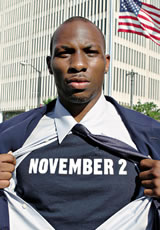
Experienced at working with international institutions and grassroots activists alike, Mark Ritchie has been known to use an “insider-outsider strategy.” It's an apt descriptor: A onetime chicken farmer and co-op organizer, he’s addressed the UN General Assembly on commodities and sustainable development. A speaker at the first-ever World Social Forum in Porto Alegre, Brazil, and organizer of a boycott of Nestle (for their campaign urging mothers in developing countries to switch from breast milk to formula), he’s worked closely with corporations like Cargill in developing sustainable practices. For 20 years, he’s lead the Institute of Agriculture and Trade Policy (IATP), a non-profit he founded that researches global trade's effects on local family farmers, and in 2004, he spearheaded the nation’s largest voter registration drive, in which five million new voters registered through a project marked by blue t-shirts emblazoned only with the text: “November 2.”

On November 7, Ritchie hopes to unseat Minnesota's incumbent Secretary of State Mary Kiffmeyer. With just days before the election, I caught up with him to discuss not just the race, but the ideas that shape his politics that are unabashedly progressive, deeply humane, and solidly pragmatic.

We’ve discussed the zero-waste campaign events you’ve hosted, IATP’s work writing standards for the production of biodegradable, plant-based polymers for industrial use, and your work on the global trade issues that affect family farmers. How will you bring your knowledge of sustainability and environmental practices into the office of Secretary of State?

I’m going to be very busy as Secretary of State dealing with certain messes and finding out the problems. But there are three things I believe I can contribute. One is sitting on the board of investment policymaking for the pension funds. $50 billion: it’s pension money. It should have a 50-year perspective, because that’s about how long most folks are working these days. And to have a 50-year perspective is to have an ecological and a sustainable perspective long term.

Second, the Secretary of State’s office spends money, so you can set standards. We have standards now for buying from veteran-owned businesses, women-owned businesses, minority-owned businesses. We have standards for mercury reduction. Having a standard that looks at bio-based, Minnesota-based, renewable sources is not that complicated anymore and certainly could be done.

And finally, people are interested in vision. What’s your vision of the democracy? What’s your vision of the country? What’s your vision of the future? As Secretary of State you get the opportunity to speak to audiences—sometimes it’s one reporter and sometimes it’s a thousand students gathered for a conference—so being able to articulate a vision that’s holistic, so that the democracy fits into respect for rights and responsibilities which then extends to the communities around us.

Who are some of the thinkers, in Minnesota or elsewhere, who’ve inspired you?

David Morris from the Institute for Local Self-Reliance. In the ‘30s, Henry Ford and others spearheaded the Chemurgy Movement, which was a movement to get off of petroleum and base our industrial economy on plant matter, on things that would grow. They were essentially defeated by cheap oil. The US invaded north Africa. We seized control of the oil fields—the British did with the US—guaranteeing cheap petroleum, and it basically killed off the chemurgy movement.

But David Morris began talking about the carbohydrate economy, and he began educating all of us about how we could do all these things with plant matter and how that would affect Minnesota’s economy, and how we could stop importing oil and stop killing ourselves with these poisonous petroleum-based products and destroying the ozone and destroying the climate. David Morris single-handedly rebirthed that movement.

Will Steger, as an explorer, basically set out to go places and do things that nobody’s ever done, and in the course of doing that he became intimate with the details of how human-generated changes in the climate have begun to alter everything from the tiniest plants to the glacial ice shelf of Greenland and Antarctica. He was able to bring a vision by being able to talk about it from the personal in a way that no one has ever done, at least in my experiences no one’s done it quite like that.

There’s a lot in our history. The artist [Francis Lee] Jaques was able to capture some of this in painting and in art. Ann Bancroft is also somebody who, through her own experience is able to articulate another way to see the world and be able to communicate that—especially to young people. Minnesota’s loaded!

In your work with IATP, you’ve befriended everyone from CEOs to small-scale organic farmers. How will that experience come into play in the Secretary of State’s office?

I feel fortunate that I’m old enough to have learned a lot of things over time, like how to be respectful of other views and how to draw on the experience of others and make the emphasis on finding win-win solutions and getting things done. I feel fortunate to be old enough to have gotten to that stage. Especially with elections. Because township officials, city clerks, and county auditors: those are the people who actually run elections. They’re a mix of every political stripe you’ve got. So, if you’re able to include and involve all those election officials, then you’re going to have a richness that transcends a single partisan perspective or any perspective in that way.

Elections are the most prominent part of the Secretary’s job. What about the other aspects? There are business filings, you’re the keeper of the state song or whatever…

(Laughs.) The two other big things: the Secretary of State sits on the pension board. This has been pretty secretive until the big flap over Mary Kiffmeyer’s support of William McGuire and the whole United Health board debacle. Mike Hatch and Pat Anderson voted to remove the board of United that had all these corrupt executives and Pawlenty recused himself, because he takes a lot of campaign contributions from these corrupt executive. Mary Kiffmeyer voted in favor of the corrupt executives. That whole process needs to be transparent. The second is that the conflicts of interest need to be put out there. I mean, Mary Kiffmeyer is a major owner of a very large bank, so there’s all kinds of potential conflict of interest, because banks have customers and pension funds are making investments. There’s a lot to that pension fund that hasn’t been talked about much.

That’s one job. The second one is two-thirds of the staff, and it’s business filings. One of the reasons I’ve gotten such strong, positive support from the county recorders—the folks who handle business filing at the county level—is that they’re constantly frustrated by the failures in the office when the computers go down or all the services are unavailable and it makes them look like fools back home.

One thing I hadn't noticed was how angry the commercial business-related lawyers were until I started getting invited to give presentations at all these fancy downtown law firms. When I got to my first one, a guy said to me, “You know, we were all furious when Mary Kiffmeyer decided to just close the business filings part of her office” in kind of a snit with Jesse Ventura. Ventura said all agencies should save money by reducing costs by a certain percent, and she said, essentially, the heck with you, and shut the office down. Many lawyers said, "Wait, you can’t do that. We’ve got clients who want to file as corporations, they want us to do name changes." Some of them switched to doing it in Wisconsin and Delaware. They were furious.

Last week I was doing one of these presentation at a 40th floor of a big downtown law firm, and the guy repeated a story: earlier in the week he was talking to a lawyer in Boston, representing a Boston-based investor in a Minnesota company, and they were arguing that they should reincorporate the company in Delaware not in Minnesota. One of his arguments was: “The Secretary of State is always shutting down the office there. How can you ever deal with them?” Minnesota law firms—big ones—compete with coastal-based law firms in New York, Washington, Boston, San Francisco, Los Angeles. And the perception is the typical stereotype: we’re flyover land, we’re hicks, things don’t really work, we’re really second tier. When the Secretary of State does something like shut down the office and make everybody look like a fool, it reinforces that perception that we’re just not up to snuff here and it’s damaging to their ability to compete at a national level for legal business. I know that Business Services side doesn’t get much attention, it does take up a lot of staff, but if you don’t operate it properly, you can create a very bad situation for Minnesota businesses…

I’ve spent 20-some months meeting with all the people who interact with that office on a daily or weekly basis, and I’ve gotten an earful from auditors and recorders and everybody. I have a long list of the problems, but I also have a long list of very helpful specific suggestions on ways to fix the problems, improvements that could be made, and really creative—some of them genius—ideas for things we could do going forward. I’m very excited to get in there and roll my sleeves up and reinspire that staff and say, hey, we’re going to turn this around.

I find it interesting that you haven’t played up your huge voter registration experience more in your campaign. You’re the guy behind that, but I suspect more people have seen those November 2 t-shirts than have heard of you.

Yeah, I know. While I’m extremely proud of it and I mentioned it in the ad and I love saying it in speeches, I want to make sure that I’m always clear that this was a huge effort and that I had the privilege of being the leader and coming up with and moving it. But there was a couple thousand groups—400 in Minnesota. Registering five million people is this Herculean task, and one person can have a big role, but one person can’t be that campaign.

I haven’t seen much campaigning by Mary Kiffmeyer in the metro area; is she giving up on the Twin Cities or my demographic?

There’s a lot of billboards and radio, and there are some full-page ads in things like the Senior Federation paper. She has very high name recognition, and I have very low name recognition, so probably she’s pitching her base. Her ads feature Dick Franson speaking, with her coming in on the end saying “I approve this ad.” So her ads are a little unusual in that way.

Isn’t that a bit like what you did on your TV spots with Joan Growe?

Well. Joan Growe was the most beloved and 24-years-serving Secretary of State. Dick Franson is a 22-time failed candidate, in and out of bankruptcy, writes me racist notes and threatening little postcards. He’s like the opposite. So, anyhow. That’s her decision—whatever—but one of the four candidates, Bruce Kennedy, really went after her publicly in the debate in Duluth about this… He called it exploitation. It was a very strong statement, and he really meant it.

In preparing for this interview, I was looking for your critics. The only criticism I’ve heard is that you’re not running for higher office.

(Laughs) Yeah. I feel like there’s a bit of disrespect for the office of Secretary of State, and I’ve noticed it inside the political parties, the media, and the public, and even among my friends. I think the mechanics and the guardianship of democracy and the voting process in the past was well done, so people didn’t worry about it. So the job didn’t seem so important. And then Florida woke us up—and Ohio and Mary Kiffmeyer set off a big alarm—but I’ve found for myself, traveling the state and talking about the democracy every night, that I don’t believe there’s a more important job than being a champion of the democracy at this stage in the nation’s history. It’s not just the question of the elections, but the whole assault on the democracy: attacks on judges and gerrymandering and ripping up the constitution. To my friends who said, “Why are you wasting your time,” I’ve gotten so I answer them with some pretty strong words. Defending the democracy is the most important thing I can be doing, and that’s what I should be doing, and I’m going to do a really good job of it.