 Politics aside, this photo by the AP's Oded Balilty, showing a Jewish settler resisting police, is definitely worth a 2006 World Press Award.
Showing posts with label photography. Show all posts
Showing posts with label photography. Show all posts
4.04.2007
100 to 1.
Politics aside, this photo by the AP's Oded Balilty, showing a Jewish settler resisting police, is definitely worth a 2006 World Press Award.

3.14.2007
Ulrich named to PDN30
 Alec Soth and Joerg Colberg both shout out to Chicago photographer and Eyeteeth pal Brian Ulrich. Now it's my turn: congratulations to Brian for being selected in this year's PDN 30, Photo District News' list of "New and Emerging Photographers to Watch." This amazing shot of stars-and-bars camp chairs stacked like body bags is featured, accompanied by a quote by Ulrich on our post-9/11 imperative to do some patriotic shopping.
2.16.2007
Denis Darzacq's La chute

"When the social elevator is broken you have to know how to bounce. Between the take off and the fall, the man parachuted in the city learns to control his trajectory. In the rough manner of architecture, he opposes the elasticity between his body and his desires. This gravitation exercize requires Discipline, even if it's not the one we've learned in classrooms. After the riots of last autumn, the photograph Denis Darzacq realized 16 of those perilous shots, that says the turbulences and the life in precarious balance."
2.15.2007
Chris Jordan runs the numbers
 Interesting new project from Chris Jordan: using existing photos he illustrates statistics—from spending on the Iraq War to purchases of GMC Yukon Denali SUVs—using repeated imagery. In this case, he's depicting the 2.3 million Americans who were incarcerated in 2005, representing them through folded and stacked prison uniforms.
Earlier: An image from Jordan's Intolerable Beauty series.


2.07.2007
Archived: Logo-izing Abu Ghraib
Learning that talented documentarian Erroll Morris is doing a film on torture at Abu Ghraib--and that his ideas are shaped by Susan Sontag's Regarding the Pain of Others and his own ideas on the rhetorical (or, perhaps, moral) power of photography (read his New Yorker piece on the subject here), I went digging through old Eyeteeth posts--one on Sontag, another on the "logo-izing" of Abu Ghraib. Rereading it, it seems worth another look. So, from the archives:
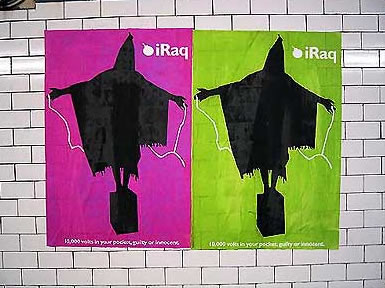
When I first saw that photo of a hooded man in Abu Ghraib’s sickly light, arms outstretched and fingertips wired, I wondered if I was seeing art – Goya meets Matthew Barney, Hannibal Lecter meets Christ on a crate. But the fact that it was orchestrated by American military men for maximum humiliation, rather than aesthetic effect, intensified its macabre allure. Could they have known that their prankish snapshot would fascinate us so, ending up on front pages worldwide, on folk-art murals in Iraq, on a Los Angeles highway overpass accompanied by the words "The War is Over," a suggestion of its inherent rhetorical force? Advertising’s supercharged images had nothing on this.
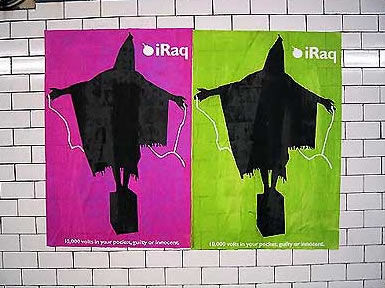
So it’s no surprise that’s where it ended up. A series of subverted branding posters in New York included the torture victim’s silhouette among a crowd of grooving hipsters, with white wires running not to imaginary car batteries but to gleaming iPods. Blackened out for graphic boldness, the Iraqi man has become an emblem for a dishonorable war – a logo, of sorts, as iconic as Nike’s dunking Air Jordan or the Playboy bunny. And like its corporate counterparts, it comes with a tagline: "iRaq. 10,000 volts in your pocket, guilty or innocent."
In a country where antiwar sentiment is pushed to the margins, it made me immediately jubilant: opposition to war has gone mainstream! Graphically powerful, intellectually interesting (if flawed: what does Apple have to do with Iraq?), the altered ads juxtapose an American version of freedom – young people expressing their individuality and nonconformity through a trendy consumer good – with another kind of "freedom" imposed half a world away. If this imagery could penetrate our commercial comfort zones and tweak our noses, maybe it could germinate resistance to the war. And how ironic if an image eerily reminiscent of the Crucifixion proved George W. Bush’s undoing – a Christian zealot finished off by pictures of a man strung-up and suffering.
But such thoughts quickly turned to unease. To have this kind of cognitive distance to coolly contemplate the rhetorical mechanics of image appropriation must mean one thing: its gut-level impact has been replaced by a less immediate, intellectual one. Its power has been dimmed. While repetition might be to blame, so might the logo-ization itself. The silhouetting negates details of the victim. Like the inherent meaninglessness of the Nike swoosh, it exists only as a vessel to pour branded messages into. Abu Ghraib’s wired man stopped being a human being when he became an abstraction into which all our antiwar gripes can be loaded. Maybe we can live with that. Like the old war photographer’s dilemma, perhaps activists have to determine whether saving a life or sparing a person greater humiliation outweighs the image’s potential to stop further suffering. That seems to be the logic of Freewayblogger, the creator of the Los Angeles highway banners, who says, "He’s already been through his torture – doing my share to remind people of that doesn’t bother me at all."
But there’s a broader tactical question: even with messages conceived on moral high ground, are we best serving our cause – or humanity – by trafficking in images of cruelty or violence? Can we compete in a media environment populated by Janet Jackson’s nipple, Dick Cheney’s "Go fuck yourself," and web photos of a contractor’s hacked-off head? And by trying, are we complicit in ratcheting up our collective tolerance to suffering? When news broke of the first beheading of an American in Iraq, I was overcome by queasiness. In the absence of an image, I imagined the sheer terror of Nicholas Berg’s last hours. But, weeks later, when I worked up the nerve to view photos of Paul Johnson, his severed head propped between the shoulder blades of his orange jumpsuit, I was calmly numb. The image was less bloody and more clinical than, say, Mel Gibson’s flayed Jesus, dressed up with special effects to leave no doubt about the depth of the man’s suffering.
Watching Fahrenheit 9/11, I winced at footage of a GI’s bomb-shattered arm, his tendons snaking out in a Terminator-like tangle, but the image didn’t linger long. What did, profoundly, was the story of Lila Lipscomb, a Michigan mom who lost a son in Iraq. Contorted by grief, physically incapacitated by loss, she testified that war’s impact goes heartbreakingly beyond the mere impact of bullets on flesh. Her story doesn’t need to be abstracted or amplified by smart design. When we logo-ize suffering, we forget what it represents: the dark heart of grief and loss that could easily be ours.
1.30.2007

1.04.2007
Found on Flickr
 The ever-photogenic lift bridge in Duluth, Minnesota, looks particulary majestic in this shot over the Lake Superior fog.
1.01.2007
American Portrait 2006
 As we all should be painfully aware by now, December was the bloodiest month for US soldiers--and civilians--in Iraq since 2004, as the total number of Americans killed surpassed 3,000 yesterday. Minneapolis photographer Alec Soth just submitted his best-0f-2006 list to go into a new-year's post at the Walker blogs tomorrow, and his pick for single best photo of the year was a moving one (above). Photographer Todd Heisler's view of 2nd Lt. James J. Cathey's casket being loaded into a plane in Reno, Nevada shows passengers of the commercial jet peering down through tiny windows. The shot was part of a series that won Heisler a Pulitzer, and as Alec puts it, it's "perhaps the best portrait of America in 2006 -- the year we finally looked out the window (and in the mirror)."
Here's to a more peaceful 2007.


12.28.2006
Photo of the year?

12.21.2006
Best Photojournalism
The PDN Photo Annual has an amazing section on Photojournalism and Sports. A few nominees for 2006's best: Mike Hewitt's photo of Andre Agassi and Roger Federer warming up before the Dubai Duty Free Men's Open, for Sports Illustrated.
 Christopher Morris' photo, for TIME, of a "damaged photograph found inside a home in Chalmette, St. Bernard Parish" after Hurricane Katrina.
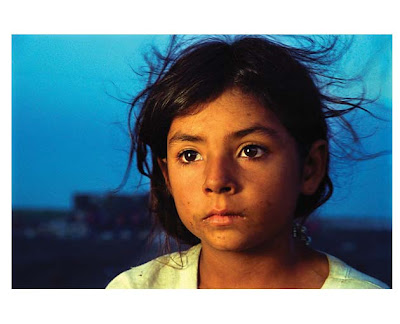 From 2005, Janet Jarman's image for German CEO magazine's article on immigration from Central America: "Marisol, 8, daydreams as she and her siblings wait for another load of garbage at the municipal waste dump."
 Mike Hewitt's photo of Andre Agassi and Roger Federer warming up before the Dubai Duty Free Men's Open, for Sports Illustrated.
 Christopher Morris' photo, for TIME, of a "damaged photograph found inside a home in Chalmette, St. Bernard Parish" after Hurricane Katrina.
 From 2005, Janet Jarman's image for German CEO magazine's article on immigration from Central America: "Marisol, 8, daydreams as she and her siblings wait for another load of garbage at the municipal waste dump."
Subscribe to:
Posts (Atom)

