In his 1995 film Telephones, artist Christian Marclay spliced together snippets of actors from Hollywood films answering phones. Apple contacted Marclay, he says, to get permission to use the concept for a new iPhone ad (above) that debuted during the Oscars.
He refused. They took the idea anyway.
"The way they dealt with the whole thing is pretty sleazy," Marclay says. He talked to a lawyer about taking legal action over the ripoff, but was told "there's nothing I can do about it. They have the right to get inspired."
Contemporary art, of course, is often about appropriation and recontextualizing material, but the brazenness of Apple's move is too bad. Still, Marclay isn't keen on going to court.
"This culture's so much about suing each other that if we want to have anything that's more of an open exchange of ideas, one has to stop this mentality. I'm just honored that they thought my work was interesting enough that they felt they could just rip it off."
The following mini-documentary on Marclay's work (which is fascinating in its own right) features Telephones about 3:40 in.
Via Kottke.
Showing posts with label advertising. Show all posts
Showing posts with label advertising. Show all posts

2.09.2007

1.26.2007

12.10.2006
Premature Christmas Card
 The Daily Irrelevant:
Every year, the premature baby unit at Edith Cavell hospital sends cards to the other departments as well as to some ex-patients. This year, they sent this card in Mid-October. When you open it you see the message:
It’s a little premature, but Happy Christmas.
11.28.2006
Conservation.

11.21.2006
Rethinking the brand: Hank Willis Thomas
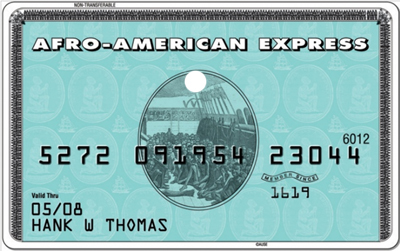 Hank Willis Thomas addresses commodification in his art--specifically, a link between the commodification of African men in the slave trade and the use of black bodies to hawk goods from credit cards to Nikes today. His work deals explicitly with branding, from the product logos plastered on athletes and rap stars to the markings that identified slaves.
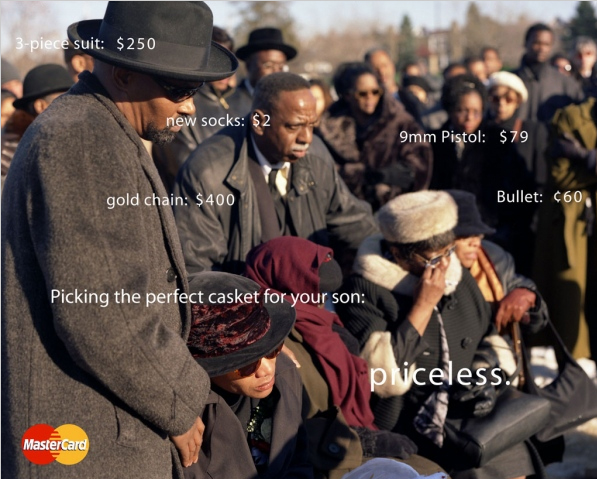
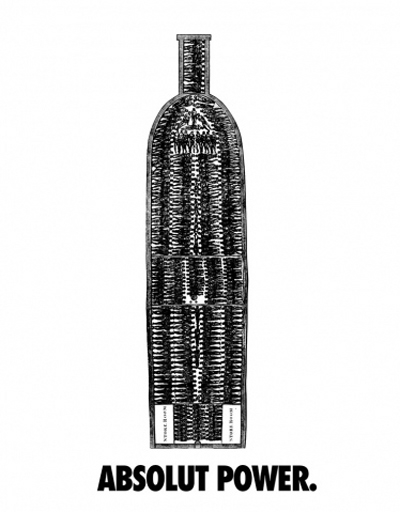 But there also seems to be another take on "consumerism"--how capitalism eats up and spits out African Americans, and many of the rest of us as well. His appropriation of the Absolut Vodka ad, in which a slave ship floorplan forms the iconic bottle outline, suggests that our appetites have a price. Similarly, his piece Priceless #1 could be seen as a quick riff on a popular ad--and exploitative of the pictured family--until you hear the backstory.
Thomas says:
I think that the irony of the ideal of the black male body is interesting…it is fetishized and adored in advertising but in reality black men are in many ways the most feared and hated bodies of the 21st Century. The majority of this work comes out of the experience of losing my cousin Songha Thomas Willis – he was killed because he was with someone who was wearing a gold chain. It is this idea – that someone could be killed over a tiny commodity. In NYC in the 1980s, people were killed over sneakers and backpacks. Songha was someone who survived DC when it was the murder capital of the country and then came home to Philly and was killed over a commodity. I want to question what makes these commodities so precious that they are worth defining and more importantly taking another person’s life?
Update: See Thomas' work here. Tyler Green offers his thoughts on Priceless #1 here.
Subscribe to:
Posts (Atom)

