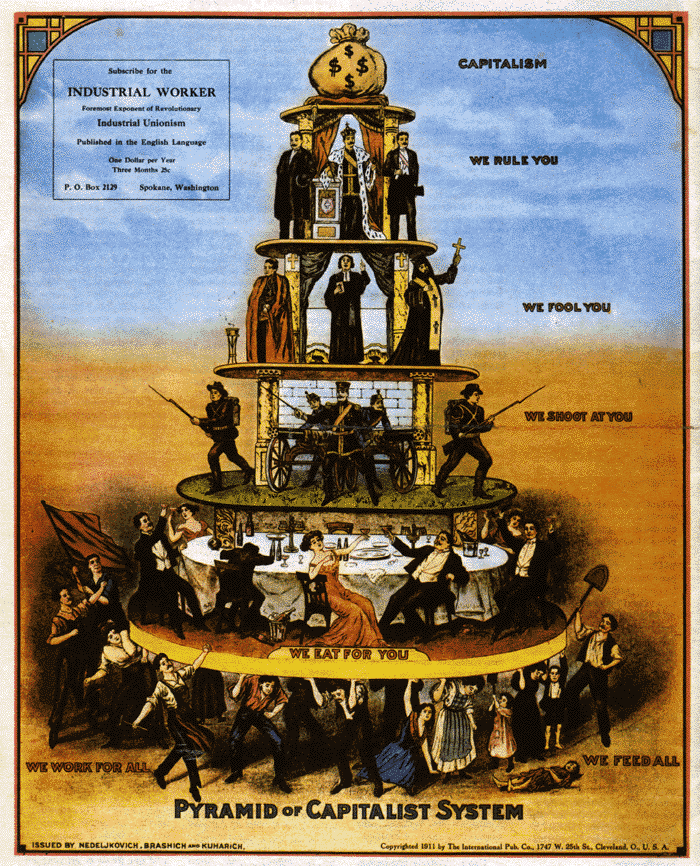
This amazing illustration was produced in 1911 for the Industrial Workers of the World by Nedeljkovich, Brashich, and Kuharich. While blunt, it definitely merits closer examination.
Via a.poretic.
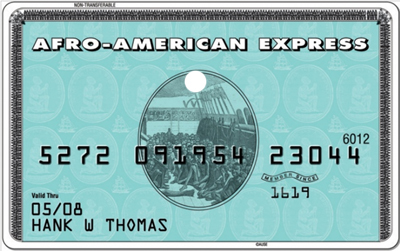 Hank Willis Thomas addresses commodification in his art--specifically, a link between the commodification of African men in the slave trade and the use of black bodies to hawk goods from credit cards to Nikes today. His work deals explicitly with branding, from the product logos plastered on athletes and rap stars to the markings that identified slaves.
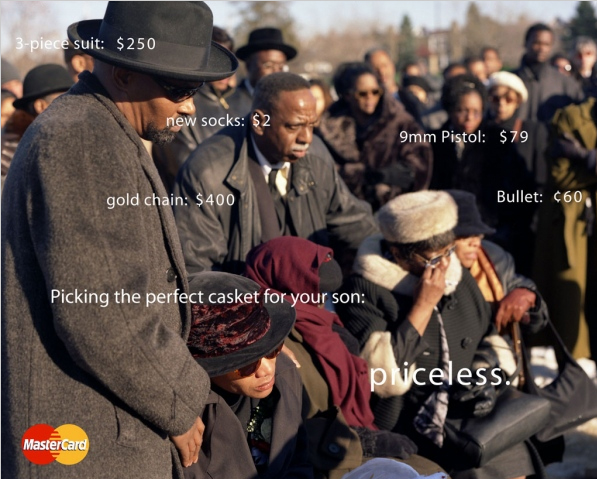
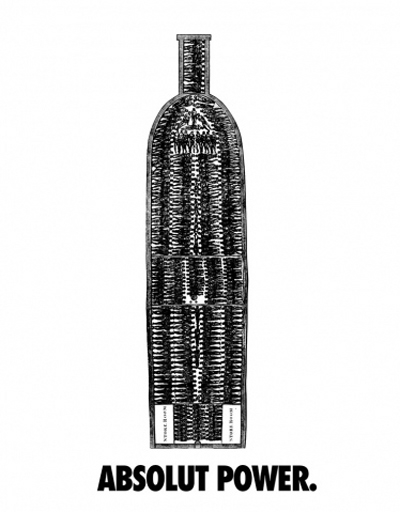 But there also seems to be another take on "consumerism"--how capitalism eats up and spits out African Americans, and many of the rest of us as well. His appropriation of the Absolut Vodka ad, in which a slave ship floorplan forms the iconic bottle outline, suggests that our appetites have a price. Similarly, his piece Priceless #1 could be seen as a quick riff on a popular ad--and exploitative of the pictured family--until you hear the backstory.
I think that the irony of the ideal of the black male body is interesting…it is fetishized and adored in advertising but in reality black men are in many ways the most feared and hated bodies of the 21st Century. The majority of this work comes out of the experience of losing my cousin Songha Thomas Willis – he was killed because he was with someone who was wearing a gold chain. It is this idea – that someone could be killed over a tiny commodity. In NYC in the 1980s, people were killed over sneakers and backpacks. Songha was someone who survived DC when it was the murder capital of the country and then came home to Philly and was killed over a commodity. I want to question what makes these commodities so precious that they are worth defining and more importantly taking another person’s life?
 |
| Paul Schmelzer, as signed by Yoko Ono |
 Merce Cunningham
 Noam Chomsky
 David Sedaris
 Kim Gordon
 Studs Terkel
 Henry Louis Gates
 Edward O. Wilson
 Abigail Van Buren
 Frank Gehry
 Ed Ruscha
 Jenny Holzer