Showing posts with label war. Show all posts

4.27.2007

The 70th Anniversary of "Shock and Awe"

Seventy years ago today, planes from Nazi Germany and Fascist Italy made one of history's more infamous bombing runs -- and its first test of the military strategy now known as "shock and awe." In wave after wave, their low-flying fighters -- acting in service of Fascist Gen. Francisco Franco -- dropped a cumulative 30 tons of munitions, strafing civilians with machine guns, and setting fire to what remained. By the end of the day, some 2,500 people were dead or injured and three-quarters of the town's buildings were destroyed, according to the Basque government.

"Guernica, city with 5,000 residents," wrote the commander of Germany's Condor Legion in his journal, "has been literally razed to the ground. Bomb craters can be seen in the streets. Simply wonderful."

The attack, of course, inspired one of Pablo Picasso's most celebrated and grisly works, a painting, named after the town, that appeared in the Spanish pavilion at the 1937 World's Fair in Paris. As he worked on the 25-foot mural, he reportedly said, "In the panel on which I am working, which I shall call Guernica, and in all my recent works of art, I clearly express my abhorrence of the military caste which has sunk Spain in an ocean of pain and death."

But beyond inspiring one of the world's most famous pieces of art, the bombing of Guernica sparked a new focus on peace in the town. The Gernika Peace Museum, which was created in part to investigate and present the truth of the attacks (they were first attributed by German soldiers to "the Reds"), is now seen as an international leader in conflict resolution and peace studies. Its mission is to remind and inform visitors about the raid 70 years ago, but also to inspire them to reflect on the nature of peace in the world and our struggles with it today.

"I think Guernica is a good example of not forgetting and trying to go further," said Iratxe Astorkia, the museum's director.

Today's anniversary has renewed calls -- so far refused -- for Picasso's Guernica to make its first showing in the town that shares its name.

3.18.2007

This day in 2003: Barbara Bush

"Why should we hear about body bags and deaths, and how many, what day it's going to happen, and how many this or what do you suppose? Or, I mean, it's, it's not relevant. So, why should I waste my beautiful mind on something like that?"
Barbara Bush on Good Morning America, March 18, 2003, on the Iraq War, which was launched two days later and has since claimed the lives of more than 3,200 U.S. soldiers (including seven so far this weekend) and countless Iraqis. As quoted by Frank Rich in today's New York Times.

2.28.2007

Sources & S.H.I.T.: Pondering Bachmann's Partition Claim

In her already-infamous podcast interview with St. Cloud Times reporter Larry Schumacher, U.S. Rep. Michelle Bachmann, R-Minn., sounded pretty certain Iran had "already decided" to partition Iraq. "There's already an agreement made," she said, to "create a terrorist safe haven zone" in the northwest part of Iraq. While iffy on the details, she even offered a name for the state that Iran would create: "The United... um, I'm sorry. I can't remember the name of it now, but it's going to be called the Iraq State of Islam, something like that."

Despite pressure from newspapers statewide to clarify the source of her allegations, Bachmann's only official comment was that she's sorry if her "words have been misconstrued" (what the Star Tribune's Eric Black, who broke the story, calls "a classic of the genre where you give the impression that you are retracting, apologizing and clarifying but do none of the above"). Since she offers no credible explanation, speculating on where she got her information is fair game.

So, what distinguishes Bachmann's claim from other partition plans that have been floating around for years? Her use of the specific name, the "Iraq State of Islam." Any guess about her source should start there — and one such explanation, be forewarned, is full of S.H.I.T.

Bachmann's own explanation for her podcast admission suggests she was merely repeating much-discussed plans for a three-way partition of Iraq along ethnic lines. According to a report by Gary Halbert at Global Research, in 2002 the United States prepared a pre-invasion plan that included separate territory for Sunnis, Kurds, and Shiites. The central state — and not "northern, western," in Bachmann's words — in that plan was to be called the "United Hashemite Kingdom." It's not all that close to the Iraq State of Islam, but is one of the few cases where partition states are named.
Another possible explanation: Bachmann misconstrued satire for hard news, just as China's Beijing Evening News did in 2002 when it earnestly reported a made-up story from The Onion about U.S. plans to put a retractable roof on the Capitol. It's possible Bachmann read the essay, "Blood Borders: How a better Middle East would look," in the Armed Forces Journal.

The piece is written by Ralph Peters, a retired Army lietenant colonel whose ideas about Iraq frequently appear at FrontPageMagazine.com, a site where Bachmann-style conservatism is heralded. As he did in the 2003 New York Post essay Break Up Iraq Now!, Peters called for a three-way division of Iraq. "A Frankenstein's monster of a state sewn together from ill-fitting parts, Iraq should have been divided into three smaller states immediately" after the fall of Baghdad. In fact, he calls for the redrawing of national boundaries across the region: Iraq's Shiite southern zone would be the heart of the Arab Shia State, whereas the House of Saud's turf would be dubbed Saudi Homelands Independent Territory.

Bachmann, who might've read the piece, might have missed Peters' joke: He was editorializing through the sophomoric acronyms A.S.S. (which he describes as "rimming much of the Persian Gulf") and S.H.I.T. (which is "confined to a rump" around Riyahd).

A more likely (but less funny) explanation is offered by conservative blogger Jay Reding. Arguing that Bachmann is both wrong and right, he wrote, "Bachmann is actually correct, except she's confusing Iran and al-Qaeda. Al-Qaeda did indeed declare their own Islamic State of Iraq." There are holes in that theory: al-Qaeda, a terrorist group, made a rogue declaration of statehood, a far cry from Iran's "agreement" Bachmann claims knowledge of. And if it was a mere slip-up, why won't Bachmann say as much? Maybe she's simply using the rhetoric her party employed to launch the Iraq war, lumping together the perpetrators of 9/11 with Saddam Hussein's ilk. Another name she uses often in the St. Cloud Times podcast, after all, is that favorite catchall, the Global War on Terror.

[Cross-posted at Minnesota Monitor.]

2.20.2007

Purple Heart-winning amputee told not to wear shorts at Bush event

Support our troops? From the Washington Post's explosive expose on conditions at Walter Reed:
Sgt. David Thomas, a gunner with the Tennessee National Guard, spent his first three months at Walter Reed with no decent clothes; medics in Samarra had cut off his uniform. Heavily drugged, missing one leg and suffering from traumatic brain injury, David, 42, was finally told by a physical therapist to go to the Red Cross office, where he was given a T-shirt and sweat pants. He was awarded a Purple Heart but had no underwear.

David tangled with Walter Reed's image machine when he wanted to attend a ceremony for a fellow amputee, a Mexican national who was being granted U.S. citizenship by President Bush. A case worker quizzed him about what he would wear. It was summer, so David said shorts. The case manager said the media would be there and shorts were not advisable because the amputees would be seated in the front row.

" 'Are you telling me that I can't go to the ceremony 'cause I'm an amputee?' " David recalled asking. "She said, 'No, I'm saying you need to wear pants.' "

David told the case worker, "I'm not ashamed of what I did, and y'all shouldn't be neither." When the guest list came out for the ceremony, his name was not on it.

ThinkProgress has more.

2.07.2007

Archived: Logo-izing Abu Ghraib

Learning that talented documentarian Erroll Morris is doing a film on torture at Abu Ghraib--and that his ideas are shaped by Susan Sontag's Regarding the Pain of Others and his own ideas on the rhetorical (or, perhaps, moral) power of photography (read his New Yorker piece on the subject here), I went digging through old Eyeteeth posts--one on Sontag, another on the "logo-izing" of Abu Ghraib. Rereading it, it seems worth another look. So, from the archives:

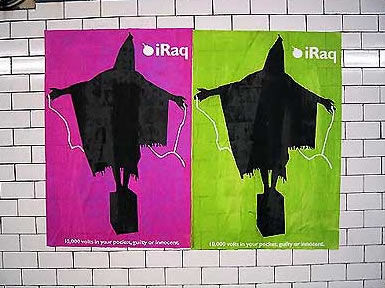
When I first saw that photo of a hooded man in Abu Ghraib’s sickly light, arms outstretched and fingertips wired, I wondered if I was seeing art – Goya meets Matthew Barney, Hannibal Lecter meets Christ on a crate. But the fact that it was orchestrated by American military men for maximum humiliation, rather than aesthetic effect, intensified its macabre allure. Could they have known that their prankish snapshot would fascinate us so, ending up on front pages worldwide, on folk-art murals in Iraq, on a Los Angeles highway overpass accompanied by the words "The War is Over," a suggestion of its inherent rhetorical force? Advertising’s supercharged images had nothing on this.

So it’s no surprise that’s where it ended up. A series of subverted branding posters in New York included the torture victim’s silhouette among a crowd of grooving hipsters, with white wires running not to imaginary car batteries but to gleaming iPods. Blackened out for graphic boldness, the Iraqi man has become an emblem for a dishonorable war – a logo, of sorts, as iconic as Nike’s dunking Air Jordan or the Playboy bunny. And like its corporate counterparts, it comes with a tagline: "iRaq. 10,000 volts in your pocket, guilty or innocent."

In a country where antiwar sentiment is pushed to the margins, it made me immediately jubilant: opposition to war has gone mainstream! Graphically powerful, intellectually interesting (if flawed: what does Apple have to do with Iraq?), the altered ads juxtapose an American version of freedom – young people expressing their individuality and nonconformity through a trendy consumer good – with another kind of "freedom" imposed half a world away. If this imagery could penetrate our commercial comfort zones and tweak our noses, maybe it could germinate resistance to the war. And how ironic if an image eerily reminiscent of the Crucifixion proved George W. Bush’s undoing – a Christian zealot finished off by pictures of a man strung-up and suffering.

But such thoughts quickly turned to unease. To have this kind of cognitive distance to coolly contemplate the rhetorical mechanics of image appropriation must mean one thing: its gut-level impact has been replaced by a less immediate, intellectual one. Its power has been dimmed. While repetition might be to blame, so might the logo-ization itself. The silhouetting negates details of the victim. Like the inherent meaninglessness of the Nike swoosh, it exists only as a vessel to pour branded messages into. Abu Ghraib’s wired man stopped being a human being when he became an abstraction into which all our antiwar gripes can be loaded. Maybe we can live with that. Like the old war photographer’s dilemma, perhaps activists have to determine whether saving a life or sparing a person greater humiliation outweighs the image’s potential to stop further suffering. That seems to be the logic of Freewayblogger, the creator of the Los Angeles highway banners, who says, "He’s already been through his torture – doing my share to remind people of that doesn’t bother me at all."

But there’s a broader tactical question: even with messages conceived on moral high ground, are we best serving our cause – or humanity – by trafficking in images of cruelty or violence? Can we compete in a media environment populated by Janet Jackson’s nipple, Dick Cheney’s "Go fuck yourself," and web photos of a contractor’s hacked-off head? And by trying, are we complicit in ratcheting up our collective tolerance to suffering? When news broke of the first beheading of an American in Iraq, I was overcome by queasiness. In the absence of an image, I imagined the sheer terror of Nicholas Berg’s last hours. But, weeks later, when I worked up the nerve to view photos of Paul Johnson, his severed head propped between the shoulder blades of his orange jumpsuit, I was calmly numb. The image was less bloody and more clinical than, say, Mel Gibson’s flayed Jesus, dressed up with special effects to leave no doubt about the depth of the man’s suffering.

Watching Fahrenheit 9/11, I winced at footage of a GI’s bomb-shattered arm, his tendons snaking out in a Terminator-like tangle, but the image didn’t linger long. What did, profoundly, was the story of Lila Lipscomb, a Michigan mom who lost a son in Iraq. Contorted by grief, physically incapacitated by loss, she testified that war’s impact goes heartbreakingly beyond the mere impact of bullets on flesh. Her story doesn’t need to be abstracted or amplified by smart design. When we logo-ize suffering, we forget what it represents: the dark heart of grief and loss that could easily be ours.

2.02.2007

Jesus Loves Osama

"Love your enemies and pray for those who persecute you." So says Jesus in the book of Matthew. But Australian PM John Howard seems to think that Christian message is too radical: he's told a Baptist church in Sydney he wishes they'd create a less controversial sign than the one that reads "Jesus Loves Osama."

1.17.2007

Fuzzy math.

In 2000, George W. Bush repeatedly referred to the "fuzzy math" Al Gore used in explaining the costs of government programs.

How's this for fuzzy: the war the Bush administration priced out at $50 billion is now pushing the $360,000,000,000 mark (remember when Bush fired economic adviser Lawrence Lindsey, in part for predicting the war would top $200 billion?).

The new estimate for the Iraq war: $1.2 trillion.

1,100 service members sign "Appeal for Redress"

In 1969, four years after US troops began arriving in Vietnam in large numbers, 1,300 active-duty service members wrote an "open letter" in the New York Times decrying the war. Today, nearly four years into the Iraq War, nearly 1,100 service members have signed a petition to Congress calling for an immediate withdrawal of troops from Iraq.

The Appeal for Redress movement, begun by 29-year-old Navy seaman Jonathan Hutto, provides military personnel a way to use the Military Whistleblower Protection Act to officially register their dissent; as long as each individual is speaking out of uniform and off-duty, there can be no reprisals against them from Congress or their commanders.

When the campaign started a few months ago, White House press secretary dismissed it as "65 people who are going to be able to get more press than the hundreds of thousands who have come back and said they're proud of their service." Yesterday, Appeal for Redress presented more than 1,000 signatures to Rep. Dennis Kucinich in Washington, D.C.

(Via Free Speech Radio News.)

Above: Cartoon by RJ Matson for the St. Louis Post-Dispatch, January 11, 2007.

1.10.2007

One speech, four networks

During tonight's speech by Bush, three networks ran the identical on-screen super: "Presidential Address on Iraq." PBS was even more declarative: "Live from the White House Library." Long accused of coziness with the White House's communications team, here's how the local Fox affiliate tagged the speech:

Rhetorically speaking: Richard Ice on Bush's speech

With a backdrop of bookshelves and an oil lamp, George Bush addressed the nation tonight, not from the Oval Office but from the White House Library. But was the change in venue enough to signal the significant change in strategy his speech was hyped to address? Dr. Richard Ice, Professor of Communication at St. John's University in Collegeville, Minnesota, shared his thoughts on the rhetoric and stagecraft of Bush's speech.
I’m surprised they were in the library. The message is they’ve got a different setting, which suggests a different strategy. I don’t think it was different enough.


He built up the argument that Iraq is central to our fight against terrorism, but also making it this kind of beacon of democracy in the whole area. He really upped the stakes of success in Iraq. Then he went to great pains to show this is somehow a different strategy. But I’m not sure most Americans see this as a different strategy. Embedding American troopss with the Iraqis? Most people might see this as a more dangerous strategy. He’s making the argument that they’re going to be able to not only expel the insurgents from areas now, but also hold the area...


Right after September 11, the theme was: victory over terrorism was different than victory in any other kind of war. That’s a good example of a rhetorical problem he’s got. He uses "war on terrorism" to mean both a literal war and a metaphoric war, and those two things get confused. Because when he talks about it as a literal war—which it is in Iraq, and people are dying—people are wanting to see a tangible outcome, but he also refers to the "war on terror" as a metaphor. Like Johnson’s War on Poverty, it suggests a kind of lasting vigilance in going after the terrorists. And he was using it that way when talking about Iraq tonight: he demands success and says democracy has to work there, but he can’t really articulate what that's going to be.


It’s clear it’s not going to be some kind of Jeffersonian democracy like we have, but I don’t know what it means to succeed there anymore. Even in Vietnam, the image of victory was South Vietnam saved. The image in Korea was South Korea stayed as a country. Here, you’re left wondering: When do we know we’ve had a victory? And he admits, we don’t.


That makes it even harder to note that there’s even success. We’re trying to get troops to secure something, instead of getting more troops to win. The idea of winning a victory, he admits is not really what's going on. So, why are we sending more people in? To win a… what?

A trickle or a surge?

If all goes as planned, I'll be interviewing St. John's University Communications professor Dr. Richard Ice in an hour or so about the rhetoric and stagecraft Bush employs in his speech tonight. For prep, I'm wondering about the sudden appearance of this word "surge" to describe the president's planned deployment of 21,500 additional troops in Iraq? The term, obviously, has an active, almost optimistic (and, may I point out, temporary) ring to it--like waves crashing on an unsuspecting (wimpy, third-world) beach--and it doesn't carry the connotations its Vietnamy synonym, "escalation," does.

The Columbia Journalism Review says "surge" is "President Bush's word, a descriptor that at the very least belongs within quotations. So far, so good. It seems that a history of being burned by insufficient skepticism of the Bush administration and its policies has taught journalists and editors to put nearly everything in quotes."

Yes, but will the press stop using the term, sans quotes, should Bush's master plan involve a protracted or gradual addition of troops--an "escalation," if you will--instead of a massive and overwhelming spike in military resources?

Gory propaganda comic in Iraq


IraqSlogger
posts an image from a comic book celebrating "heroes" of the Iraqi army. Few details at this point, but it's apparently geared towards children.

1.01.2007

American Portrait 2006

As we all should be painfully aware by now, December was the bloodiest month for US soldiers--and civilians--in Iraq since 2004, as the total number of Americans killed surpassed 3,000 yesterday. Minneapolis photographer Alec Soth just submitted his best-0f-2006 list to go into a new-year's post at the Walker blogs tomorrow, and his pick for single best photo of the year was a moving one (above). Photographer Todd Heisler's view of 2nd Lt. James J. Cathey's casket being loaded into a plane in Reno, Nevada shows passengers of the commercial jet peering down through tiny windows. The shot was part of a series that won Heisler a Pulitzer, and as Alec puts it, it's "perhaps the best portrait of America in 2006 -- the year we finally looked out the window (and in the mirror)."

Here's to a more peaceful 2007.


12.21.2006

The Military-Industrial Complex, verbalized. (Or, shop the war away.)

George W. Bush, at his much-touted final press conference of 2006, made some startling statements, including his first admission that "We're not winning [in Iraq], we're not losing." But the kicker comes at the end. From the CBC's coverage:

He said the most painful part of his presidency has been knowing that American soldiers die as a result of his decisions. His "heart breaks" for their families, he said....

...Although he said the war will require additional sacrifices, he called for no sacrifices on the home front.

"A recent report on retail sales shows a strong beginning to the holiday shopping season across the country," he told the reporters, "and I encourage you all to go shopping more."

(Thanks, Tom. Photo: Christopher Morris)

12.14.2006

Bush wants $100 billion more for wars

In addition to the $70 billion set aside for wars in Iraq and Afghanistan this fiscal year, and the $475 billion the Pentagon recieved for military operations, George Bush wants an additional $100 billion for wars. Wouldn't this constitute gross mismanagement? Wisconsin Rep. Dave Obey nails it: "Republicans have spent years handing out billions upon billions of dollars in tax cuts to millionaires while shortchanging our national priorities."

The war, originally estimated by the administration to cost between $50 and $60 billion, has already cost Americans seven times that figure, and by the end of March 2007, the pricetag will have surpassed $378 billion.