David Choe, who's giving a free artist talk at the Walker in Minneapolis on May 24, just finished painting the offices at Facebook.com, and Wooster Collective has the link to the shots.

 I'm definitely not endorsing the message behind this chilling (and kind of clever) bit of street-art, but it could be the alternate cover to Benjamin Barber's book Jihad vs. McWorld: How Globalism and Tribalism Are Reshaping the World.

 Simpsons graffiti murals spotted in Vancouver, apparently commemorating the 2010 winter Olympics. Laughing Squid has more.
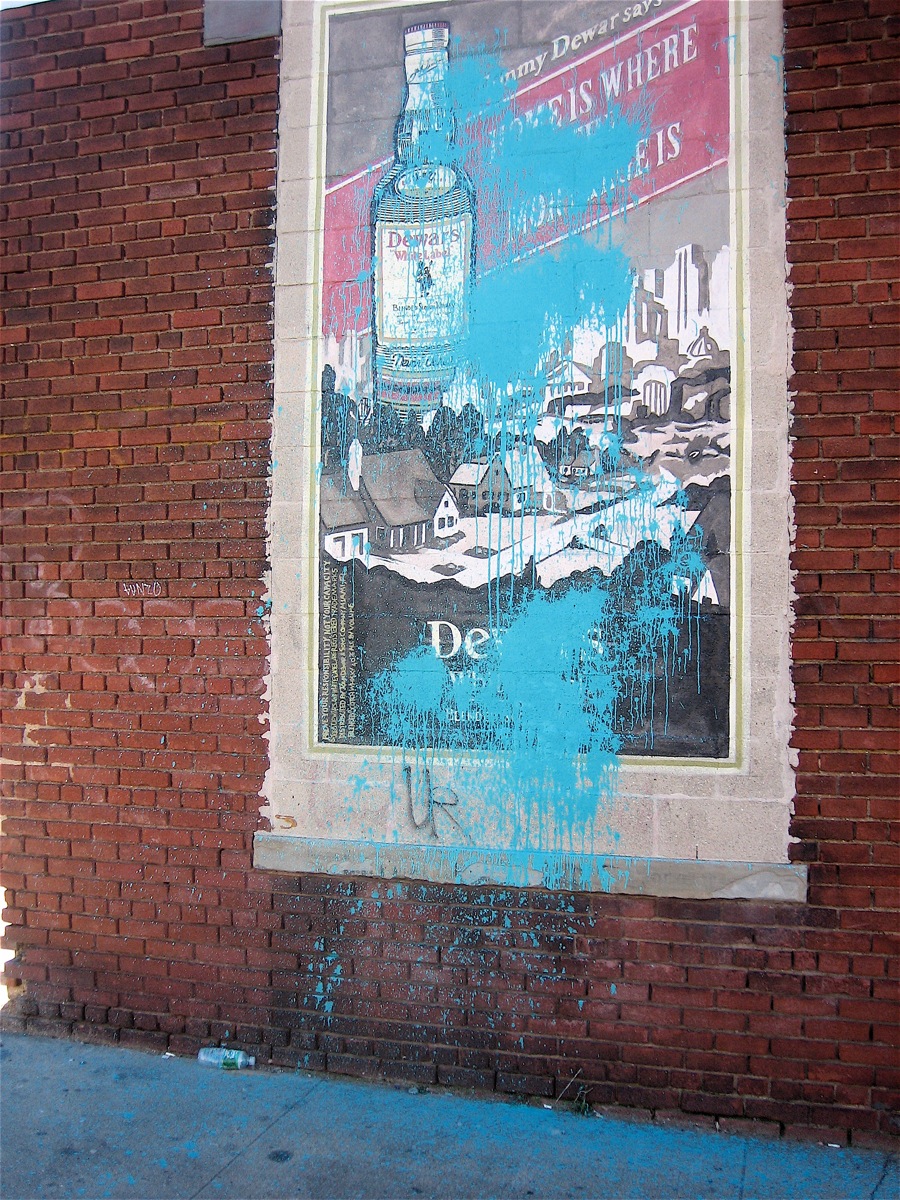
 In New York, a person or group dubbed "The Splasher" has been getting plenty of attention for dousing street-art works with paint, then wheat-pasting posters beside them decrying their creators as "advance scouts for capital." The NYC street-art crowd is up in arms about the destruction of their work and doesn't want people like me giving attention to vandals.
 Given this, the Splasher's anti-art sentiment reads as anti-artist. And why target (or suggest you're targeting) the safety of artists if your real beef is with commodification? Why not take on the ads that have engulfed our public spaces? (Although, apparently a commissioned Dewar's mural was hit.) Isn't it more deplorable that communal spaces are sold, without our consent, to market deodorant or the latest Fox series to us? Or is that part of the point: Shepard Fairey's Obey, Swoon's paper pieces, are they just brands? Ads for the next gallery show or the line of posters and boxer shorts (in Fairey's case) that get a marketing boost from the perceived street-cred of their makers? Such arguments seem valid, but they're deflated a bit by the irony of the Splasher's use of Dada to decry the bourgeois nature of street art.
 In the end, though, I think the critique is hokey. Too outraged, self-righteous, and, well, flaky. I cynically expect this person to eventually come forward--ta-da!--and reveal himself as an artist making what he considers an incisive critique. If that happens, there'll surely be a gallery show, complete with a bound book and an essay likening the modified street art to an exquisite corpse or referencing Situationist tracts. The Splasher, then, will be hoping to get a paycheck, like those he criticizes, through the "fetishized action of banality" and "an alienated commodity." Which will simultaneously deflate and underscore his entire point.
 Banksy has made several of his most famous images available as free downloads. Note from the artist: "Prints look best when done on gloss paper using the company printer ink when everyone else is at lunch." (Via MeFi.)
 Depicting the gun-mounted pickup trucks driven throughout Mogadishu by militias, this street-art shot accompanies Doctors Without Borders' list of the top ten under-reported humanitarian crises of 2006. Somalia makes the list for its constant upheaval, near-record-low life expectancy (47), recent flooding, and now US attacks. Definitely worth a read. Via WC.
 Not sure if this is culture-jamming or an ad campaign, but this billboard shot by Giant Robot's Eric Nakamura shows a billboard hidden behind a grass-printed construction barrier. The board, aptly, reads "a little better."

 While not all that original--Adbusters ran some images a few years back of trash bags covered with the Louis Vuitton logo--I like the sentiment. Rene Gagnon created this "top dollar garbage" stencil as "a statement about the value we put on things because there is a pattern associated with it, coach, gucci, doony and bourke..." It also suggests, from a dumpster-diver's perspective, that there's gold in them thar bins, as fickle consumers toss items they grow bored with or figure it's easier to buy something new rather than fix the damaged old one you've already got. Below, a different artist's logo-covered dumpster from early 2006, via Stencil Revolution.
 I've got so many problems with this stencil piece--it's location on the facade of the Art Institute of Chicago, it bogus (although well-intentioned, I'm sure) claim, its grandiosity--but I'll post it (relatively) comment free.