2.22.2009

Atlantikwall: Paul Virilio and the experimental geography of war bunkers


When he was 25, urbanist, art critic and political theorist Paul Virilio happened upon the Atlantikwall, a series of nearly 1,500 military bunkers erected by the Germans on the French coast during World War II to ward off Allied incursion. It was 1958, and the structures had begun blending into the surroundings through familiarity: bikes were stowed there by sunbathers, for instance, and even a young Virilio found he'd failed to truly recognize the sturdy war huts he'd on occasion used as a beach cabana. But once he really looked, the squatty forts conjured cultural memories of "the Egyptian mastabas, the Etruscan tombs, the Aztec structures…as if this piece of artillery fortification could be identified as a funeral ceremony."

Virilio's 1975 book about his explorations was only recently translated into English and published by Princeton Architectural Press. The Morning News posts photos from the book along with Virilio's introduction, in which he shares his thinking on the odd fortifications, which point out into the Atlantic abyss. Virilio, it dawns on me, was doing "experimental geography," long before the term was invented: He ponders the placement of the bunkers (not "oriented toward a specific, staked-out objective" as such fortifications typically were, these "concrete altars" were "built to face the void of the oceanic horizon"), how such modern edifices came to be overlookably normal ("Why continue to be surprised at Le Corbusier’s forms of modern architecture? Why speak of 'brutalism'? And, above all, why this ordinary habitat, so very ordinary over so many years?"), and how they'd been modified over time, plastered with anti-German graffiti and later ads.

The essay concludes with Virilio entering one of the dark enclosures, lit only by a few stabbing shafts of sun slicing through the gun slots:
[T]he whole structure weighs down on the visitor’s shoulders. Like a slightly undersized piece of clothing that hampers as much as it enclothes, the reinforced concrete and steel envelope is too tight under the arms and sets you in a semiparalysis fairly close to that of illness.

Slowed down in his physical activity but attentive, anxious over the catastrophic probabilities of his environment, the visitor in this perilous place is beset with a singular heaviness; in fact he is already in the grips of that cadaveric rigidity from which the shelter was designed to protect him.
Read it.

2.21.2009

Bits: 02.21.09


Knitta, Please! hits Paris, via Flickr.

• Clive Murphy's Amost Nothing, " a series of meticulously crafted inflatable sculptures made entirely of domestic trash bags," will fill the entirety of Minneapolis' Soap Factory starting tonight.

Social Design Notes points out 40 key articles on radical geography, including Neil Smith and Phil O'Keefe's "Geography, Marx and the Concept of Nature," compiled to commemorate Antipode's 40th anniversary.

• The Creative Capitol/Warhol Foundation Arts Writers Grant recipients for 2009 have been named: Congrats to all -- including blog pal Paddy Johnson and former Walker curator Joan Rothfuss, who's writing a book on Nam June Paik collaborator Charlotte Moorman.

• The Taliesen Mod.Fab is a prototype prefab green home sized to be transported via railway and designed to be wired or unplugged, "relying on low-consumption fixtures, rainwater harvesting, greywater re-use, natural ventilation, solar orientation, and photovoltaics to reduce energy and water use." Via Dwell.

• Guerrilla knitter Magda Sayeg recently yarnbombed a bus in Mexico City. Watch the video.

• "Tetris for typophiles": The KERN iPhone app.

2.20.2009

Bits: 02.20.09


Antidote to the flag lapel pin: Richard Barlow's Save Your Own Soul

• In December, Damien Hirst demanded remuneration -- to the tune of $284 -- from a 16-year-old artist who sold collages that used imagery of his diamond-encrusted skull. Now, as ArtInfo reports, a group of British artists -- Jimmy Cauty, formerly of The KLF; Jamie Reid, who designed the cover for the Sex Pistols' God Save the Queen single; and artist Billy Childish -- have produced a series of limited-edition prints mocking Hirst -- with proceeds helping the young artist, "Cartrain," pay off his debt to zillionaire Hirst.

• San Francisco's Asian Art Museum offers a slideshow on the cleaning and conservation of thangkas, devotional paintings and embroideries from Bhutan. Conservator Eddie Jose worked with Buddhist monks, training them how to maintain the delicate textiles back at their monasteries. The Dragon's Gift: The Sacred Arts of Bhutan is on view at The Asian through May 10.

• Administrators at Ottawa's Carleton University have removed from campus a poster promoting "Israeli Apartheid Week" Mar. 1-8. It depicts an Israeli helicopter firing a missile at a Palestinian boy with a teddy bear who stands above the word "Gaza."

Folkstreams.net, an archive of documentary films about folk culture, has an amazing array of films, essays and previews, including Pete Seeger's movie about Ghanaian fisherman songs and films about bluesmen, outsider artists, street games of Los Angeles and hip hop in Clarksdale, Miss., to name a few. Via Flavorpill's Daily Dose.

La Entrada, a project in San Diego that aims "to infuse art into a low income housing project as it is being built." Watch the video.

• Highly recommended: Ray Lee's sound installation Siren, at the Walker tonight and tomorrow. Saw it last night -- it's amazing: haunting, meditative, surprising -- and hope to write something up on it yet. (Two perspectives on Siren here.)

Typographic illusions (or, optical eyesores) via FiddlyIO.

• Flickr thumbnail galleries as art: A gallery of colorul old German currency and every iteration of the Walker Teen Art Council's web page.

2.19.2009

The Axis of Schmelzer


Ed Kohler points out a cool tool: Facebook Nexus, which maps your Facebook connections. Above, my Facebook universe.

Bits: 02.19.09


From “Way to Go Go (The Tao of the Pink Slip)” via 2buildings1blog.

• Creative Capital's just-announced 2009 grants include a local: playwright, poet and humorist Robert Farid Karimi. Artistic director of Kaotic Good Productions, Karimi will receive an initial $10,000 grant plus career consulting worth another $25,000. His project, The Cooking Show con Karimi y Comrades: Diabetes of Democracy, "uses the framework of a live cooking show to engage audiences on the subject of diabetes in communities of color." Among the other 60 grant-winning artists: Matthew Coolidge of the Center for Land Use Interpretation, poet Paul Beatty, writer Rebecca Solnit, artist Beatriz da Costa, media art collective neuroTransmitter, former Minneapolis playwright Lisa D’amour and Walker Art Center regulars Young Jean Lee and Tere O'Connor. See all the winners.

• Via @artsMIA, an Eames-inspired prosthetic leg.

• John MacArthur on Studs Terkel in Harper's: "Studs called himself a 'radical conservative,' asserting that 'radical means getting to the core of things.' At the core of his life was the importance of memory and of hope."

White Canvas goes into the "bittersweet" world of illustrator Gary Baseman.

• I wasn't aware of the contoversy, but apparently magenta is a color. Whew.

• House Minority Whip Eric Cantor created a music video bragging that no Republicans supported the economic stimulus package. Now Aerosmith, whose "Back In The Saddle" made up the soundtrack, has asked YouTube to pull the video, which used their song without permission.

• The Decemberists are looking for poster designs for their SXSW NPR showcase.

Obama sushi.

Water-powered jet-pack


Jet-packs are no longer in the realm of sci-fi, thanks to the JetLev Flyer. But this pack has a key difference: it uses water for propulsion, fed by twin hoses hooked up to a separate vessel tethered behind the user. With top speeds as high as 30 mph and a blast of power than can shoot you 50 feet in the air, it looks like a lot of fun. But with a pricetag hovering (ahem) around $230,000, it certainly ought to.

2.18.2009

Bits: 02.18.09


Justin Heideman's rendering of Spoonbridge and Cherry, Claes Oldenburg and Coosje van Bruggen's Minneapolis icon, which will see its cherry disappear for refinishing next week.

• "Who is remembered? Who is mourned? Who is responsible? How do we, as artists, choose to respond?" The founder of IraqMemorial.org, Joseph DeLappe, is calling for artist submissions for a memorial to civilian casualties in Iraq. "Memorials exist for a variety of reasons: to create an opportunity for the contemplation of loss; to honour sacrifice; to celebrate heroism and to consecrate a process of mourning that is ongoing and public. This call for proposals for memorials to the thousands of innocents killed in Iraq is an effort to establish an opportunity for the creative community to conceptualize works that seek to recognize, reveal, and process the true cost of this war." Via Flavorpill.

• Video documenting Lawrence Weiner's The Crest of a Wave, the physical manifestation of the phrase, "a cloth of cotton wrapped around a horseshoe iron tossed upon the crest of a wave." Read more at Latitudes.

Catherine Opie interviewed by nomorepotlucks (via Art Threat).

• "A Communications Primer," by Charles and Ray Eames. [via]

• Suggesting that the NEA's $50 million stimulus windfall is a pittance, Tyler Green has a suggestion: "The arts community should take a lesson from how policy is made in Washington, from the policy-driven infrastructure of the city. The first step: The arts should join Washington's think-tank culture."

• How a bookseller stumbled upon a rare "Keep Calm and Carry On" poster -- and into a career selling posters. While we're on the topic, could someone buy me a "Keep Calm and Carry On" rug?

• Your moment of Conchords: "Too many dicks on the dance floor." (Thanks, Ron.)

2.17.2009

This art made possible by...


Well put, Jörg:
With so many people - especially from the right - railing against government funding for artists, here's another way to think about it. Without the US government giving money to photographers to document life during the Great Depression, this iconic photograph, one of the most important and famous photographs ever to be taken in the United States, would not have come into existence...
But wait, he's not done.

The Piñata Factory


As Twin Cities homeless people take over foreclosed homes in a kind of "modern underground railroad," Chicago's Piñata Factory enlisted more than 100 Chicago-area kids to create hundreds of colorful piñatas -- filled with functional blankets -- and place them under overpasses to raise awareness of homelessness. Watch the Current's video.

Bachmann's back: “We’re running out of rich people in this country.”

Oy vey. Rep. Michele Bachmann, R-Minn., who brought us October's rant about "anti-American views" allegedly held by members of Congress, is back, telling a local rightwing radio host that “We’re running out of rich people in this country.” Check out her factually challenged ideas here.

Bits: 02.17.09


Eugenio Merino on For the Love of Gold: "[Damien] Hirst is always trying to think of ways to make his art the most expensive. If he killed himself, then the value of his art would increase a lot.”

• "God save the Damien Hirst rip-off industry!"

• Who signs their pajamas? Julian Schnabel, that's who. He's auctioning off a pair, along with an Annie Liebovitz photo of him actually wearing said PJs! My goodness: "The dark blue, yellow-striped pajamas are a laundered, paint-splattered, lovingly mended and patched two-piece collectible, signed by the artist." Top bid so far (reserve not met!) is just shy of $2,400. Now, if only Eugenio Merino, who's sculpture of a suicidal Damien Hirst is shaking up ARCO, could put a gun to Schnabel's pajamas...

Arts & Ecology interviews Superflex on their "Flooded McDonalds" video: "Of course climate change is also one issue that we wanted to point out with this. But we wanted to try to keep it as open as possible, even though we chose a McDonalds. McDonalds is iconic for a certain type of consumption, but it was also trying to make a film that would give you the impression of these consequences."

• PBS offers a nice interactive tour of "backyard paradises," outsider-art environments including Palais Ideal in France, Grandma Prisbey's Bottle Village in California, and the Forevertron by my old pal Dr. Evermor near Madison, Wis.

Gradients for sale.

• Minnesota's got the world's largest ball of twine and, I've just learned, the world's fastest banjo picker: 260 beats per second (video).

• "41% of museums don’t know how dogs actually walk."

• More misheard lyrics.

• No artblogs make the list, but, yow, TIME's top-25 blogs of '09 list is teemin' with libruls: TPM, Huffington Post, Paul Krugman's blog, Daily Kos, Crooks & Liars, etc. Local conservative blogger James Lileks makes the cut as does unclassifiable, but once thought to be conservative, political blogger Andrew Sullivan.

New for foodies: The Heavy Table


The upper midwest's newest foodie site. Give 'em your love.

More.

2.16.2009

Bits: 02.16.09


Detail of a project by JR, the "hippest street artist since Banksy," in Kibera, Kenya.


• Yoko Ono does the "25 things" meme.

• Peter Schjeldahl on Shepard Fairey's ICA Boston show: "I found myself regarding the show as strangely wholesome, like a vaccine that defeats the virus it imitates. It’s as if Fairey meant to ridicule rebellion." [Thanks, Jake.]

Bruce Sterling launches the Imaginary Gadgets project, "a catalog of the weirdest things imaginable."

• Frank Lloyd Wright's "Falling Water" in Legos. [via]

Horses in street art.

• Sarah McLachlan's "World on Fire" music video cost $150,000. See the breakdown of where the money went.

• Apparently, this is the thing to blog about: The Simpson's new title sequence, now in HD.

2.15.2009

Bits: 02.15.09


Huang Xu's Fragment No.26, made from tattered bags from Chinese dumps, via Arts & Ecology.

• As the art industry's bubble bursts, there's hope for a return to, y'know, art. That's the gist of Holland Cotter's New York Times piece today. While he gets nostalgic for scrappy '60's NYC art, he makes some quoteworthy points, like: "It’s day-job time again in America, and that’s O.K. Artists have always had them — van Gogh the preacher, Pollock the busboy, Henry Darger the janitor — and will again. The trick is to try to make them an energy source, not a chore."

• Modern Art Notes' Tyler Green tweets that Cotter can't "see past the trading floor. He thinks market equals art, artists equal retail. (Groan.)"

• Régine reports that an exhibition that documents the practices of butchers in rural Mexico has been postponed. The show by Abdel Abdessemed at Italy's Fondazione Sandretto Rebaudengo includes a work that shows six videos of animals at slaughterhouses -- raised specifically to be turned into meat -- being killed with sledgehammers. When the work, Don't Trust Me, was shown at the San Francisco Art Institute, it was shut down after four days, following death threats against the artist and gallery staff over what they termed "animal snuff films."

Hoopla, the "world's most revolutionary craft zine," is looking for submissions.

• Kick(gr)ass! Our own Snarkmarket says that the entire "American Experience" documentary on Walt Whitman is available online.

• Yes, that really is John Cleese tweeting "with all the other... twats."

• Eat your heart out, Lakoff! "GOP votes against biggest tax cut in American history."

2.14.2009

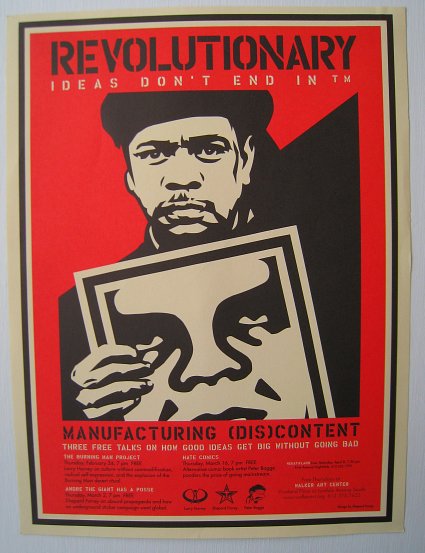
Manufacturing (Dis)content: Shepard Fairey in 2000


Nine years ago next week, back when Shepard Fairey was big enough to be the subject of a documentary, but well before he became a household name, he came to the Walker Art Center for a lecture series about "how big ideas get big without going bad." David Logan (now Kennedy-Logan) came up with the list of speakers -- Fairey, Burning Man founder Larry Harvey and HATE comics artist Peter Bagge -- and the Chomskyan series title, "Manufacturing (Dis)content." (Five years later, that would become the title of a book by Michael Perelman.) And he turned to me to help with the marketing concept.

From the start, we wanted to collaborate with Shepard on a poster, but it took some time for us to come up with a compelling concept. (I remember one headline favorite -- "Pissing in the mainstream" -- which we knew wouldn't fly with our institutional bosses.) Eventually, we agreed upon the lline "Revolutionary ideas don't end in ." In retrospect, the trademark symbol perhaps didn't read clearly, but at the time we felt it conveyed the spirit of the series: how can good ideas take off without being co-opted, commodified or watered down.

Shepard created the imagery for the poster, appropriating an image of a beret-wearing African American man he's used on other pieces since. We also commissioned him to make a series of four buttons for the Walker's Target Free Thursday Nights. (I couldn't find a copy of the fourth one, but I remember it vividly, a fistful of dollars and the words "Free Enterprise.")

Here's the final poster:
Shepard Fairey

Bits: 02.14.08


Mural by Minneapolis' Broken Crow, a.k.a. John Grider

• As Steve Dietz at Northern Lights ponders whether the iPhone and iPod Touch are "new spheres of public art," his Minneapolis-based digital-art organization curates Add-Art, now through Feb. 26. Artists featured on Add-Art, a Firefox extension that replaces online ads with art, include Jodi, Jennifer and Kevin McCoy, Vivian Selbo and others.

Roadsworth: Crossing the Line, the new documentary about Montreal "street" artist Peter Gibson, makes its US debut at SXSW, through Feb. 21. Watch the trailer.

• Word of the day: Misconceptual art, "artists who shortcut to the now via conceptual art without understanding history of conceptualism."

This posting by the Vigilance Organisation in India (shot by my friend Kate) could be a Jenny Holzer Truism: "Moral contempt is a far greater indignity and insult than any kind of crime."

• Christie's reports a 19 percent decrease in art sales (down to $5.1 billion) from 2007 to 2008. Plus, C-Monster gets a whiff of Greed.

• Dude loves him some Bon Jovi: Jeremy Fry captured on the Celtics Jumbotron.

• In honor of Valentine's Day, here's some meat.

2.13.2009

Minneapolis homeless to announce "takeover" of foreclosed homes on Valentine's Day

While delivering a where’s-the-love message on Valentine’s Day may seem like a gimmick, an action by homeless advocates to be announced this weekend is anything but a stunt, according to its organizer. On Saturday, Cheri Honkala (above, center) of the Poor People’s Economic Human Rights Campaign will reveal to members of the media its long-running project to find housing for homeless people in some of the many foreclosed and vacant homes on Minneapolis’ North Side and South Side.


Photo: Harvey Finkle

Bits: 02.13.09

Detail from the Radical Islam t-shirt via FiddlyIO.

• I've heard of seat-fillers, but for architectural firms? After massive layoffs, a firm boss "was offering $100 cash to employees' friends who could come in during the meeting, sit at desks, and look busy" -- all for the benefit of an important client.

• Photojournalism bits: NEED magazine has a nice gallery of Nepalese girls spared from human trafficking, and the World Press Photo of the Year goes to a news shot of a sheriff clearing a home after an eviction.

• With all due respect to Twin Cities illustrator Mary GrandPre, M.S. Corley's speculative Penguin Classic-style book covers for the Harry Potter series are a refreshing change of pace. Via Curate.

Vito Acconci on VBS.tv, via Culturebot: "The great thing about words is they seem so definite but they're so hazy and cloudy."

• This starts out as a bit of classic culture-jamming, but then gets weird: Shoppers in Grand Forks return to their cars to find fake parking tickets on their windshields, with a note to go online to see evidence of their infraction. When they get there, malware is downloaded to their computer.

• Improv Everywhere wants to give you a high-five.

Pie chart of pie-shaped light.

2.12.2009

Bits: 02.12.09


A page from the tome created to rationalize Pepsi's multi-million-dollar logo tweak.

• Pepsi logo tweakers seem to see branding as a metaphysical art. The overinflated design rationale behind the minor noodging of the Pepsi logo is either an elaborate joke, a con job or as Gawker puts it (referencing the title of the branding document) "Breathtaking bullshit."

• Dave Combs of PEEL Magazine, who was with Shepard Fairey when he was arrested last week, writes: "
It is my belief that the Boston Police Department had carefully planned to serve their warrants in front of an audience of approximately 800 excited Shepard Fairey fans, some of whom had reportedly paid as much as $500 on Craigslist for a ticket to the event. In my opinion, the BPD had at the very least set out to make a public spectacle of the arrest, and at worst were intent on provoking the agitated crowd to riot. They clearly had it out for Mayor Menino, and had engineered the perfect scenario with which to simultaneously tie Menino to a 'criminal graffiti vandal' and conveniently show up to be the heroes of their own story."

• Milton Glaser finds "the relationship between Fairey’s work and his sources "discomforting."

• A new Americans for the Arts study, "Arts and Economic Prosperity III," finds that "[n]ationally, the nonprofit arts and culture industry generates $166.2 billion in economic activity every year—$63.1 billion in spending by organizations and an additional $103.1 billion in event-related spending by their audiences."

• When I worked in advertising years ago, we sent a rubber monkey named Weegee on the road -- with Beck and the Old 97's, to Paris and Washington -- and now Weegee's kin, a plush monkey, is making the rounds at MoMA.

• I will read this and then write a proper blog post on this, I will! Marco Deseriis and Brian Holmes on "
today’s dilemma of producing critical culture within recuperative ‘ semiocapitalism’."

• Finally, the quote du jour comes from Cloaca-maker Wim Delvoye: "This machine doesn't just make poop, it makes reflection, it asks questions. It is a big metaphor for art creation: digesting influences from other artists and making it your own."

2.11.2009

Trailer: Our City Dreams


"Our City Dreams," on view through Tuesday at New York's Film Forum, is a new documentary by Chiara Clemente (daughter of artist Francesco Clemente) that features five women artists: Swoon, Kiki Smith, Ghada Amer, Nancy Spero and Marina Abramovic. While it's conceived as a "love letter" to New York, the trailer suggests a strong Minneapolis connection, too: Kiki Smith (above) is interviewed at the Walker Art Center, and Swoon is shown at the local launch site for the Miss Rockaway Armada. Watch the trailer.