12.12.2006

A white wall for Darfur.

Via networked_performance, here's a nice way to remember those killed in Darfur--and help those still alive: The Darfur Wall has forty panels bearing gray numbers from 1 to 400,000, representing each of the people killed since 2003 in northern Sudan. Spend a dollar (or more) to turn each number from gray to bright white, and eventually, a dismal gray wall will be illuminated. Every penny of funds raised will go to these four organizations:
The Darfur Foundation, creator of the piece, writes: "As we light the wall, we acknowledge the importance of each life lost, we cast light upon a tragedy too many have ignored, and we overcome one barrier to peace."

Earlier: "The Darfur Meme" and "With Darfur in 'free fall,' can Congress transcend partisanship?"

Another way to help: This afternoon I interviewed Dr. Ellen Kennedy, a sociology and anthropology professor who oversees the University of St. Thomas' Genocide Intervention Network chapter (more on her interview soon). She told me of the "Ten-for-Ten" program: instead of receiving Christmas gifts this year, students are asking ten relatives to give $10 each to the national GI-Net office. If you'd like to give the "gift of safety" to civilians in Darfur, send your (tax deductible) gift to:

Genocide Intervention Network
"Ten for Ten" Campaign
1333 H Street NW
Washington, DC 20005,

Homosexuality's milky origin revealed!

Soy Toys? Tofoofs? Edamame's Boys?

According to conservative news site WorldNetDaily, soy milk turns boys gay!

James Rutz of Megashift Ministries writes:
Soy is feminizing, and commonly leads to a decrease in the size of the penis, sexual confusion and homosexuality. That's why most of the medical (not socio-spiritual) blame for today's rise in homosexuality must fall upon the rise in soy formula and other soy products.

I Swear: CO radio host challenges Ellison's ethics, morality

Colorado AM radio host Mike Rosen questions whether Keith Ellison can "ethically and morally hold office" if he wishes to have a private swearing-in using the Quran instead of the bible (he also calls Ellison "a follower of Louis Farrakhan," despite Ellison's repudiation of the Nation of Islam's "propagation of bigoted and anti-Semitic ideas and statements.")

During his December 8 broadcast, Rosen said:
One of the reasons that traditionally people have taken oaths -- either serving as witnesses in trials or defendants, or being sworn in with the oath of office as president or a member of Congress -- one of the reasons people have put their hands on a, on the Judeo-Christian Bible -- which includes the Old Testament and the New -- is that this is one of the foundations of Western civilization, and it's also one of the foundational sources of our law. Moses was known as the lawgiver. The Ten Commandments have -- have had a great deal of influence over the creation of law in Western society. So it's consistent with that part of our society that qualifies as Caesar's element -- render unto Caesar what is Caesar's -- for people who serve in law-making and governing capacities to take an oath consistent with our foundation. For those who really believe that the Constitution is blasphemy, at least in parts when it conflicts with Islam -- these people have a right to their religious beliefs and they can operate in our society. But the question is, can they ethically and morally hold office?
Rosen's mention of courtroom procedures, however, fails to recognize that the bible needn't be used to swear in witnesses in court proceedings. Last summer, when Muslims in North Carolina attempted to donate copies of the Quran for courtroom oaths (and were refused), the Christian Science Monitor wrote:

Already, witnesses in American courts do not have to take a religious oath and can instead simply testify on pain of perjury. It's up to judges to decide what passes for an oath.

Most have apparently given other oaths wide latitude. In a federal terrorism case in 1997 in Washington D.C., for instance, the judge allowed Muslim witnesses to swear to Allah. And the practice isn't new: Mochitura Hashimoto, the Japanese submarine commander who testified in the court martial of a US Navy captain in 1945, was allowed by a military tribunal to swear on his beliefs of Shinto, the ancient religion of Japan.

As to Rosen's mention of the Ten Commandments, a letter from Thomas Jefferson to Thomas Cooper in 1814 casts doubt on this notion:
[I]n answer to Fortescue Aland's question why the ten commandments should not now be a part of the common law of England? we may say they are not because they never were made so by legislative authority, the document which has imposed that doubt on him being a manifest forgery.
Further, Jefferson writes, British common law--which the American legal system is largely based upon--was established in England before Christianity arrived there:
...Christianity was not introduced till the seventh century; the conversion of the first Christian king of the Heptarchy having taken place about the year 598, and that of the last about 686. Here, then, was a space of two hundred years, during which the common law was in existence, and Christianity no part of it...."
[Cross-posted at Minnesota Monitor.]

Quoting Kofi

Annan's speech yesterday:

[A]s Truman said, “If we should pay merely lip service to inspiring ideals, and later do violence to simple justice, we would draw down upon us the bitter wrath of generations yet unborn.” And when I look at the murder, rape and starvation to which the people of Darfur are being subjected, I fear that we have not got far beyond “lip service.” The lesson here is that high-sounding doctrines like the “responsibility to protect” will remain pure rhetoric unless and until those with the power to intervene effectively — by exerting political, economic or, in the last resort, military muscle — are prepared to take the lead.

And: as the UN Human Rights Councils holds a special session on Darfur today, the US General Accounting Office reveals that six of the State Department's Darfur death toll estimates had "methodological strengths and shortcomings" but "none appeared very accurate."

12.10.2006

Darfur: The Meme.

Elie Wiesel, a Holocaust survivor, has used the G-word in describing the situation in Darfur, Sudan. So has Colin Powell, George Clooney, the US House of Representatives, Madeleine Albright, George W. Bush, and millions of demostrators worldwide.

So why, for the third year running, does genocide continue in Darfur?

It's complicated, doubtless, but if we claim to be a "never again" nation--a "culture of life" that won't stand for another Rwanda, another Holocaust--why isn't preventing the rape, murder, and displacement of millions an urgent priority? If we're moral people, how can this continue?

Pressure has been exerted on all fronts--in state houses and the UN General Assembly, on streets by protesters and by tireless media figures like Nicholas Kristof. As a meme that stands in for massive human suffering, "Darfur" has to take off and permeate all aspects of our world, so the willfully ignorant or the otherwise distracted can be that way no longer. Both as recognition and a call-to-action for demonstrators, legislators, graffitists, artists, bloggers, interventionists, benefactors, gamers, and others, here's a run-down of innovative ways of passing Darfur-awareness memes. Can art and protest, graffiti and YouTube change the world? Probably not, but as part of a relentless and multi-faceted effort to change minds, maybe it can help.

Pass it on...

YouTube: We saw it used, to great effect, in the midterm elections, and activists are using it for Darfur. This one features bits of rally speeches by Tom Lantos (the only Holocaust survivor to serve in Congress), Barack Obama, George Clooney, and others before offering the testimony of The Lost Boys of Sudan, who at ages 6 and 7, saw their parents murdered in front of them. Below that, a homemade YouTube Darfur plea.

Last month, the U.S. Holocaust Memorial Museum projected wall-sized images of the genocide on the side of their building. A partnership with the traveling exhibition Darfur Darfur, the project--headlined "Our Walls Bear Witness"--serves the dual roles of educating and challenging us that "not on our watch" can this continue. That an institution focused on the world's most horrifying genocide is doing it links the suffering in Sudan to the murder of millions of Jewish people, making clear: a Holocaust is what we'll have if we don't act.


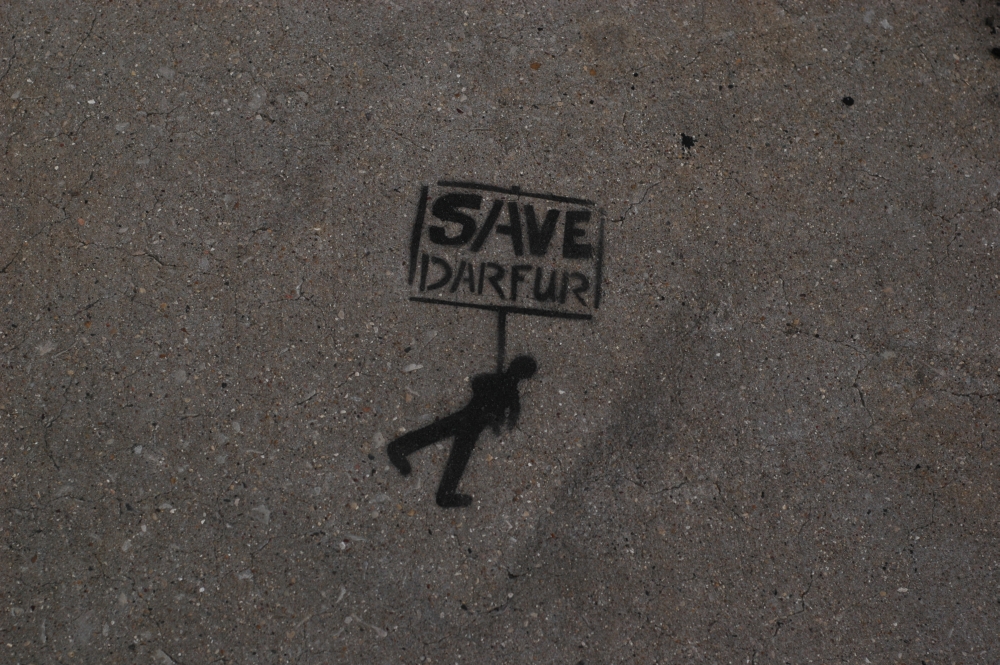
Flickr pools pass the meme, including this street stencil, a tiny reminder on the pavement in Edgewater.

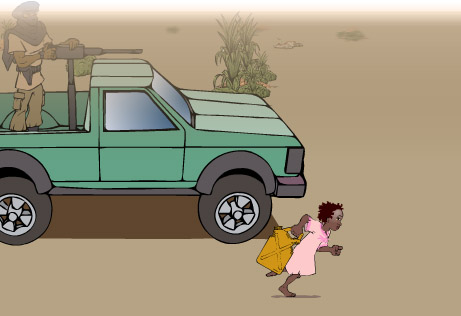
Darfur is Dying is a video game that illustrates life in northern Sudan. The free online game created by MTV has two parts. In the first, you can pick one of eight characters--from 10-year-old Deng to 30-year-old Rahman--to forage for water. Hiding from Janjaweed militias can be tough, and if you're caught--and, likely, raped and killed--that character disappears next time you play. The second part simulates life in a refugee camp, putting yourself in the place of those struggling a world away. Naturally, it includes background on the crisis, action steps, and an email-a-friend function.

Finally, this isn't a meme, but it could be. Searching for a map of Sudan, I stumbled upon this image showing the tiny town of Darfur in Minnesota. What if Darfur was in the US? Would we wait this long to ensure the safety of millions of people?
Of course, there are dozens of sites selling merchandise with proceeds going to Darfur awareness initiatives and humanitarian relief in Sudan. Become a walking billboard with t-shirts, the Save Darfur Yarmulke, wristbands, etc. And bloggers, consider putting up an anti-genocide link bug to the Genocide Intervention Network on your site. (Also, from GI-Net, "ten things you can do right now.")

Genocide Intervention Network

Premature Christmas Card

The Daily Irrelevant:
Every year, the premature baby unit at Edith Cavell hospital sends cards to the other departments as well as to some ex-patients. This year, they sent this card in Mid-October. When you open it you see the message:

It’s a little premature, but Happy Christmas.

12.09.2006

The Nietsche Family Circus

"The Nietzsche Family Circus pairs a randomized Family Circus cartoon with a randomized Friedrich Nietzsche quote."

Zogby polls yuks.

I just got a call from Zogby: they're doing a poll on comedy. I had to laugh when the guy who probably earns most of his paycheck polling on presidential approval ratings and voting preferences had to ask me whether I found a "Yo Mama" joke funnier than "racist, homophobic, or anti-religious" jokes, knock-knock jokes, etc. It was somewhat difficult: I've never thought about which age group is most gifted at the comedic arts (how old is Jon Stewart?), whether large people are funnier than people with average body types, whether gays and lesbians are more hilarious that straight folks, blacks are funnier than whites, etc.

The easiest to answer (and please make note of it): No, I don't forward email humor.

With Darfur in "free fall," can Congress transcend partisanship?

US politicians on both sides of the aisle have spoken out about the civil war in Sudan that has killed some 400,000 people and displaced two million more--including a unanimous House vote that defined the violence as "genocide." But in the two years since Congress spoke in that unified voice, there's been no major change in Darfur. This week the UN's departing humanitarian chief said Darfur is in "free fall" and outgoing UN head Kofi Annan decried the "shameful passivity" of world governments who have all but ignored this "new Rwanda."

So: is American bipartisanship real in a legislative sense?

No, according to the Darfur Scorecard, run by the nonpartisan Genocide Intervention Network. It ranked every member of the House and Senate based on factors including votes on bills that could affect change in Darfur, from the Darfur Peace and Accountability Act to measures seeking to increase humanitarian aid. In the Senate, those with the highest scores were overwhelmingly Democrats and those with the worst were Republicans.Eight of 10 members who received F scores were Republican, and congressional members receiving grades D through F outnumbered Democrats by 164 to 14. On the other hand, politicians with scores of A and A+ were also mostly Democrats: 120 Democrats versus 19 Republicans (independents Joe Lieberman and Bernie Sanders are also in this group).

In Minnesota, however, Senators Norm Coleman and Mark Dayton both scored As. In the House, Republicans Gil Gutknecht and John Kline bottomed the rankings with Ds. Topping the list were Betty McCollum with an A+ and Oberstar with an A.
Partisanship, of course, isn't the issue: change for the civilians suffering in Darfur is. It's been more than two years since George W. Bush announced that "The world cannot ignore the suffering of more than one million people" in Darfur. As more than 1000 faith communities across the country are now observing a prayer weekend for Darfur, plan to check back here for Darfur news and analysis on whether the 110th Congress and its majority Democrats can do what the Republican House and Senate didn't--bring relief to civilians in Darfur.

[Cross-posted at Minnesota Monitor. Image via the American Refugee Committee's Darfur Project.]

12.07.2006

HBO hires Thais to play corpses in tsunami series

While the Indian Ocean tsunami of December 2004 might seem like ancient history, to people in affected areas, it's not. Consider: after the "largest forensic operation in history," Thailand finished burying the last of its nearly 5,400 dead this week. Another 3,000 have never been found. And, another 270,000 people in neighboring countries were killed or missing.

So today's reports of outrage at the filming of an HBO miniseries Tsunami: The Aftermath on the Thai coast is certainly understandable. That the film crews is hiring Thai people to play corpses in the production--at a third the rate they're paying western extras--is almost beyond belief.

The two-part series, starring Tim Roth and focusing largely on the plight of foreign tourists in the disaster, is scheduled to air its first episode on the tsunamis second anniversary, December 26. That focus is telling: The Nation reports that Thai extras are being paid 400 baht per day (around $10) to be in the film while western extras were making 1500 baht for the same work.

"It doesn't make me very happy that they [the film-makers] are making money out of this," said Reynolds, a 10-year resident of Krabi whose five businesses were "all but wiped out" in the tsunami.

He said the mini-series' focus on Western tourists distorted the reality of what happened. "It's tragic that so many tourists died and that so many lost family members, but Thais lost everything. They had no homes to go back to," he said.

12.06.2006

Filthy rich, dirt poor

"The richest 2% of adults in the world own more than half of all household wealth, [while] the poorer half of the world's population own barely 1% of global wealth."

Source: World Institute for Development Economics Research

"Hummer that breathes"

At last, a non-deplorable Hummer! Unveiled at the L.A. Auto Show's Design Challenge, this prizewinning Hummer has "algae-filled body panels that would convert carbon dioxide exhaust gases produced by the vehicle's engine into pure oxygen." Available at a dealer, well, nowhere, the concept, by GM’s West Coast Advanced Design Studio, is now just a series of 2D renderings.

12.05.2006

New warnings.

A new generation of warning signs, via Fallon.

eBay: Castle for sale

Minneapolis' Van Dusen Mansion, a castle-like complex built in 1892 in an eccentric Richardsonian Romanesque-meets-French Renaissance architectural style, is being auctioned at eBay. With annual taxes of around $75k and a current bid of $3,550,100 (that's $100 more than the previous bidder), the 23,000 s.f. residence has no buy-it-now price.

50 works of art to see before you die

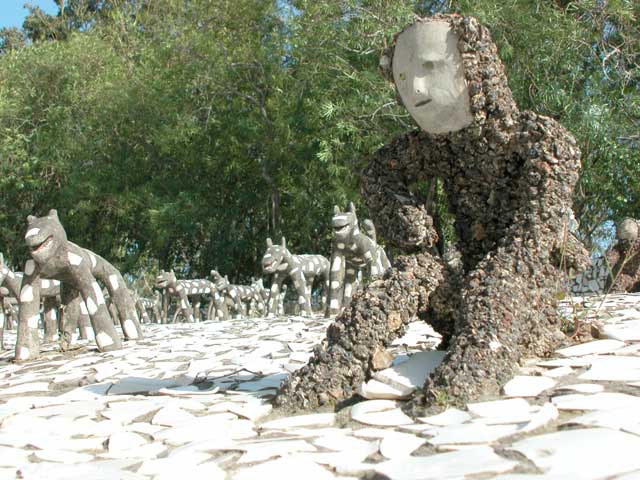
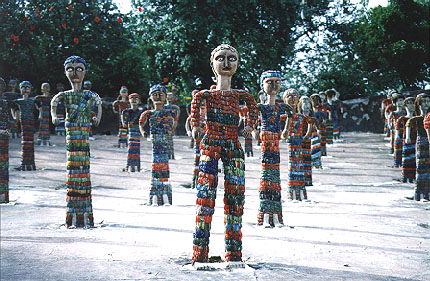
The Guardian's Jonathan Jones asked blog readers to help him compile the top 50 artworks worth a once-in-a-lifetime viewing. The final list runs the gamut from Antony Gormley's Angel of the North (above) to Constable's The Hay Wain, The Mark Rothko Chapel in Houston to Smithson's Spiral Jetty. But it's not all western art: The Alhambra, San Rock Art in South Africa, Iran's Masjid I-Shah Mosque, and the Terracotta Warriors in Shaanxi Province, China, also get mentioned. One I'd add, but haven't yet seen: Nek Chand's Rock Garden in Chandigarh, India:
In 1951, Nek Chand was hired as a roads inspector to help construct LeCorbusier’s master plan for the new capital city of Chandigarh in northern India. When not laboring in service of the great architect’s vision, Chand quietly carved out a secret legacy of his own in the jungle outside town—one that eventually trumped the great Corbu’s city of Chandigarh.

To give LeCorbusier a blank slate to design an entire 240-acre city, the shining symbol of a modernizing India, twenty villages had to be razed. Chand worked in a secluded clearing under cover of darkness for 18 years transforming scavenged materials from that rubble into mosaic-tile trees, monkeys, bears, men, women, walls, and waterfalls--all using the newest construction techniques he picked up during his day job. He created some 2,000 sculptures by the time his illegal Rock Garden--created without permission on government land--was discovered in 1972. Despite countless threats to destroy the garden--one in which a human wall prevented bulldozers from plowing a roadway through the park—Chand’s work still stands, a symbol of his autonomous spirit.

(Nek Chand photos courtesty the Nek Chand Foundation, except for the last one, by Carl Lindquist.)

12.04.2006

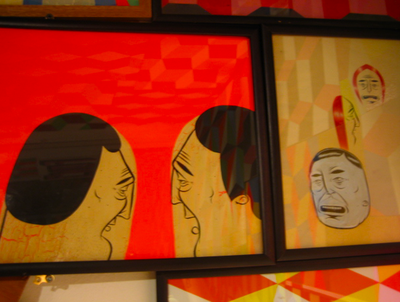
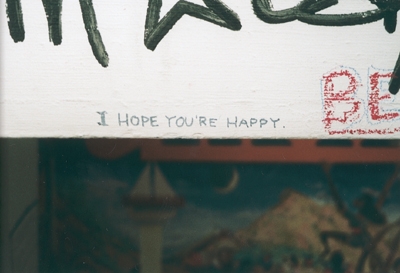
On View: Barry McGee


Via Unbeige, an excuse to show more images by Barry McGee, the exhibition Do Not Stack at LA's Robers & Tilton.

Special thanks...

I got a surprise email from a reader today: the author of a great blog on issues near and dear to me (and you, possibly, if you're reading this), she emailed to tell me my Paypal account wasn't working correctly. Once I fixed it, she made a generous donation to keep Eyeteeth going. Thanks to her; and, to anyone who's (unsuccessfully) tried to make a Paypal donation over the past several months, my apologies for the technical difficulties. Things are up and running correctly. And, again, thanks unnamed benefactorperson.

Written on the city.

Earnest, sometimes funny, occasionally profane, and once-in-a-while surprising: text-based graffiti compiled at written on the city. Especially bizarre is this series of flyers in San Francisco expressing CIA paranoia.

Earlier: Written on North Minneapolis, "Love thy bro."

Ghost bike for Eric Ng

For a year and a half, Eliot and his friends at Visual Resistance have been making "ghost bikes" throughout New York, but today he posts that he had to make one of these white-painted bikes--memorials to cyclists killed by cars--for a friend, 22-year-old NYU grad Eric Ng, who was run down on a bike path by a drunk driver. Through his eulogy for Eric—he remembers the math and history major as a "body full of honest energy and a face like contagious hope"--he potently conveys the message of the white bikes, to remember those who've died and remind the rest of us to slow the hell down and respect the safety of those on two wheels.

Republican calls for Castro's assassination

The Church Committee discovered at least eight CIA plots to assassinate Fidel Castro between 1960 and 1965 alone. Now, when the indefatiguable dictator seems, well, fatigued, a Republican Congresswoman in Florida is overtly calling for his assassination, in violation of several laws (this legal opinion by John W. Dean, which discussed whether Pat Robertson broke the law in calling for the killing of just-re-elected Venezuelan president Hugo Chavez, seems to apply to Ileana Ros-Lehtinen's statement that she'd "welcome" the murder of Castro.)

Jesus Camp on GoogleVideo

Jesus Camp, the film about a now-closed "Kids on Fire" bible camp by documentarians Heidi Ewing and Rachel Grady, keeps racking up awards like the Special Documentary Jury Prize at Tribeca and the Sterling Award at SilverDocs. Now you can watch the entire film at GoogleVideo.

Via Digg.

Fimoculous includes Eyeteeth in year's best

Fimoculous' Rex Sorgatz, a former Twin Cities resident now living in Seattle, had some awfully nice things to say about Eyeteeth in his roundup of best blogs for 2006. Check out his list of 30 "Best Blogs of 2006 That You (Maybe) Aren't Reading."

Prompts a question: what are the best under-the-radar blogs you're reading? Leave 'em in the comments.

12.03.2006

Comparing greenhouse emissions

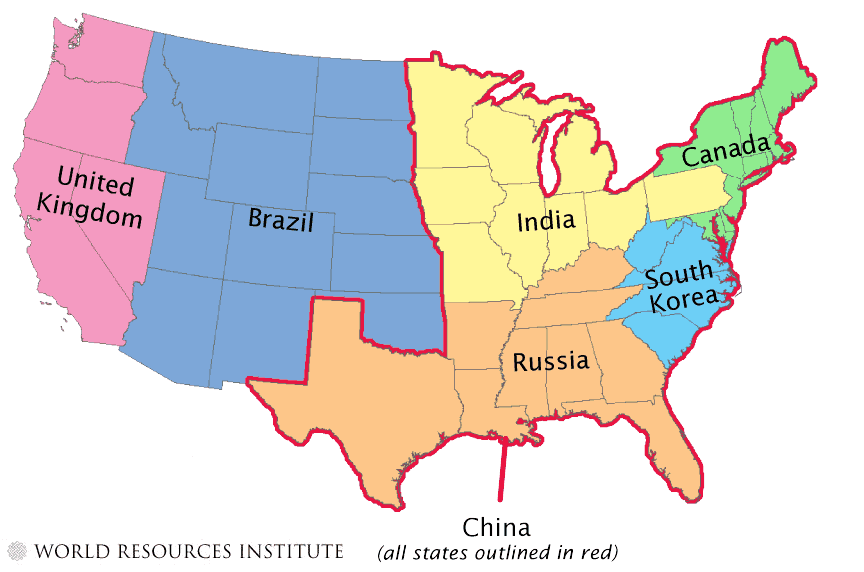
World Resources Institute illustrates America's disproportionate emission of greenhouse gases compared to other countries:
When it comes to climate change, states make a difference -- even when compared internationally. If states were ranked individually, six states -- Texas, California, Pennsylvania, Ohio, Illinois and Florida -- would rank among the top 30 emitters internationally.

This map, featured in Science magazine, shows how regions within the U.S. compare to major emitters. The lower 48 states are approximately equivalent to China, Brazil and the United Kingdom combined: or the United Kingdom, Brazil, Russia, India, South Korea and Canada.

Coloring commandos

Sinosplice's John, a grad student in linguistics in China, found this military themed coloring book published by the Beijing Children and Juvenile Publishing House. The book's cover features a cartoony image of two helmeted kids and a gun-wielding dog riding a tank.

Banksy Industries

As street-artist/provocateur Banksy sees prices for his artwork go through the roof, his streetside guerrilla stencils are in demand too. So much so a group of men dressed as workmen recently entered a run-down building in Liverpool in a foiled attempt to steal a rusted door marked with one of the artist's signature rat pieces.

Banksy's new works, on view in a new show on London's Oxford Street called Santa's Ghetto, include a piece (reportedly bought by Brad Pitt and Angelina Jolie) in which Michael Jackson appears in a reimagining of Hansel and Gretel.

11.30.2006

Rotary Reader

From Proceedings of the Athanasius Kircher Society comes this wonder, a rotary desk that allows a person to keep up with multiple books at once. Designed in 1588 by Italian engineer Agostino Ramelli, "with this sort of machine a man can see and read a great quantity of books, without moving his place: besides, it has this fine convenience, which is, of occupying a little space in the place where it is set."

11.28.2006

Build-a-Bert

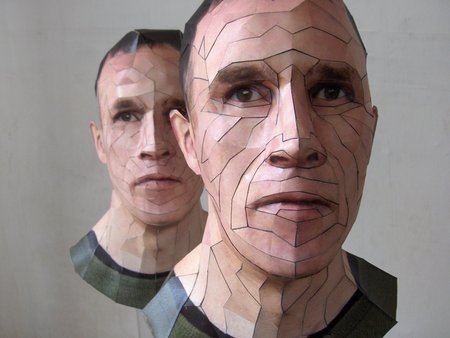
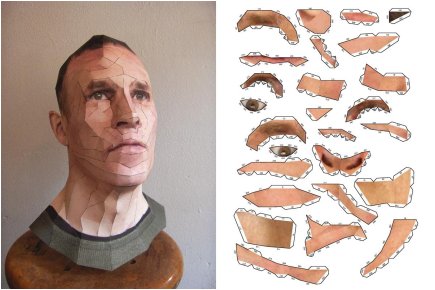
Using a computer-modeled wireframe head from a previous project, artist Bert Simons "cloned" himself, making a cut-out replica of his noggin to keep around the house. He even provides a pdf so you can build your own. Final version above, beta version below.

Via PlaceboKatz.

Eyeteeth Elsewhere

FYI: the interview I did with NEED co-founder and editor in chief Stephanie Kinnunen is now online at Worldchanging, and a piece following a rumored newsroom shakeup at the cash-strapped St. Paul Pioneer Press is at Minnesota Monitor.

Conservation.

Headline: "If you don't preserve nature by installing solar panels, who will?"

One in a series. Via reBlog.

Enough

Nice concept for a Denver water conservation campaign. Could apply to just about anything--oil, electricity, food...

11.27.2006

Filling a NEED: "LIFE for a new generation"

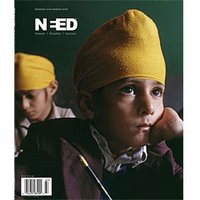
Flip through the premiere issue of NEED, a new magazine produced in northeast Minneapolis, and you'll be confronted: with horrifying before-and-after photos of Marthaline, a Liberian woman, whose tumor growing in her mouth the past three years was beginning to suffocate her, prompting her to buy poison to end her suffering. With a quote by a Minnesotan named Patrick who "got lost" looking for a bathroom while passing through New Orleans four months ago and ended up staying there to help rebuild the city. With the faces of young girls--their eyes blurred out to protect their identity--who'd been rescued from the sex trade in Cambodia, bursting into laughter over cans of Sprite.

But the confrontation isn't about guilt or shock, but hope: you can't help but be moved by how much people are pitching in to help those in need--and how little it takes to remove a benign tumor, pick up a hammer, or provide supplies for groups giving girls hope after being sold into sexual slavery.

The brainchild of Kelly and Stephanie Kinnunen, NEED launches today with a print run of 25,000 copies and the simple mission of giving exposure to humanitarian aid organizations that do good work. Beautifully designed and printed, perfect-bound, and filled with full-bleed photographs by photojournalists including Steve McCurry, the publication avoids the political, instead putting its energy toward connecting potential donors and volunteers for humanitarian causes with the beneficiaries of that work.
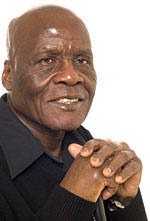
The inaugural issue begins with an introduction to Timon Bondo, a 70-year old Kenyan man who lives in Golden Valley and has almost single-handedly raised funds to build two schools and a healthcare center in his AIDS-ravaged village Rabondo. His successes have come mainly through cold-calling--and despite one major obstacle: he's blind. But Stephanie Kunninen says NEED didn't feature Bondo's work simply to raise awareness of Rabondo or Bondo's work, but to also highlight how the man sets about helping his village.

"If you want to help a little girl with a school uniform, he won’t let you buy a school uniform. You buy fabric; then he utilizes one of the local seamstresses and pays her to sew the uniform for the child," she says. "One widow is taking care of 12 of her grandchildren because her husband and children have died from AIDS. So she makes bricks in her front yard while the children go to school, then when Timon does a building project, he buys the bricks from her instead of from the wealthy businessman in Nairobi."

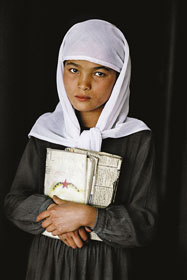
The issue also features an array of aid programs around the world, including literacy programs in Afghanistan (McCurry's ImagineAsia among them); the floating MercyShips hospital that removed Marthaline's tumor (and those of many others); and Right to Play, a group founded by Olympic speedskating gold medalist Joey Cheek that uses sports as a platform to teach kids around the world about healthy living. Issue 2 will look at child soldiers in northern Uganda, Colombia's population of "internally displaced people" (the country has the world's second largest population of IDPs), and Wings of Hope, to name a few.
The magazine, which sent out its first 2,500 issues over the past weeks, is a hit with philanthropists and nonprofits, says Kinnunen. She reports that a big supporter of the UN's Refugee Committee, the UNHCR, ordered 100 subscriptions for friends and family, plus bought up 1,350 issues to send to the organization's top monthly donors. But the Kinnunens are surprised at the buzz beyond this insider community.

"We’ve received a subscription from an inmate at Moose Lake Prison, a 16-year old high school student in Prior Lake, Minnesota, an order of nuns in north Minneapolis, a woman in Virginia who owns a tattoo parlor," she says. "NEED's demographic has become all across the board. Even my mother’s friends are clamoring for this."

But the early success has also earned other key endorsements: President Jimmy Carter agreed to an interview in the debut issue, and an impressive array of celebrated photojournalists have signed on. More remarkable is that group's assessment.

"We hear over and over and over again from photographers, 'This is the new LIFE Magazine for our generation of photojournalists.' That’s such a huge compliment to us," she says. "How could we ever—I mean, we’re six people in a warehouse office in Northeast Minneapolis! To hear this could be the next LIFE magazine is such an honor and shock, almost."

We hear over and over and over again,
"This is the new LIFE Magazine
for our generation of photojournalists."

The magazine is also compared to another famous publication, one heralded for its edgy design and unflinching portrayal of graphic suffering in the world--Oliviero Toscani's COLORS. Kinnunen says wherever she and her husband have lived--most recently, they lived in Finland, where Kelly taught at a university and Stephanie taught business English--they sought out each issue of the publication. "We love the imagery of COLORS Kinnunen says wherever she and her husband have lived--most recently, they lived in Finland, where Kelly taught at a university and Stephanie taught business English--they sought out each issue of the publication. "We love the imagery of COLORS. We love the storytelling of colors, but again, we're inspired by contact. There's no way for us to become involved with the something. Thgat's the one thing we didn't like about COLORS."
The production value of NEED, however, is on par with COLORS', using full-color photos, with text as backup, to tell its stories. And NEED's art-magazine price tag of $9 seems to reflect that quality. But the Kinnunen's, who funded the magazine entirely with their own savings and their now-maxed-out credit cards, believe the cause is worth the price tag. "We have a 19.5% ad ratio to content, when we’re full. So if we’re full of ads, there’s 19.5% and you’re getting the highest quality printing, photography, and uninterrupted stories for nine dollars—if that’s to value of you, you see $9 as quite inexpensive. If you see $9 as too expensive, we do have a great website where people can get involved," Kinnunen says.

But, more convincing is her argument of the need for such production values. On one hand, she and Kelly were inspired by the director of a refugee shelter Kelly volunteered for in Greece years ago; he refused a load of bread from a baker who "was trying to pass off day-old bread" on the shelter residents, retorting, "Just because these people are poor doesn’t mean they don’t deserve the very best."

"So often aid organizations have such small budgets, and they don’t want to sacrifice their budgets that are going to directly helping people in need to promoting their work and connecting potential supporters to their work," she adds. "We wanted to help in that way. How do we help the people who are helping the people on the ground and showing the people in need in a dignified way?"

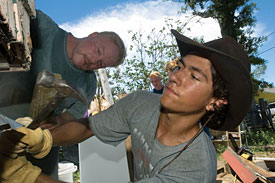
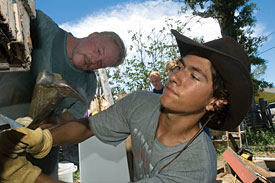
Photos (top to bottom): Cover of NEED, an Afghani boy in school, by Steve McCurry; Timon Bondo by Justin Grierson; Afghani Girl by Steve McCurry; a volunteer with a homeowner in New Orleans, by Leslie Spurlock.

More on NEED: Read my interview with Kinnunen at Worldchanging, plus Brian Lambert's "Disaster Glam."

11.22.2006

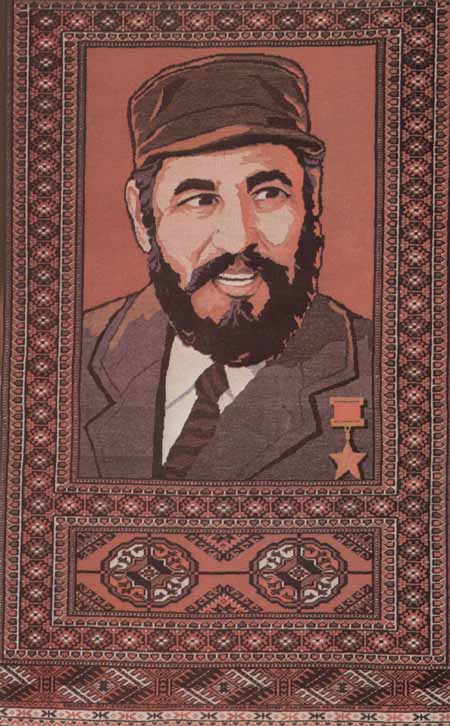
Castro carpet...


and other propaganda rugs of the Soviet Union.

Rest in peace, Sister Rita

My favorite nun--and there have been quite a few--died: Sister Rita Steinhagen, peace activist, author, and Sister of St. Joseph, passed away yesterday afternoon. Steinhagen was a tireless opponent of militarism, protesting the School of the Americas in Georgia and organizing countless protests against local defense contractor Alliant Techsystems. At 70, she was incarcerated for tresspassing at Fort Benning and served six months; I was so moved by her chutzpah and resolve, I wrote her there (wish I could find her lengthy and thoughtful reply).

As Doug Grow recounts, she told the judge who sentenced her: "Your honor, I'm 70 years old today and I've never been in prison and I'm scared. I tell you, when decent people get put in jail for six months for peaceful demonstration, I'm more scared of what's going on in our country than I am of going to prison."

So long...

Thomas Hirschhorn's unbuilt book

Two years ago, artist Thomas Hirschhorn visited Minneapolis with a plan: to create a 50-foot-tall effigy of Deleuze & Guattari's classic philosophical text A Thousand Plateaus on a corner of diverse, gritty Lake Street. He loves the "pointless disproportionality" of roadside attractions like the Jolly Green Giant Statue in Blue Earth, MN, and the Big Fish Supper Club in Bena, MN, and so he set out to create a "Road Side Giant" of his own--only this one would serve his passions: for two months this "obscene gift" to Minneapolis was to print a daily philosophy newspaper, present talks by international thinkers, and house both Hirschhorn's residency and a lending library of philosophy books. Alas, the project was never realized, its budget not as outsized as its vision. Read all about it at Off Center.
11.21.2006

Rethinking the brand: Hank Willis Thomas

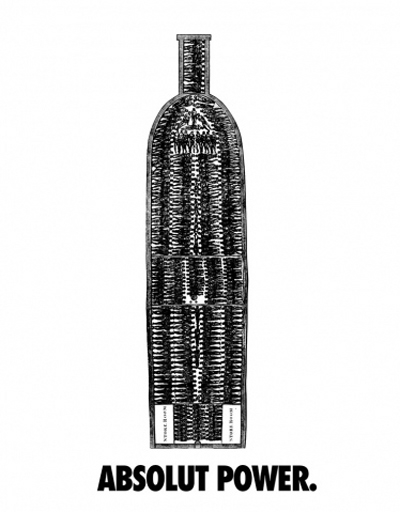
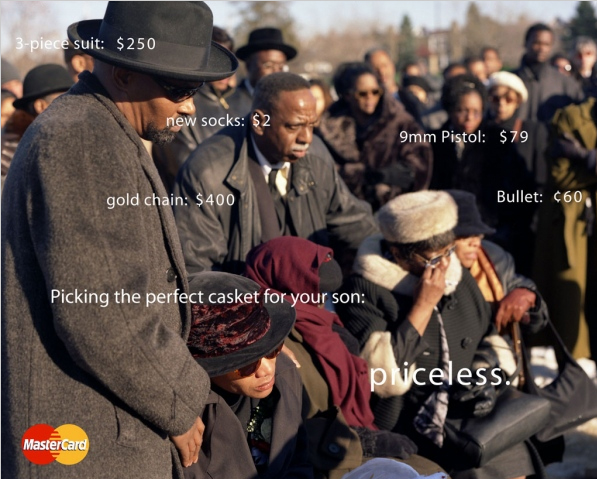
Hank Willis Thomas addresses commodification in his art--specifically, a link between the commodification of African men in the slave trade and the use of black bodies to hawk goods from credit cards to Nikes today. His work deals explicitly with branding, from the product logos plastered on athletes and rap stars to the markings that identified slaves.

But there also seems to be another take on "consumerism"--how capitalism eats up and spits out African Americans, and many of the rest of us as well. His appropriation of the Absolut Vodka ad, in which a slave ship floorplan forms the iconic bottle outline, suggests that our appetites have a price. Similarly, his piece Priceless #1 could be seen as a quick riff on a popular ad--and exploitative of the pictured family--until you hear the backstory.

Thomas says:
I think that the irony of the ideal of the black male body is interesting…it is fetishized and adored in advertising but in reality black men are in many ways the most feared and hated bodies of the 21st Century. The majority of this work comes out of the experience of losing my cousin Songha Thomas Willis – he was killed because he was with someone who was wearing a gold chain. It is this idea – that someone could be killed over a tiny commodity. In NYC in the 1980s, people were killed over sneakers and backpacks. Songha was someone who survived DC when it was the murder capital of the country and then came home to Philly and was killed over a commodity. I want to question what makes these commodities so precious that they are worth defining and more importantly taking another person’s life?

Update: See Thomas' work here. Tyler Green offers his thoughts on Priceless #1 here.

T.

"This is a marketing stunt" t-shirt, by Corporate Hack.

11.20.2006

YouTube: The Allens

Steve Allen interviews Jack Kerouac (late 1960s):


Woody Allen interviews Billy Graham (1959):