3.30.2007

Blood sprays from Minneapolis sewers

I don't know which is more horrifying--that there's blood spurting out of our sewers or the fact that the company responsible for it has a permit to do so:
A Minneapolis city worker is worried about blood in the sewer system because he said, while he was cleaning the system, blood sprayed out of a hole and got all over him.

"We could tell it was blood, I mean large amount of blood," said Minneapolis Sewer Maintenance Worker Ron Huebner.

It happened about two weeks ago in Northeast Minneapolis near a lab that does medical testing and dumps blood into the sewer. It is allowed but the city is now making changes to help protect workers in the future.

"Blood just all over my face, in my mouth, I could taste it. It was terrible. I had it in my mouth and I kept spitting and I couldn't get rid of it," said Huebner.

Huebner said he hasn't been sleeping much. He's worried about the blood that he swallowed when he was operating a jet machine to clean out the sewer.

The Met Council said it was a mix of human and animal blood used in medical testing at this nearby lab.

In fact, the company, R & D Systems, does have a permit to dump blood in the sewer system.

However, Huebner wasn't protected or warned about the blood because his immediate bosses didn't know about.

"We did not specifically know that this particular facility was discharging blood into the sewer system," said Minneapolis Public Works Deputy Director Heidi Hamilton...

Training Hooch

Sure, I grew up eating candy cigarettes and chewing gum cigars, and I didn't end up a smoker, but Disney's new Partyfizz, "a fizzy juice drink aimed at the massive children's party market" seems like a bad idea. Especially since the packaging -- green bottle, foil top, presumably a big-eared mouse somewhere on the label -- is the spittin' image of a real bottle of bubbly. (Activists in Scotland, where 40% of 15-year olds reportedly drink "regularly," are particularly miffed.)

Earlier: Hello Kiddy! A debit card for youngsters.

Pods for passing

From a woman who long worked with natural childbirth techniques comes a natural death product, earth-friendly Ecopod caskets. Made from hardened, 100% recycled paper, the coffins designed by the UK's Hazel Selina take inspiration both from ancient Egyptian sarcophogi and from the form of a seedpod, a metaphor for natural cycles of life and death. Silk-screened versions, overlaid with Thai paper and screened with one of three images, are available for the artfully departed.

Earlier: Helen Nearing recalls her husband Scott's choice to die, unaided by food or medicine. "He said 'All... right,' and breathed slower and slower and slower till there was no movement anymore and he was gone out of his body as easily as a leaf drops from the tree in autumn, slowly twisting and falling to the ground."

Open-source automobile

Called c,mm,n (pronounced "common"), the blueprints of this car, unveiled at the Amsterdam auto show, are available online for modification and adaptation. Better yet, this world's first open-source car is green: according to Core77, it's "a zero-emission, hydrogen-powered 2+2 family car."

3.29.2007

David Lynch on product placement in movies

Apple rips off Christian Marclay for iPhone ad

In his 1995 film Telephones, artist Christian Marclay spliced together snippets of actors from Hollywood films answering phones. Apple contacted Marclay, he says, to get permission to use the concept for a new iPhone ad (above) that debuted during the Oscars.

He refused. They took the idea anyway.

"The way they dealt with the whole thing is pretty sleazy," Marclay says. He talked to a lawyer about taking legal action over the ripoff, but was told "there's nothing I can do about it. They have the right to get inspired."

Contemporary art, of course, is often about appropriation and recontextualizing material, but the brazenness of Apple's move is too bad. Still, Marclay isn't keen on going to court.

"This culture's so much about suing each other that if we want to have anything that's more of an open exchange of ideas, one has to stop this mentality. I'm just honored that they thought my work was interesting enough that they felt they could just rip it off."

The following mini-documentary on Marclay's work (which is fascinating in its own right) features Telephones about 3:40 in.


Via Kottke.

3.28.2007

What art museums can do.

The New York Times' Holland Cotter writes an excellent piece on art museums, where "money is like white noise, so there that you forget it’s there." He cites the building boom in expansion-crazy American institutions, concluding (I think correctly) that "the more successful a museum grows, the more elitist it tends to become." But among the criticisms -- of the crowd-pleasing Picasso shows making the rounds and of conditions that result in curators serving as "personal shoppers to the collectors who swarm through the art fairs" -- is an understated and realistic glimpse of what museums can do. Not a lot, for sure, but something:
One thing it can do — that museums can do — is clear an alternative space in that culture, a zone of moral inquiry, intellectual contrariness, crazy beauty. In this space, artists can simultaneously hold a magnifying glass up to something called “America” and also train a telescope on it: probe its innards and view it from afar, see it as others see it. From these perspectives, they might come up with models of a cosmopolitan, leveled-out society for a country in solidarity with the world, in contrast to the provincial, hierarchical, self-isolating one that exists today.
Also in the Times, a nice report on the Grand Rapids Museum of Art, a new building project expected to get a rare gold LEED rating for green building practices.

3.27.2007

Fundamentalism on the Covers


In the April 2 issue of Time, Americans get treated to a different cover story than the rest of the world. The global editions report on the situation in Pakistan just across the Afghanistan border: "young religious extremists have overrun scores of towns and villages in the border areas, with the intention of imposing their strict interpretation of Islam on a population unable to fight back." Such jihadists, writes Time, are providing cover for al-Qaeda leaders who are training new recruits, and Osama bin Laden is thought to have hidden in these tribal lands, dubbed Talibanistan.

U.S. readers, however, get a cover story called "The Case for Teaching the Bible." The story is teased using this blurb:
Should the Holy Book be taught in public schools? Yes. It's the bedrock of Western culture. And when taught right, it's even constitutional.
It's officially a trend: in September, Newsweek chose to shield American readers from distressing stories about the Taliban, which appeared on the cover of its international editions, instead offering a cover story on celebrity photographer Annie Liebovitz.

3.22.2007

Curry's courage

NBC's Ann Curry on why she's returned to Darfur, Sudan, for the third time in 12 months:
“The real reason, to be perfectly honest, is that as a child when I first learned that there were people who risked their own lives and even the lives of their children, their families, to save Jews during the Holocaust, it was a profound moment for me. It made me question whether I am the kind of human being who would take such risks.”

Kiki's Spring


Artist Kiki Smith contributed artwork on the vernal equinox to the New York Times' Op-Art feature. Happy Spring, all.

RIP Larry Bud Melman

Old-school David Letterman regular Calvert DeForest (aka Larry Bud Melman) passed away this week at age 85.

"Everyone always wondered if Calvert was an actor playing a character, but in reality he was just himself -- a genuine, modest and nice man," Letterman said. "To our staff and to our viewers, he was a beloved and valued part of our show, and we will miss him."


Obama "1984" Creator Revealed (And It's Not Bill Hillsman)

As word comes out who was behind the infamous anti-Hillary Clinton "1984" ad, it's worth noting who was not behind it: Minneapolis adman Bill Hillsman, who created memorable ads for Paul Wellstone and Jesse Ventura, among others. TechPresident caught up with Hillsman, who admitted that he grew up in a Chicago suburb near Park Ridge (where Clinton was raised) and did a similar cut-and-paste style ad for Wellstone (in which Newt Gingrich became Oz and Rudy Boschwitz Ming the Merciless). But he denied involvement with "1984."

No, ParkRidge47, the pseudonymous creator of the Obama ad, was revealed by The Huffington Post to be Phillip de Vellis, an employee at Blue State Digital, a company created by former members of Howard Dean's web team. Per that company's policy prohibiting outside political work de Vellis has been terminated for creating the commercial.

In a guest post at Arianna Huffington's site, de Vellis was unapologetic. "I did it. And I'm proud of it," he wrote. "I made the 'Vote Different' ad because I wanted to express my feelings about the Democratic primary, and because I wanted to show that an individual citizen can affect the process."

And that he did. De Vellis' version of "1984" has been viewed on YouTube 1,897,492 times (and counting).

While he can't take credit for the hacked Apple commercial, Hillsman did praise the message of the spot:

It is a very shrewd attack piece, though, politically speaking. The subtext points up what I have been saying for a year now-- that Hillary has big problems with her base of liberal women (note that the hero in the 1984 spot is a woman, which was key to its success at the time). And if you are for Obama, it really hits at her weak spot-- coming across as a cold automaton even when she thinks she is being friendly and sincere (Al Gore disease).


[Cross-posted at Minnesota Monitor.]

3.21.2007

Joseph Beuys' Second Life

Joseph Beuys' project 7000 Oaks was begun in 1982 with the intent of planting 7,000 trees of various types throughout the city of Kassel, Germany, each beside a basalt monolith (or stele). "The solid stone form beside the ever-changing tree symbolically represents a basic concept in Beuys' philosophy, that these two natural and yet oppositional qualities are complementary and coexist harmoniously," explains the website for the Walker At Center's exhibition Joseph Beuys: Multiples.

Beuys, who died in 1986, didn't live to see the project's completion, but just as the work juxtaposes permanence (death/stone) with ethereal dynamism (life/tree), the project has lived on, spawning others, like a tree-planting effort in Minneapolis in 1997 and, more recently, a re-enactment in the online game Second Life.

On March 16, exactly 25 years after Beuys planted his first tree, artists Eva and Franco Mattes (a.k.a. 0100101110101101.ORG) began a virtual re-enactment of 7000 Oaks. The pair began stacking basalt on the island they own in the game, Cosmos Island. The pair's website reads:
The diminishing pile of virtual stones will indicate the progress of the project, which will go on until all 7000 oaks and stones will be placed. Second Life inhabitants will have the chance to take part to the performance, placing stones and trees in their lands.
Via networked_performance.

"Why I Was Fired."

David Iglesias, one of the eight attorneys general asked to resign by the Bush Administration, writes an op-ed in today's New York Times on his path from a prosecutor with a 95% conviction rate to an out-of-work AG. In part:
I will never forget John Ashcroft, then the attorney general, telling me during the summer of 2001 that politics should play no role during my tenure. I took that message to heart. Little did I know that I could be fired for not being political.

Politics entered my life with two phone calls that I received last fall, just before the November election. One came from Representative Heather Wilson and the other from Senator Domenici, both Republicans from my state, New Mexico.

Ms. Wilson asked me about sealed indictments pertaining to a politically charged corruption case widely reported in the news media involving local Democrats. Her question instantly put me on guard. Prosecutors may not legally talk about indictments, so I was evasive. Shortly after speaking to Ms. Wilson, I received a call from Senator Domenici at my home. The senator wanted to know whether I was going to file corruption charges — the cases Ms. Wilson had been asking about — before November. When I told him that I didn’t think so, he said, “I am very sorry to hear that,” and the line went dead.

A few weeks after those phone calls, my name was added to a list of United States attorneys who would be asked to resign...
And Yahoo reports that "six of the eight U.S. attorneys fired by the Justice Department ranked in the top third among their peers for the number of prosecutions filed last year."

Meanwhile, George W. Bush says he'll oppose efforts to subpoena top aides to testify on their role in what appears to be politicized firings of the AG's. His rationale? He doesn't want the case to become -- wait for it -- a "partisan fishing expedition."

3.18.2007

Brilliant: Carbon footprint on product labels

The Independent (UK):

The Carbon Trust is launching a green equivalent to the Fairtrade label - a consumer label which details the carbon footprint of a product and a commitment by its producer to reduce it.

Several major brand products, including Walkers crisps (carbon footprint: 75g), Boots Organics shampoo (148g) and Innocent smoothies (294g), will test the use of the logo - a white arrow wrapped in a black letter C. Over time it is expected that many more will join, raising the prospect that products might be marketed on the basis that they have the lowest carbon footprint in their marketplace.

The first product to be stamped with the logo will be Walkers cheese and onion crisps - the company's best-selling flavour. The Carbon Trust has enabled the company to identify the footprint of the three competing products in its range - crisps, Quavers and Doritos - by tracing its production cycle from the potato and corn producers at the start to recycling consultants at the end.

As a result, Walkers has reduced the carbon footprint of the product by a third...
Read more.

This day in 2003: Barbara Bush

"Why should we hear about body bags and deaths, and how many, what day it's going to happen, and how many this or what do you suppose? Or, I mean, it's, it's not relevant. So, why should I waste my beautiful mind on something like that?"
Barbara Bush on Good Morning America, March 18, 2003, on the Iraq War, which was launched two days later and has since claimed the lives of more than 3,200 U.S. soldiers (including seven so far this weekend) and countless Iraqis. As quoted by Frank Rich in today's New York Times.

3.17.2007

Happy St. Urho's Day!

Today, as regionally-manufactured Finnish lore has it, marks the day St. Urho drove the grasshoppers out of Finland thereby saving the country's grape (and wine) harvest. He did this, He did this by uttering the phrase: "Heinäsirkka, heinäsirkka, mene täältä hiiteen" (roughly translated: "Grasshopper, grasshopper, go to Hell!").

A bit more of the story:

The legend of St. Urho was the invention of a Finnish-American named Richard Mattson, who worked at Ketola's Department Store in Virginia, Minnesota in spring of 1956. Mattson later recounted that he invented St. Urho when he was questioned by coworker Gene McCavic about the Finns' lack of a saint like the Irish St. Patrick, whose feat of casting the snakes out of Ireland is remembered on St. Patrick's Day.[1]

According to the original "Ode to St. Urho" written by Gene McCavic and Richard Mattson, St. Urho was supposed to have cast "tose 'Rogs" (those frogs) out of Finland by the power of his loud voice, which he obtained by drinking "feelia sour" (sour whole milk) and eating "kala mojakka" (fish soup).

The original "Ode to St. Urho" identified St. Urho's Day as taking place on May 24. Later the date was changed to March 16, the day before St. Patrick's Day. St. Urho's feast is supposed to be celebrated by wearing the colors Royal Purple and Nile Green. Other details of the invented legend also changed, apparently under the influence of Dr. Sulo Havumäki, a psychology professor at Bemidji State College in Bemidji, Minnesota. The legend now states that St. Urho drove away grasshoppers (rather than frogs) from Finland.

3.16.2007

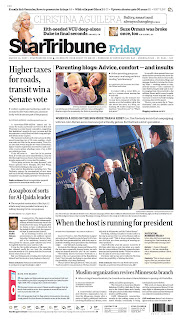
Who's minding the story in D.C.? Strib takes issues with McCollum's departures email

When U.S. Rep. Betty McCollum sent out her weekly e-mail newsletter on March 5, the Minnesota Democrat included a farewell to the paper's longtime Washington reporters, who will continue working for the Strib's former owner, McClatchy.

"I want to thank Rob Hotakainen and Kevin Diaz for more than 20 years of service each with the Star Tribune and wish them well in their new assignments," wrote the fourth-term representative. "I and the rest of the Minnesota congressional delegation look forward to working with the Star Tribune's intern, Brady Averill, who will now be responsible for covering the news from our nation's capitol."

The sentiment didn't sit well with Star Tribune reader's representative Kate Parry, who received "a note of concern" from a reader about it. She called and e-mailed McCollum's chief of staff, Bill Harper, and said McCollum's words left "the misimpression that the Star Tribune will now be covering Congress only with an intern. This is not the Star Tribune's plan for Washington coverage."

Two days later, McCollum's office sent out the clarification Parry requested -- prefaced with a note that in fact the paper's intern will be the paper's only Washington staffer "until an unspecified future date when they plan to 'hire at least one new correspondent,' according to a Star Tribune article on March 6." The exchange highlights that the paper hasn't been entirely clear about when and how it will replace these Washington reporters.


And it suggests a larger question: in these days of shrinking newsrooms nationwide (including the Star Tribune, where 24 newsroom employees took voluntary buyouts this week) and Walter Reed-sized scandals making headlines, how will the Minneapolis paper maintain the "vitality," as Harper puts it, that is "critical to ensure that citizens are informed" until its Washington office is fully staffed?

Parry's answer to that question: Averill will be "bolstered by reporters here and our continuing access to Washington coverage provided by the McClatchy newswire," she wrote.


Plans beyond that aren't very firm. Will they hire two positions or one? Will one be hired on as the bureau chief? When do they expect these new staffers to be in place? Strib nation/world editor Dave Peters, who oversees Averill's Washington work, couldn't answer any of these questions. Managing editor Scott Gillespie did not return Minnesota Monitor's request for an interview, and Averill declined comment.

But Peters acknowledged his desire to have more reporters in D.C. "I wish we didn’t have this disruption," he said. "I liked working with Kevin and Rob. They’re good. But for whatever reason, we’re having to change gears and naturally there’s a little bit of a hitch in there, but we’ll come out in a good place in the end, I’m confident."

In fact, neither Diaz nor Hotakainen wanted to leave the Star Tribune either, but the pay package offered by Avista, the paper's new owner, presented them few options.

Hotakainen, the Strib's bureau chief who just started as Washington correspondent for the McClatchy-owned Kansas City Star, wrote in an email to Minnesota Monitor, "It was an easy decision: Stay with McClatchy at full salary or take a pay cut to work for the Star Tribune."

Diaz said he "didn't relish" leaving Minnesota politics behind, especially with the treasure trove of material, from Al Franken running for Senate to Michele Bachmann and Keith Ellision in the House, the Republican National Convention in 2008 to Minnesota congressmen chairing influential committees.

"This was not a good time to leave," he said. "But new management really gave me no choice. The alternative was to give back every performance pay raise I've received since I came to Washington in 2000."

The same financial matters that lost the Star Tribune its veteran Washington writers may affect the hiring of their replacements as well. The paper's classified ad for the job(s) named a $60,000 to $75,000 pay range. Is that competitive, considering the expertise and connections required of a D.C. correspondent, not to mention that city's cost of living and the responsibilities that come with the title "bureau chief?"

Tom Hamburger, a Washington reporter for the Los Angeles Times, chose not to weigh in on those questions, but instead said he'd look to a broader issue, the "bleeding of quality" the situation in Washington suggests. When he began his ten-year stint at the Strib's Washington bureau in 1989, he was one of five reporters, one intern and four full-time journalists.

"This appears to be a sign of reduced commitment to Washington coverage by the paper," he said. "The most significant signs are the continued reduction in staff in the bureau and the failure to keep experienced people -- who knew what they were doing, knew how to cover Washington, and were doing an excellent job -- in their jobs."

Hamburger added that the staff he worked with continued the bureau's long tradition of reporting regional news while breaking national stories, like reporter Frank Wright's Nixon-era stories on the scandal over milk price supports, Finley Lewis' coverage of Walter Mondale's presidential run, and, more recently, revelations about the role of Minnesotans like Vin Weber in the rise of the modern conservative movement in the 1990s. (Hamburger didn't mention the story he co-wrote with Star Tribune reporter Sharon Schmickle about questionable gift receipts by members of the U.S. Supreme Court, which was a finalist for the Pulitzer Prize.) He's disappointed that the bureau is, even temporarily, reduced to a single intern.

"It's part of a general sadness that I find with what's happened to regional newspapers," he said. "But it's particularly insulting to those of us who worked at the Star Tribune for so many years. I worked there when the Cowles family owned the paper, and they were really trying to do a good job of maintaining the paper's legacy when they sold it to McClatchy. And it just hasn't worked out."

While Hotakainen admitted he has mixed feelings about leaving the paper he's worked at for more than two decades, he doesn't take anything personally. "It's simply a desire by the new owners to cut costs." He added that he suspects publisher Par Ridder and interim publisher Chris Harte won't be around in three to five years, at which point "a new managemenet team will come in and pick up the pieces."

As for the future, Strib editor Peters hesitated to predict when the Washington bureau would be fully staffed (its ad posted at JournalismJobs.com has a closing date of April 6), but said he's optimistic. "It’s going well. We’re getting good applications. I can say that much."

McCollum's press secretary, Bryan Collinsworth, hopes so. He said there's so much going on in Washington over the next few weeks that Minnesotans need to know about; topping that list, he said, is a key Iraq vote now in committee that will likely get a floor vote next week.


"You could say this is one of the most important times to have good coverage in Washington in years," he said.

Hamburger concurred. "This is an enormously busy, news-filled time in Washington: new Congress, an administration that’s on the ropes, a war that’s going poorly, the economy’s shaken," he said. "Those will still be covered. How Minnesota's congressional delegation responds is going to be covered less thoroughly. It has to be, not because the intern’s not competent -- I've met her, and I think she's very good -- but because they’ve taken away the experienced professionals who were covering it previously. That’s a loss for Minnesota."

Diaz's conclusion was more succinct. "Welcome to the modern American newsroom."

[Cross-posted at Minnesota Monitor.]

The Simpson's on Fox News bias

Via DailyKos.

3.15.2007

Michael Savage calls for deportation of MN journalist

A few days ago, after fellow Minnesota Monitor reporter Abdi Aynte broke the story of the lawsuit being filed by the so-called "flying imams" who were kicked off a USAirways flight in Minneapolis last November, we got a curious response to our press email on the topic. Michael Savage, the third-rated talkshow host, sent a personal email to our managing editor. It said, simply:

"You and they should be deported for taking advantage of this great nation."

Huh? Deported for being a journalist? A confirmation from Savage's producer and series of blog posts and releases followed, I discussed it on Air America Minnesota last night, and Abdi wrote a nice rebuttal to Savage, in which he pointed out that he's a legal resident, a refugee from Somalia, who came to the U.S. in 2000, learned English and found a job:
Since coming to this country barely six years ago, I have done all the right things. I secured a job to support myself and my family back home, all the while attending school to study what I’ve always dreamed of doing: telling people’s stories.
Savage -- as you recall -- is the radio host who advocated "kill[ing] 100 million Muslims," said Muslims are "nonhumans," and suggested an "outright ban on Muslim immigration."

Proof enough this probably isn't the last we'll hear from Michael Savage.