8.30.2011

Inside the Moveable Type mobile letterpress lab

The type truck at MCBA
Starting out in Oregon, Kyle Durrie's Moveable Type, a box van loaded with letterpress gear that's been making stops around the country, rolled into Minneapolis last night. Parked by the Minnesota Center for Book Arts, the type truck opened its doors to visitors who wished to give the press a pull or talk to Durrie about the project, which she says she's been documenting for an upcoming exhibition. She's designed unique pieces at each stop, and here's what she came up with here.
Open for business
Recent travels
Kyle Durrie places type
Our letterpress pieces
More shots here.

8.29.2011

Moveable Type letterpress van stops in MPLS tonight; afterparty at the Zine Apothecary


Moveable Type -- a 1982 Chevy van loaded with letterpress equipment -- makes a pit stop in Minneapolis tonight with a workshop and talk at the Minneapolis Center for Book Arts, followed by a potluck after-party in South Minneapolis at the Zine Apothecary, a resource center for zine makers near Powderhorn Park.

Moveable Type founder Kyle Durrie, fresh off a stop in Iowa (which is neither Idaho nor Ohio) brings her mobile letterpress studio to MCBA (1011 Washington Ave S) from 4 to 7 as she gives visitors a chance to try out a press and hear about her itinerant printing practice (a slideshow's part of the deal). Then the festivities move to the Apothecary (3310 15th Ave S.), a zine library created by artist/photographer Lacey Prpić Hedtke, where zine makers and fans can share a dish and their work.

"I'd been admiring the Moveable Type truck from afar and was sad it wasn't coming to Minneapolis," Hedtke explains via email. "I must have sent out an Aquarius brain wave, because MCBA asked if I'd want to do an afterparty at the Zine Apothecary if they could get the Type Truck to do an event at MCBA."

She says that following the MCBA event, the type truck along along with the Fly Away Zine Mobile will head to her place, where zine fans can peruse and check out zines (three-week limit). A sister project of the Zine Apothecary, the Fly Away Zine Mobile will be open as a reading loung, she adds, "complete with a stripy orange cat."

Opened this May, the Zine Apothecary combines the zine libraries from the Belfry Center for Social and Cultural Activities and the Stevens Square Center for the Arts, offering some 2,000 zines on topics ranging from politics and health and wellness to food and photography.

"I'm really excited about our large how-to section, and would like to build the collection so that's one of our main focuses," she notes. "We also have a 'Weird' section, and a 'Little of Everything' section."

With the surge in food-truck culture of late, the project seems to fit into the zeitgeist. But Hedtke points out Minneapolis' unique culture as more of a factor.

"It embodies a lot about what I love about Minneapolis -- it's sort of private, sort of public. It's sort of underground, but enough people know about it that it's not unapproachable. The Zine Apothecary is a little old fashioned in its content, a little new-fangled in its approach, and has something for almost everyone."

8.27.2011

Graffiti Wars: Banksy v. Robbo


Are there rules to graffiti? That question is at the crux of the fascinating new Channel 4 program Graffiti Wars, which chronicles a long-running feud between a legendary London graffiti artist and an artist whose fame and marketability are unsurpassed in the street-art genre. While the movie tells of an alleged physical altercation between Banksy and King Robbo years ago as one possible motive for the feud, the central question of Graffiti Wars is whether Banksy "broke the rules" of graffiti by altering the last remaining work by 1980s writer Robbo.
Robbo apparently thought so, and engaged in a call-and-response with Banksy:

He responded to Banksy's image of a worker painting over Robbo's piece on a canal wall in north-central London by replacing his old mural with the words KING ROBBO.

To that, Banksy or his fans replied, adding a FUC before KING.

Banksy's infamous "I don't believe in global warming" piece was likewise modified by Robbo, who reportedly canoed to the site in a confiscated canoe (paddling with his hands) to alter the message to read: "I don't believe in global war," with the added note, "It's too late for that, Sonny." He signed it Team Robbo.

The back-and-forth continued from late 2009 and into 2010, with some of Banksy's more famous works getting Robbo retouches. Eventually, as the film tells, things got uglier, with Banksy's fans threatening Robbo (someone added a "Die Robbo" tag to one piece) and Robbo altering one of Banky's trademark rat pieces to give homage to Blek le Rat, the Parisian graffiti artist who pioneered both street stenciling and rat imagery in the '80s: Banksy Le Rat.

While Banksy once acknowledged his debt to Blek, the French artist doesn't seem to share the sentiment. "I'm not sure about his integrity," says Blek in Graffiti Wars about the appropriation of his style and imagery. Blek, whose website says he's the "original stencil pioneer," also doesn't get the same kind of props in the art world. The Deitch-curated Art in the Streets exhibition at LA MOCA dissed Blek altogether, as Carolina Miranda wrote in her ARTnews review of the show: "British prankster Banksy is given a sprawling space for an installation that includes a steamroller, stencils, and a taxidermied dog apparently relieving itself, while Blek Le Rat, a pioneer in the stencil form whose tongue-in-cheek images predate Banksy's work by at least a decade, is left out entirely."

The program -- which includes interviews with Ben Eine, Robbo, Blek le Rat and others -- concludes with Robbo starting to see some Banksy-style success of his own. After criticizing Banksy's lucrative career and his lack of "street cred" Robbo winds up with a solo show at a gallery that helped launched Banksy's commercial career, and gets a commission to do a giant mural to promote a film at the Berlin Film Festival. Unlike Banksy, who didn't make an appearance at the Oscars when Exit Through the Gift Shop was nominated, Robbo attended the film's premiere, wearing a suit and a mask to hide his identity, to vamp for the cameras on the red carpet.

But that seems to have been the end of his rise, at least for now: A few days after filming for Graffiti War finished in April, Robbo was found unconscious with serious head injuries near his home and put into an induced coma. Robbo has been released from the intensive care unit, the London Standard wrote last week, "but his condition is not thought to be improving." As Team Robbo plans a fundraiser Sept. 4 to raise funds for Robbo and his 17-month old daughter, Banksy is being urged to donate a work for auction. He reportedly hasn't yet responded to that request.

8.25.2011

Bits: 08.25.11


Big Yellow Rabbit, Florentijn Hofman, Oreboro, Sweden, via Juxtapoz


• Damien Hirst's sculpture Charity, a 22-foot girl with a leg brace holding a collection box, has been vandalized in Bristol, UK. The word "HOAX" has been spraypainted on her dress. Via @GroundswellBlog. (Which reminds me: I, too, am on Twitter. Are you?)

• Pete Brook, who runs the excellent site Prison Photography, is fundraising on Kickstarter to fund a road trip to do some 40 audio interviews cross-country with photographers addressing prisons and prison reform. Help fund this worthwhile project.

• Little-known fact about Clara Kim, former REDCAT director and new senior visual arts curator at the Walker: She learned to drive stick shift from a member of Superflex. That, as well as news that she'll be curating a show of video projections by Minouk Lim next May, in Minnesota Monthly's interview.

• The Rochester (Minn.) Art Center has reportedly been getting some unfriendly press over its unsuccessful request from the city for $23,000 in funds to help cover a shortfall in operational costs. Go to the local paper to vote on whether you think the center should receive taxpayer funding.

• The new issue of the Journal of Aesthetics & Protest, on "Grassroots Modernism," is ready for advance orders.

• Your moment of dogheadwall.

Twin Cities art weekend: Hopsack, Sing Along, Nightmare, S.S. Soap Boat

Clockwise from top let: Guo Gai, Hopsack Painting Co., Nightmare, Giant Sing Along

• The Soap Factory opens the exhibition Three Artists: Guo Gai, Meng Tang, Slinko Saturday night. Beijing-based Guo Gai's politically charged large-scale photos will be on view, and his chorale work "Lament" will be performed live by a local choir. Gai was detained by Chinese authorities for a month this April for his involvement with the pro-democracy movement; he is prohibited from traveling outside China and won't be attending the opening. Minneapolis-based Chinese artist Meng Tang will present her projection/installation piece Impression: Babel, and Ukrainian-born, New York-based sculptor Slinko will present the work-in-progress Make-Believe, which explores "the poetic possibilities of a physical object, its cultural role, the artistic labor invested in its materiality and its place in the contemporary circulation of immaterial commodities."
Mark your calendar: I'm part of a panel discussion on "the interlocking issues of art, politics and censorship" on Sept. 17 with sculptor and exhibition co-curator Tom Rose, University of Minnesota China historian Edward Farmer and Rain Taxi editor Eric Lorberer.
• The Future Presence Gallery, an occasional gallery at 1126 2nd St. NE, Minneapolis, presents Future Presence 3, a group show featuring works by Bryant Locher, Nathaniel, Austin Swearengin, Justin James Sehorn, Joshua Wilichowski, Hannah Hall, Russ Olson, Danielle Voight, Gregory J. Rose, Ben Lansky and Andy Shannon. Aug. 26–28.

Hopsack Painting Co. is redoing the Dressing Room. Named after Valspar Paint's most popular color, Hopsack is the brainchild of Broc Blegen, whose inflatable George W. Bush monument I featured awhile back. His team of artists will unveil their creative use of the bland color at the Dressing Room, the residence/gallery of former Art of This Gallery head David Petersen and Crystal Quinn. Recepti0n Saturday night.

• Saturday afternoon sculptor Aaron Dysart embarks on the maiden voyage of the S.S. Soap Boat, a seaworthy vessel made from 550 pounds of soap -- a metaphorical probing into the question of what it means to clean up the Mississippi. Launch starts at 1 pm at Boom Island in Minneapolis.

• And going on now at the Minnesota State Fair, the Giant Sing Along. Step up to one of 32 microphones to sing along with karaoke favorites presented on a giant LED screen. Shy singers, fret not: the mics are auto-tuned to disguise voices. A project by Montreal-based artists Mouna Andraos and Melissa Mongiat, the project is put on by Northern Lights.

• Also from Northern Lights, Andréa Stanislav's Nightmare, a public video work that creates the illusion of a white horse galloping on the Mississippi, at night, and in slow motion:
Nightmare makes its much-anticipated debut launch from Harriet Island in St. Paul, MN, on Friday, August 26, 2011, at 9:00 pm.

Nightmare will initially travel downriver past the Wabasha Bridge toward Lowertown Saint Paul after the launch, visible only from the Harriet Island side of the river till it turns around. Once Nightmare turns around, it will head upriver toward the High Bridge and Minneapolis, visible only from the downtown Saint Paul side of the Mississippi. It is anticipated Nightmare will be visible from downtown Saint Paul with views of the Mississippi between approximately 9:30 and 10 pm, passing by Upper Landing Park (across Shepard Rd from the Science Museum at Chestnut St.) at approximately 10 pm.

8.24.2011

Photographer Wing Young Huie on the stabbing death outside his Minneapolis studio


Known for his photographs of Minneapolis' urban communities, Wing Young Huie has long lived and worked in some of the city's most diverse and bustling neighborhoods. His new one in south Minneapolis was recently the site of a stabbing: 22-year old Justin Jackson was killed Friday at an intersection near Wing's studio. Police won't be pressing charges as the stabbing was ruled self-defense and likely gang-related. On Facebook today, Wing reflects on the situation and welcomes visitors to the neighborhood for today's vigil to stop by his studio. While "art and engagement" is a buzzword in the institutional artworld these days -- and an admirable one at that -- I respect the many artists like Wing who embody it, by opening their studios or using their work to reflect and examine who we are and how we're connected.

His Facebook message and photo (above):

The tragic stabbing death last Friday in front of my Third Place Gallery on 38th & Chicago has been highly charged, provoking a multitude of reactions from paralyzing fear to connective support. It shocks and exposes our bubbled realities.

I've been interacting with many of the mourners keeping a vigil, inviting them into my gallery as the blood stained sidewalk became a growing shrine. To consider all the things that had to happen, the confluence of personal and historical dynamics, in this neighborhood, in this country, to bring this horrible incident to my front door, ostensibly over a pair of shoes, is dizzying and incomprehensible.

How will this corner and beyond respond to this and its rippling currents? The wake is today, Wednesday August 24, 2011. Sometime after 3 pm a large contingent will converge here to pay their respects. A very, very large police force will be here also.

I will be here too. All are welcome to come to The Third Place today and show their support.

Peace.

Wing Young Huie

Bits: 08.24.11

Jerome Liebling, Butterfly Boy, New York, 1949

• Of Lei Yixin's monument to Martin Luther King, Jr., just unveiled in Washington, Hyperallegic writes: "It is the first monument to a non-US president on the National Mall and the first dedicated to a black American, except, well, it is memorialized in white … to fit in, we assume."

• Meanwhile, in Indianapolis, members of the African-American community are protesting a planned sculpture of a freed slave by Fred Wilson, and in Charlottesville, a resident wants a 1919 sculpture of Sacajawea moved inside because it "obviously denigrates both women and Native Americans."

• RIP Jerome Liebling, photographer, filmmaker and founder of the University of Minnesota's film and photography program. Here's Mike Hazard's short film on the photographer.

• Today Tyler Green's Tumblr blog 3rd of May -- which groups headlines with relevant works of art -- links Otto Dix's Shock Troops Advance Under Gas (1924) from his amazing series The War with news about fears of the safety of Syria's chemical weapons stockpile.

• Warhol contemporary Ultra Violet proposes a Robert Indiana-esque 9/11 memorial.

• Must-read from Pete Brook: How Google's mapping tools have spawned a new breed of art projects, for Wired.

$278.4 billion: How much "key cultural industries" contributed to the U.S. economy in 2009, according to the NEA.

• Get your geek on: R2D2 sweater.

8.23.2011

Cinephile graffiti: "Ichi the Killer" stencil

"Ichi the Killer" stencil
Filmmaker Takashi Miike's character Ichi, from the 2001 film Ichi the Killer, shows up in a stencil by Inome near the Minneapolis riverfront. The film, shown at the Walker as part of a 2003 retrospective, is based on the Hideo Yamamoto manga series of the same name.

8.18.2011

Swoon brings Haiti to Minneapolis

Wheatpaste by Swoon
The artist Swoon's ties to Minneapolis run fairly deep: She helped launch the Miss Rockaway Armada from the Mississippi shores here (and did some wheatpaste pieces around town) in 2006; her work was part of the Minneapolis Institute of Arts' 2010 exhibition Until Now; and she did a residency last year with the Kulture Klub Collaborative, an art program with youth experiencing homelessness. Near Minneapolis' Cedar-Riverside light rail station, I recently spotted one of her works on a wall, nearly covered by vines. But it's about another locale to which she has deep ties: Haiti.

The work features an image Swoon also used on prints created to raise funds for the Konbit Shelter, "a sustainable building project with the objective of sharing knowledge and resources through the creation of homes and community spaces in post earthquake Haiti." (See the construction of the shelters on the project's blog.) The project's first community center was inaugurated this January.

A version of the piece in Minneapolis appeared in a London show, and on London streets, and here it has an equally global context. Situated in the heart of Minnesota's Somali community, it's now got company across the tracks in Broken Crow's new mural of running cheetahs. Broken Crow's travels took the duo -- Mike Fitzsimmons and John Grider -- to Gambia last year just as Swoon was returning to Haiti. Her journeys, likewise, have hit the African continent: Last spring, she taught artmaking in Zambia.
Broken Crow mural

Broken Crow goes for speed in new Minneapolis cheetah mural

Broken Crow mural
The ever-prolific Broken Crow (Mike Fitzsimmons and John Grider) recently finished another mural: A gigantic piece showing running cheetahs that's viewable from the light rail train as it passes north through Cedar-Riverside en route to downtown (update: John tells me they're not cheetahs, but servals). The piece stands in contrast to the towering minimalist architecture of Ralph Rapson, whose Riverside Plaza is both famous (it was featured as Mary Tyler Moore's apartment building on later seasons of the show) and infamous (some dubbed it the "Ghetto in the Sky" for problems there in the '80s and '90s). But the piece's site specificity refers mainly to the bike path and train tracks right beside it.
Broken Crow mural
The piece -- which follows Broken Crow's collaboration with OverUnder in Northeast Minneapolis and a more grisly savannah scene in South Minneapolis this summer -- seems tamer in comparison to other recent pieces. But the theme is all movement: Situated next to the passenger train and bike routes, the artists hoped the work would give viewers whizzing past the sensation of bounding felines. (Here's an animated gif they created to convey the idea.)
Broken Crow mural
But a funny juxtaposition of mural and advertising (above) suggests one possibility of what they might be bounding after.
Broken Crow mural
See more photos at my Flickr page.

Video: Etsuko Ichikawa's "glass pyrographs"


Jen Graves tips us off to this lyrical video of Etsuko Ichikawa creating her enigmatic works on paper -- using molten glass pressed briefly onto paper. In her artist's statement, Ichikawa says her "glass pyrographs" are "made by drawing hot molten glass, which is one way to capture and eternalize the immediacy of a moment, while my hanging and floating installations are about ever-changing states of mind."

7.25.2011

Bits: 07.25.11


Ceramic milk crate, Matthias Merkel Hess, via C-Monster

• Combat photographer Adam Ferguson in the audio slideshow, "War is boring": "One can feel like a predator working as a conflict photographer, looking for those extreme moments, the ugly ones that ram the absurdity of this war home... War strips the child out of being human, because war talks in absolutes. I guess many grunts can't find that child inside again..." Via Yumi Goto.

• Also via Yumi, the late photojournalist Tim Hetherington's last photos.

• Long silent on his blog and Twitter, Chinese artist Ai Weiwei is now on Google+.

• Over the weekend, "Bono and Somali–born singer and poet K’naan met in Minneapolis with several Somali Minnesotans to discuss and draw attention to the growing famine in Somalia, where a food crisis has led to the deaths of tens of thousands of people and is putting nearly 12 million more lives at risk. There has been very little coverage of the crisis in the US media to date, despite the gravity of the situation."

• Meet Dyslexie, a typeface designed to help people with dyslexia read. Via Leif Utne on paper.li.

• Jen Graves on bear poop, volunteerism and Mark Dion's living Seattle installation, Neukom Vivarium. Via MAN.

7.21.2011

Bits: 07.21.11


Irina Werning, La Negra 1980 and 2010, Buenos Aires

• Irina Werning's been asking people to reenact childhood photos, to awesome effect. Via Andy Ducett on Facebook.

Clash Music picks up on yesterday's story of the band Sigur Ros using the photographer John Yang's iconic image of a sleepwalking boy for its 2005 album without permission, noting "that Sigur Ros have been the victim of this sort of thing in the past. Publishing an article on their own blog, the Icelandic group bemoaned ad agencies who use 'sound-a-like' versions of their material without giving any credit to the original composition."

The Mighty Flynn responds via a Tumblr comment to the story with a link to Jonathan Lethem's Harper's essay, "The ecstasy of influence: A plagiarism."

RIP Lucien Freud.

• Fossil fuel interests in Wyoming are none too thrilled by British environmental artist Chris Drury's forthcoming sculpture, Carbon Sink, which will feature a "flat whirlpool of beetle-killed logs spiraling into a vortex of charred, black wood and studded with large lumps of Wyoming coal." A Wyoming mining official said of the piece, which was commissioned by the University of Wyoming: "They get millions of dollars in royalties from oil, gas and coal to run the university, and then they put up a monument attacking me, demonizing the industry. I understand academic freedom, and we're very supportive of it, but it's still disappointing."

• Culturejamming preacher Rev. Billy took his tour -- and his gown-bedecked Earthalujah gospel choir -- to Tate Modern Monday to exorcise the "evil spirit" of BP, a major financial sponsor, from the gallery.

• Worth reading of the day: "Testing the Limits: Cultural Activism in the Gateway City" at Art21. Via Erik Moe.

• Minneapolis exhibition: Finally, We Are All Young Again: Adam Caillier and Michael Mott and Movie: Scott Nedrelow, Minneapolis Institute of Arts, opens tonight Thursday, July 21.

• Also tonight at the MIA: It's Bike Night!

• Also tonight in Minneapolis: Eat Ramen! Help Japan!

7.20.2011

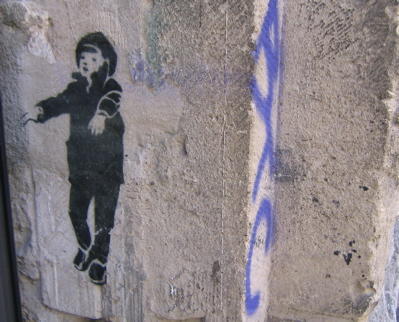
In the age of derivatives, reasserting an original: John Yang's “Blindman's Bluff”

Yang’s work adapted as stencil art on a boxcar in Minneapolis, 2011. Photo: Paul Schmelzer

Sometimes in the life of images, derivatives end up eclipsing the original, leaving creators of unique works unacknowledged—and, often, unpaid—for their creative endeavors, even as spinoffs of their art zoom around the globe. And that’s the case with a 1960 photo by the late John Yang called Blindman’s Bluff. The first time I saw a version of Yang’s photo of a sleepwalking boy was in 2005 when I spotted a stencil rendering of it outside an art squat in Berlin. I quickly learned that it was what the band calls an “adaption” [sic] of Yang’s photo, used to promote the Icelandic band Sigur Ros’ album ( ). I forgot about the image until I noticed another stencil version of it on a boxcar in Minneapolis earlier this month. It’s showed up in Reykjavík, Melbourne and elsewhere—likely by artists who know little, if anything, about the original. 

Determined to figure out the back story of this arresting image, I contacted the estate of Yang, who passed away in September 2009. The reply I got back from his daughter was both beautiful and disconcerting.

 Yang’s work adapted as stencil art on a Berlin wall, 2005. Photo: Paul Schmelzer

Born in Suchow, China in 1933, Yang emigrated first to the UK with his family, then, when he was six, to the United States. A U.S. citizen living in New York, he attended Harvard where he got his philosophy degree, then went on to architecture school at the University of Pennsylvania before being drafted into the military. Stationed in Germany, he played cello in the 7th Army Symphony and performed throughout Europe, according to his daughter, Naomi Yang, herself an artist (graphic design) and musician (Galaxie 500). It was in Strasbourg, France, just across the border from Germany, where he encountered the iconic sleepwalker: “The photo was not posed, my father was taking street scenes at the time and happened upon the boy,” Naomi writes in an email. 

John Yang later focused his lens closely on details of urban life, including ornamental stonework on the facades of New York brownstones and memorial photographs on headstones at an Orthodox Jewish cemetery in Queens, but at the time he shot Blindman’s Bluff, he took a broader view, shooting documentary-style streetscapes. The photo was reproduced in the Time/Life book Photographing Children, which Naomi surmises, is where Sigur Ros found it—and took it.

Blindmans Bluff, courtesy the John Yang Archives 


“[Sigur Ros] did not ask permission and they have never paid for the usage of the photograph, which as a musician and a graphic designer myself, I really, really object to,” says Naomi, who is now half of the music duo Damon & Naomi. “Approaching their management for some compensation has just met with indifference.” (Interestingly, the one place Sigur Ros gives Yang credit is on Flickr, where the band’s composite of Yang's photo and the stencil is copyrighted and marked “all rights reserved.”) 

Upon seeing the graffiti version of her father’s work, Naomi wrote, “Wow, that image really gets around.”

After retiring from his architecture practice in 1978, John Yang committed himself to photography full-time. His final project explored the remnant of Indian Ladder Trail, a path threading the ridge known as the Helderberg Escarpement, in John Boyd Thacher State Park, near Albany, New York. Near the end of his life, Yang conducted an interview—with himself—that was included in the catalog for the “Indian Ladder” series. His words reference the seemingly unpeopled cliffs of the park, which he photographed mainly from the shadows in a style that has echoes of Ansel Adams, whom he admired. But they could just as easily apply to that 1960 photo—much more resonant than later works it inspired—of a French boy, silently and undisturbed in his private world of sleep, walking down a rain-damp street:

Am I correct in noting that there is also an unearthly silence that can be heard in many of your photographs?

Could be. Someone once said that my pictures have a distinctive elegiac tone, that they are pictures taken in a minor key.
For more on John Yang, visit johnyangphoto.com.

7.18.2011

Bits: 07.18.11

California Department of Corrections by Eyeteeth.org
• Pete Brook of Prison Photography and Wired's Raw File blog offers a great look at the California Department of Corrections, a culture-jamming group that since 1994 has described itself as "a private correctional facility that protects the public through the secure management, discipline, and rehabilitation of California’s advertising." It's most recent project (above), released as guerrilla bus shelter ads just prior to the July 4 holiday, commemorates the assassination of Osama bin Laden.

• The "Shared Sacrifice" mural at Intermedia Arts has a blog, with posts ranging from developmental sketches and in-process photos of the piece to news stories related to the political themes behind the work.

• Stumbled upon at the Intermedia site, images from photographer Dirk Anschütz's series of portraits of people with cognitive or developmental disabilities, created for Upstream Arts.

• Just like the title says: uglybelgianhouses.tumblr.com.

• Legendary Minneapolis artist Frank Gaard, blogged about here, here and here, has a solo show scheduled at the Walker Art Center. Dates: Jan. 19–May 6, 2012. Here's an (excellent) interview Permanent did for Gaard's (excellent) CO Exhibitions show this spring.

• At OPEN Magazine, the war photographers of India.

Gun-shot Avedon still at home in Minneapolis German restaurant


A Minneapolis German restaurant is home to a work by famed photographer Richard Avedon, but the tale of the work's current state -- peppered with a few bullet holes -- makes it an even better story (via @artsmia).

Minneapolis Institute of Arts associate curator of photography Christian Peterson blogs about Avedon's 1963 work Generals of the Daughters of the American Revolution. In town for a 1970 MIA show of his work, Avedon frequented the Black Forest Inn a few blocks away and befriended its owners, Erich and Joanne Christ. Before leaving town, he gifted the first print of the photo to his new friend, and it still hangs in the restaurant's bar today. But it now bears two signs of age: Many years later, a customer pulled out a gun and shot it.

Writer Christy DeSmith chronicled the event in a 2004 piece for The Rake:
Sixteen years later, Ellis Nelson, a regular at the bar, was sitting on his favorite stool when he pulled out a revolver and opened fire on the photograph. “That was a wild day,” remembers Erich, who was walking his wife and infant son through the parking lot when the shooting occurred. “People came running out of every hole in the place shouting ‘He’s got a gun! He’s got a gun!’ and I said to myself, ‘Ellis, this time you really did it.’” When police later questioned the shooter, trying to uncover a motive, Nelson was reported to have answered, “That photo always bugged the hell out of me.”
"[S]ince you could smoke in the bar until fairly recently, those holes are now rimmed in a distinctive nicotine brown," writes Peterson.

The Black Forest nicely chronicles its art on its website, but only nods to the photo's history by calling it "infamous." The restaurant's online image of the work, however, shows evidence of the two shots -- a chest wound and an eye shot -- that make two of the Daughters of the American Revolution look more like soldiers in the American Revolution.

7.15.2011

7.14.2011

Tonight in Minneapolis: Auction of works by Yoko Ono, Alec Soth, Laurel Nakadate, others, to benefit Leon Shambroom

Leon Shambroom

Some of the art world's big names are stepping up to help a fellow artist and his parents, Minneapolis-based independent curator Joan Rothfuss and photographer Paul Shambroom. Last July, 25-year old Leon Shambroom, a musician and DJ, was found unconscious from smoke inhalation and carbon monoxide poisoning after being trapped in a house fire in South Minneapolis. He's unable to speak or walk, and his medical bills are sure to mount.

Tonight, a benefit art auction will be held at Weinstein Gallery to help defray the costs. Organized by Chicago photographer Brian Ulrich, Alec Soth, Soth's studio manager Carrie Thompson, MCAD and Weinstein, the event will include a silent auction featuring works by more than 50 artists from around the world: Edward Burtysky, David Goldis, Todd Hido, Glenn Ligon, Sharon Lockhart, Richard Misrach, Yoko Ono, Martin Parr, Soth, Ulrich and many others. Channy from the band Roma di Luna will perform.

That's tonight, July 14, 6-9 pm, at Weinstein Gallery, 908 West 46th Street, Minneapolis. I hope to see you there.

Martin Parr, England. New Brighton, from "The Last Resort" (1983-1985)

7.13.2011

"Shared Sacrifice": Intermedia Arts mural tackles Minnesota's government shutdown


Perhaps you've heard: The State of Minnesota's government has shut down. At issue is a budget impasse between the Democratic governor, Mark Dayton, and the GOP legislature: While Dayton favors bridging the budget gap with solutions including tax increases for the 7,700 richest Minnesotans, Republicans are holding firm with their no-new-taxes pledge. As compromise seems to have ground to a halt, people statewide are suffering, including (but certainly not limited to) teachers whose licenses are in limbo, grant-funded nonprofits serving some of the state's most vulnerable people, out-of-work state workers and average folks who are required to pay taxes during the shutdown but won't be getting any refunds, rebates or tax credits -- or many of the services they've paid all year for.

So Intermedia Arts' ever-changing mural wall caught my eye today for its timely political message: "Shared Sacrifice." I don't know anything about who made it -- although I'll ask -- but its carnival typeface is reminiscent of the politically charged boxcar graffiti of Impeach and the Abraham Lincoln Brigade. Its sentiment -- that all of us should bear the burden of the budget mess and the poor economy, instead of the wealthiest being treated with deference -- hits home for me, and I'd bet, many, many Minnesotans.

The mural's theme, of course, has national significance as the debate rages about raising the United States' debt ceiling. Just this afternoon, the U.S. Senate failed to get enough votes to pass a symbolic resolution calling for "shared sacrifice" from the wealthy in addressing the debt-limit conflict. The text of the non-binding resolution:

SECTION 1. SENSE OF THE SENATE ON SHARED SACRIFICE.

(a) Findings - Congress makes the following findings:

(1) The Wall Street Journal reports that median pay for chief financial officers of S&P 500 companies increased 19 percent to $2,900,000 last year.

(2) Over the past 10 years, the median family income has declined by more than $2,500.

(3) Twenty percent of all income earned in the United States is earned by the top 1 percent of individuals.

(4) Over the past quarter century, four-fifths of the income gains accrued to the top 1 percent of individuals.

(b) Sense of the Senate- It is the sense of the Senate that any agreement to reduce the budget deficit should require that those earning $1,000,000 or more per year make a more meaningful contribution to the deficit reduction effort.

Emphasis mine.

7.12.2011

Chairs -- including Ai Weiwei's -- gather at the Walker Art Center


As I write this, chairs are gathering along Minneapolis' Hennepin Avenue in anticipation of an observation tonight of the 100th day of artist Ai Weiwei's arrest and the continued imprisonment of hundreds of dissidents in China today. Inspired by Ai's work, Fairytale: 1001 Qing Dynasty Wooden Chairs, the Walker Art Center has asked the community to bring chairs, and they have -- 250 or so already. While many more are yet to come -- yours, hopefully -- one has yet to be placed: An office chair from Ai Weiwei's studio has been sent from Beijing and will be present for a moment of silence at 6 pm tonight.

The urgency of Ai's plight has diminished some -- he's been freed, although he remains under a media gag order that, according to the BBC, includes Twitter -- but I commend the Walker for sticking with the event nonetheless, and using it as a way to bear witness to China's continued crackdown on creative expression and political speech among those without Ai's star power.

And for making the event so visible. For those unfamiliar with Hennepin Avenue, it's a major thoroughfare near downtown Minneapolis, and while it often provides an unpleasantly cacophonous front yard for the Walker, the eight or 10 lanes of roadway provide a perfect stage for such a highly visible event. As I dropped off our chairs, quizzical passersby peered from car windows and cyclists rolled up with cameras to shoot the quirky scene: an artist's sculptural chair, children's toy furniture, rummage sale chairs, a plywood chair by ro/lu, a "gold-plated" lawnchair, among them.

Most fitting, though, is the event's placement beneath Lawrence Weiner's wall piece, a Walker icon placed on the building's facade of bricks, that simply reads, "BITS AND PIECES PUT TOGETHER TO PRESENT A SEMBLANCE OF A WHOLE" -- a testament, in this context, to the potential power of collective action. Naysayers may scoff at the effectiveness of this kind of arty assemblage of mismatched chairs in affecting Chinese policy half a world away, and I suppose they're right. But this is the realm of art, which, for me anyway, puts the power of this collectivism more in the realm of spirituality than policy. If we ask what the effectiveness of art is, then we should also ask about the effectiveness of a prayer or a hope or a spiritual practice that connects its adherents with those in their community or those around the world.

Maybe that's why the Walker's site is perfect for the event: This repository of art -- which I've called "divinity for the reality-based community" -- is situated across the road from a line of churches, including the country's first Catholic basilica.

Update: Here are some photos from the event, including this shot of the chair Ai would sit at to use his studio computer.
Ai Weiwei's studio chair