11.06.2006

Audio Blog: Thomas Hirschhorn

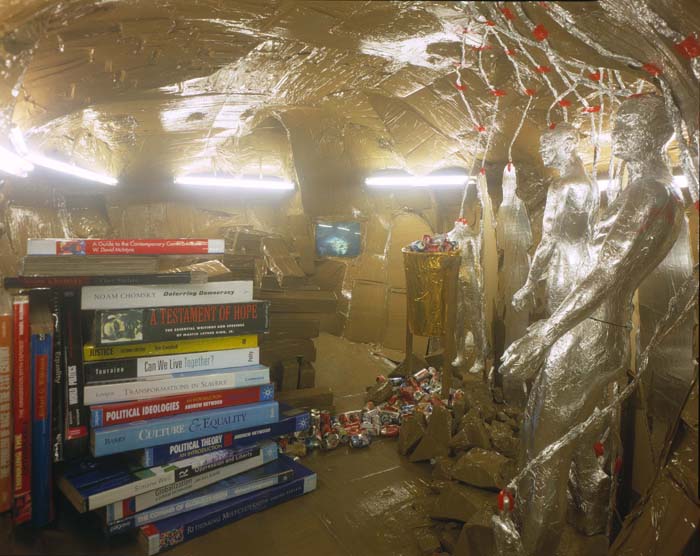
Over at the Walker, we're hosting the exhibition Heart of Darkness, featuring large-scale installations by Thomas Hirschhorn, Ellen Gallagher, and Kai Althoff. I've been blogging on the installation and ideas behind Hirschhorn's piece Cavemanman, and today we posted the first-ever Walker Audio Blog. Covering the political and historical influences of the piece (bin Laden at Tora Bora, graffiti artists and Lascaux), his unorthodox materials (packing tape, cardboard, aluminum foil), and how the mind can be structured like a cave, it turned out to be a wide-ranging look at Hirschorn's "collage in the third dimension."

Listen to the podcast here. As it's my first podcast, please leave feedback in the comments. Thanks.

More on the installation here and here.

Operation Enduring Occupation: The Simpsons on Iraq

(Via Americablog.)

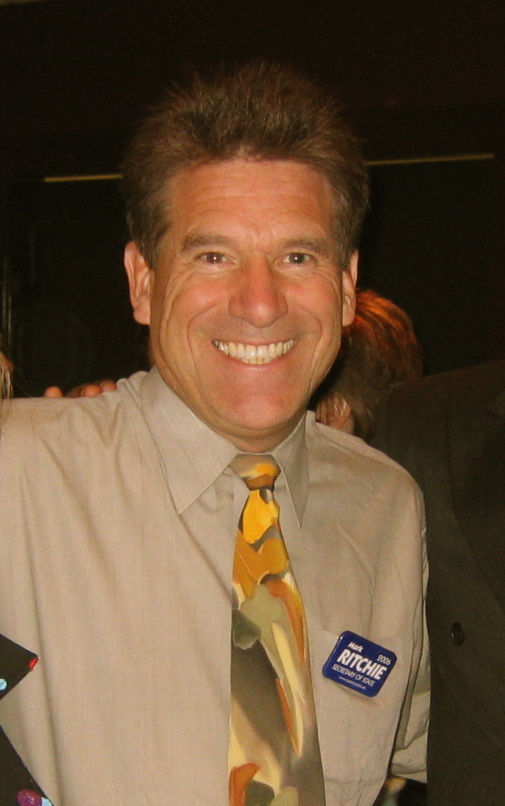
Insider outsider: An interview with Mark Ritchie

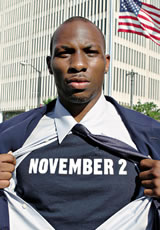
Experienced at working with international institutions and grassroots activists alike, Mark Ritchie has been known to use an “insider-outsider strategy.” It's an apt descriptor: A onetime chicken farmer and co-op organizer, he’s addressed the UN General Assembly on commodities and sustainable development. A speaker at the first-ever World Social Forum in Porto Alegre, Brazil, and organizer of a boycott of Nestle (for their campaign urging mothers in developing countries to switch from breast milk to formula), he’s worked closely with corporations like Cargill in developing sustainable practices. For 20 years, he’s lead the Institute of Agriculture and Trade Policy (IATP), a non-profit he founded that researches global trade's effects on local family farmers, and in 2004, he spearheaded the nation’s largest voter registration drive, in which five million new voters registered through a project marked by blue t-shirts emblazoned only with the text: “November 2.”

On November 7, Ritchie hopes to unseat Minnesota's incumbent Secretary of State Mary Kiffmeyer. With just days before the election, I caught up with him to discuss not just the race, but the ideas that shape his politics that are unabashedly progressive, deeply humane, and solidly pragmatic.

We’ve discussed the zero-waste campaign events you’ve hosted, IATP’s work writing standards for the production of biodegradable, plant-based polymers for industrial use, and your work on the global trade issues that affect family farmers. How will you bring your knowledge of sustainability and environmental practices into the office of Secretary of State?

I’m going to be very busy as Secretary of State dealing with certain messes and finding out the problems. But there are three things I believe I can contribute. One is sitting on the board of investment policymaking for the pension funds. $50 billion: it’s pension money. It should have a 50-year perspective, because that’s about how long most folks are working these days. And to have a 50-year perspective is to have an ecological and a sustainable perspective long term.

Second, the Secretary of State’s office spends money, so you can set standards. We have standards now for buying from veteran-owned businesses, women-owned businesses, minority-owned businesses. We have standards for mercury reduction. Having a standard that looks at bio-based, Minnesota-based, renewable sources is not that complicated anymore and certainly could be done.

And finally, people are interested in vision. What’s your vision of the democracy? What’s your vision of the country? What’s your vision of the future? As Secretary of State you get the opportunity to speak to audiences—sometimes it’s one reporter and sometimes it’s a thousand students gathered for a conference—so being able to articulate a vision that’s holistic, so that the democracy fits into respect for rights and responsibilities which then extends to the communities around us.

Who are some of the thinkers, in Minnesota or elsewhere, who’ve inspired you?

David Morris from the Institute for Local Self-Reliance. In the ‘30s, Henry Ford and others spearheaded the Chemurgy Movement, which was a movement to get off of petroleum and base our industrial economy on plant matter, on things that would grow. They were essentially defeated by cheap oil. The US invaded north Africa. We seized control of the oil fields—the British did with the US—guaranteeing cheap petroleum, and it basically killed off the chemurgy movement.

But David Morris began talking about the carbohydrate economy, and he began educating all of us about how we could do all these things with plant matter and how that would affect Minnesota’s economy, and how we could stop importing oil and stop killing ourselves with these poisonous petroleum-based products and destroying the ozone and destroying the climate. David Morris single-handedly rebirthed that movement.

Will Steger, as an explorer, basically set out to go places and do things that nobody’s ever done, and in the course of doing that he became intimate with the details of how human-generated changes in the climate have begun to alter everything from the tiniest plants to the glacial ice shelf of Greenland and Antarctica. He was able to bring a vision by being able to talk about it from the personal in a way that no one has ever done, at least in my experiences no one’s done it quite like that.

There’s a lot in our history. The artist [Francis Lee] Jaques was able to capture some of this in painting and in art. Ann Bancroft is also somebody who, through her own experience is able to articulate another way to see the world and be able to communicate that—especially to young people. Minnesota’s loaded!

In your work with IATP, you’ve befriended everyone from CEOs to small-scale organic farmers. How will that experience come into play in the Secretary of State’s office?

I feel fortunate that I’m old enough to have learned a lot of things over time, like how to be respectful of other views and how to draw on the experience of others and make the emphasis on finding win-win solutions and getting things done. I feel fortunate to be old enough to have gotten to that stage. Especially with elections. Because township officials, city clerks, and county auditors: those are the people who actually run elections. They’re a mix of every political stripe you’ve got. So, if you’re able to include and involve all those election officials, then you’re going to have a richness that transcends a single partisan perspective or any perspective in that way.

Elections are the most prominent part of the Secretary’s job. What about the other aspects? There are business filings, you’re the keeper of the state song or whatever…

(Laughs.) The two other big things: the Secretary of State sits on the pension board. This has been pretty secretive until the big flap over Mary Kiffmeyer’s support of William McGuire and the whole United Health board debacle. Mike Hatch and Pat Anderson voted to remove the board of United that had all these corrupt executives and Pawlenty recused himself, because he takes a lot of campaign contributions from these corrupt executive. Mary Kiffmeyer voted in favor of the corrupt executives. That whole process needs to be transparent. The second is that the conflicts of interest need to be put out there. I mean, Mary Kiffmeyer is a major owner of a very large bank, so there’s all kinds of potential conflict of interest, because banks have customers and pension funds are making investments. There’s a lot to that pension fund that hasn’t been talked about much.

That’s one job. The second one is two-thirds of the staff, and it’s business filings. One of the reasons I’ve gotten such strong, positive support from the county recorders—the folks who handle business filing at the county level—is that they’re constantly frustrated by the failures in the office when the computers go down or all the services are unavailable and it makes them look like fools back home.

One thing I hadn't noticed was how angry the commercial business-related lawyers were until I started getting invited to give presentations at all these fancy downtown law firms. When I got to my first one, a guy said to me, “You know, we were all furious when Mary Kiffmeyer decided to just close the business filings part of her office” in kind of a snit with Jesse Ventura. Ventura said all agencies should save money by reducing costs by a certain percent, and she said, essentially, the heck with you, and shut the office down. Many lawyers said, "Wait, you can’t do that. We’ve got clients who want to file as corporations, they want us to do name changes." Some of them switched to doing it in Wisconsin and Delaware. They were furious.

Last week I was doing one of these presentation at a 40th floor of a big downtown law firm, and the guy repeated a story: earlier in the week he was talking to a lawyer in Boston, representing a Boston-based investor in a Minnesota company, and they were arguing that they should reincorporate the company in Delaware not in Minnesota. One of his arguments was: “The Secretary of State is always shutting down the office there. How can you ever deal with them?” Minnesota law firms—big ones—compete with coastal-based law firms in New York, Washington, Boston, San Francisco, Los Angeles. And the perception is the typical stereotype: we’re flyover land, we’re hicks, things don’t really work, we’re really second tier. When the Secretary of State does something like shut down the office and make everybody look like a fool, it reinforces that perception that we’re just not up to snuff here and it’s damaging to their ability to compete at a national level for legal business. I know that Business Services side doesn’t get much attention, it does take up a lot of staff, but if you don’t operate it properly, you can create a very bad situation for Minnesota businesses…

I’ve spent 20-some months meeting with all the people who interact with that office on a daily or weekly basis, and I’ve gotten an earful from auditors and recorders and everybody. I have a long list of the problems, but I also have a long list of very helpful specific suggestions on ways to fix the problems, improvements that could be made, and really creative—some of them genius—ideas for things we could do going forward. I’m very excited to get in there and roll my sleeves up and reinspire that staff and say, hey, we’re going to turn this around.

I find it interesting that you haven’t played up your huge voter registration experience more in your campaign. You’re the guy behind that, but I suspect more people have seen those November 2 t-shirts than have heard of you.

Yeah, I know. While I’m extremely proud of it and I mentioned it in the ad and I love saying it in speeches, I want to make sure that I’m always clear that this was a huge effort and that I had the privilege of being the leader and coming up with and moving it. But there was a couple thousand groups—400 in Minnesota. Registering five million people is this Herculean task, and one person can have a big role, but one person can’t be that campaign.

I haven’t seen much campaigning by Mary Kiffmeyer in the metro area; is she giving up on the Twin Cities or my demographic?

There’s a lot of billboards and radio, and there are some full-page ads in things like the Senior Federation paper. She has very high name recognition, and I have very low name recognition, so probably she’s pitching her base. Her ads feature Dick Franson speaking, with her coming in on the end saying “I approve this ad.” So her ads are a little unusual in that way.

Isn’t that a bit like what you did on your TV spots with Joan Growe?

Well. Joan Growe was the most beloved and 24-years-serving Secretary of State. Dick Franson is a 22-time failed candidate, in and out of bankruptcy, writes me racist notes and threatening little postcards. He’s like the opposite. So, anyhow. That’s her decision—whatever—but one of the four candidates, Bruce Kennedy, really went after her publicly in the debate in Duluth about this… He called it exploitation. It was a very strong statement, and he really meant it.

In preparing for this interview, I was looking for your critics. The only criticism I’ve heard is that you’re not running for higher office.

(Laughs) Yeah. I feel like there’s a bit of disrespect for the office of Secretary of State, and I’ve noticed it inside the political parties, the media, and the public, and even among my friends. I think the mechanics and the guardianship of democracy and the voting process in the past was well done, so people didn’t worry about it. So the job didn’t seem so important. And then Florida woke us up—and Ohio and Mary Kiffmeyer set off a big alarm—but I’ve found for myself, traveling the state and talking about the democracy every night, that I don’t believe there’s a more important job than being a champion of the democracy at this stage in the nation’s history. It’s not just the question of the elections, but the whole assault on the democracy: attacks on judges and gerrymandering and ripping up the constitution. To my friends who said, “Why are you wasting your time,” I’ve gotten so I answer them with some pretty strong words. Defending the democracy is the most important thing I can be doing, and that’s what I should be doing, and I’m going to do a really good job of it.

11.04.2006

CO2 ground war.

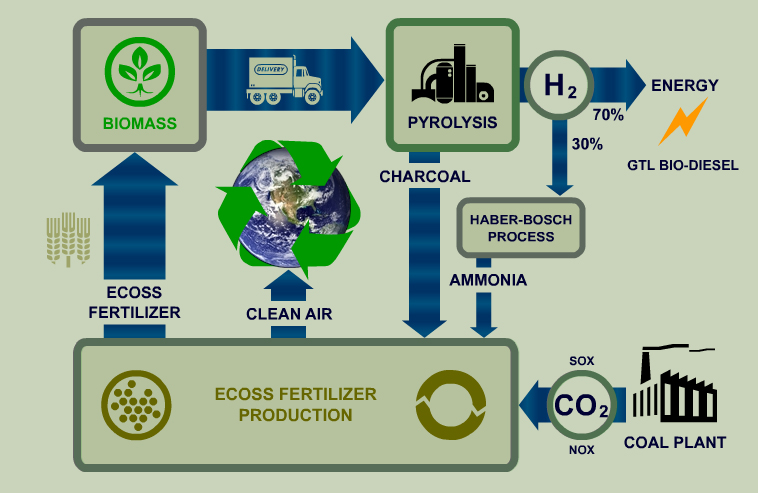
Eprida seems to be onto something rather remarkable: a sustainable energy technology that removes CO2 from the air by putting carbon into the topsoil where it is needed. In other words:
The Eprida technology uses agricultural waste biomass to produce hydrogen-rich bio-fuels and a new restorative high-carbon fertilizer (ECOSS). The process actually removes net CO2 from the air by stabilizing carbon in the topsoil where it is needed. In tropical or depleted soils ECOSS fertilizer sustainably improves soil fertility, water holding and plant yield far beyond what is possible with nitrogen fertilizers alone. The hydrogen produced from biomass can be used to make ethanol, or a Fischer-Troupsch gas-to-liquids diesel (BTL diesel), as well as the ammonia used to enrich the carbon to make ECOSS fertilizer.
For more, watch this Flash animation.

Also: A quick shout out to the Carbohydrate Economy. More info on this to come..

11.03.2006

Mentally and spiritually Haggard.

The Ted Haggard scandal in a nutshell: the pastor of the 20th fastest-growing evangelical church in America--the "most powerful megachurch in America"--described as "the most important evangelical, period," who had weekly conference calls with George W. Bush, and decried gays, ends up confessing to buying meth from a gay prostitute he met looking for a massage. But, honest, he didn't have sex with that man.

Whatever.

What's more interesting to me than all this hypocrisy is the evangelical mindset that allows it, as illuminated here by British scientist Richard Dawkins:

Johnson ad: Native American or native intelligence?

Is Minnesota's Republican Attorney General candidate Jeff Johnson getting racial in his latest TV spot? Members of the White Earth and Leech Lake bands of Ojibwe think so, according to Minnesota Public Radio's Polinaut; they've written letters of complaint to the candidate for what they believe is an unfair characterization of a would-be thief as a dark-skinned, long-haired, bandana-wearing man.

The commercial begins with a phone call already in progress: a man, dialing in from a lawn chair in his bedroom, is told by a female voice, "Mrs. Carlson, we can't deposit your Social Security check without a password," causing him to slam the phone down in frustration. A voiceover tells us "Jeff Johnson wrote the law protecting consumers and seniors from identity theft"--and, as AG, he'll work to protect you.

Mrs. Carlson? Social Security check? Consumers and seniors?

Needlessly thumping us over the head with it, this spot clearly targets older Minnesotans who, we're to assume, fear nothing more--as seniors and consumers both--than con-men swiping their government checks. That the intended victim is the ubiquitously Scandinavian Mrs. Carlson, instead of, say, a Mrs. Whitecloud or Mrs. Jimenez or Mrs. Zbigniew, could be seen as giving more credence to the complaints of Ojibwe leaders.

But what puzzles me about the spot has more to do with native intelligence than Native Americans: how did this guy get so far in the phone call that he was merely a password away from identity theft? How'd this brawny, long-haired, bandanda-wearing, lawnchair-sitting fella--presumably with a male voice to match--convince the banker he was Mrs. Carlson in the first place?

Watch it:


adMN is an ongoing review of communications created to shape Minnesota's campaigns and culture.

Escape Mechanism.

About five years ago, I started chatting with one Jon Nelson, who then worked at the Walker Art Center's front desk when not DJing for the University of Minnesota's Radio K. He turned me onto a project that he, under the art alter-ego Escape Mechanism, was participating in: a group of audio collage artists from across North America had created a mix CD of their Negativland-style art, packaged and shrink-wrapped it, and "reverse shoplifted" (or "droplifted") it into the bins at Sam Goody, Tower Records, and other big record stores that, out of fear of prosecution for copyright infringement, wouldn't carry their sample-heavy work. (I owe Jon a lot; I ended up writing on the project for a Canadian magazine, and landed a three-year editorship because of it.)

Today, Nelson is the mastermind behind the syndicated radio show and podcast Some Assembly Required, a prolific visual- and sound-artist, and the subject of a new videoblog piece by Blogumentary filmmaker and Minnesota Stories videoblogger Chuck Olsen.

Created in partnership with mnartists.org, it's the first in a series of video profiles Olsen will create focusing on area artists.


Cross-posted at Off Center.

Art Army.

sp_resize-1.jpeg
Artist Michael Leavitt has been paying homage to the living artists around him--and some of the dead ones--through one-of-a-kind Art Army action figures. Made from synthetic polymer clay and elastic, the pieces range from 6- to 12 inches tall and feature art "icons" including Barry McGee (below, bottom), Banksy, Jean-Michel Basquiat, grafitti legend Futura 2000, Shepard Fairey (above), Hieronymus Bosch, Andy Warhol, Barry White, outsider Joe Coleman, culturejammer Ron English (below, top), "Rat Fink" artist Ed "Big Daddy" Roth, Dale Chihuly, Jim Jarmusch, Billie Holliday and others.

Writes Leavitt of the characters that sell for $400 or more:

This is no customization hobby, and it also ain't some profound artistic statement. The one-off figures are each original, fully posable mini sculptures engineered for major articulation. They look like real toys, but no Art Army® figure is machine manufactured. These action figures don't fit in any molds. Each is sculpted from scratch as one artists' offering to an icon.

sp_resize.jpeg

barrymcgee.jpg
Thanks, Witt.

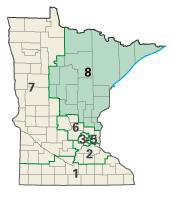
A Closer look at MN 8

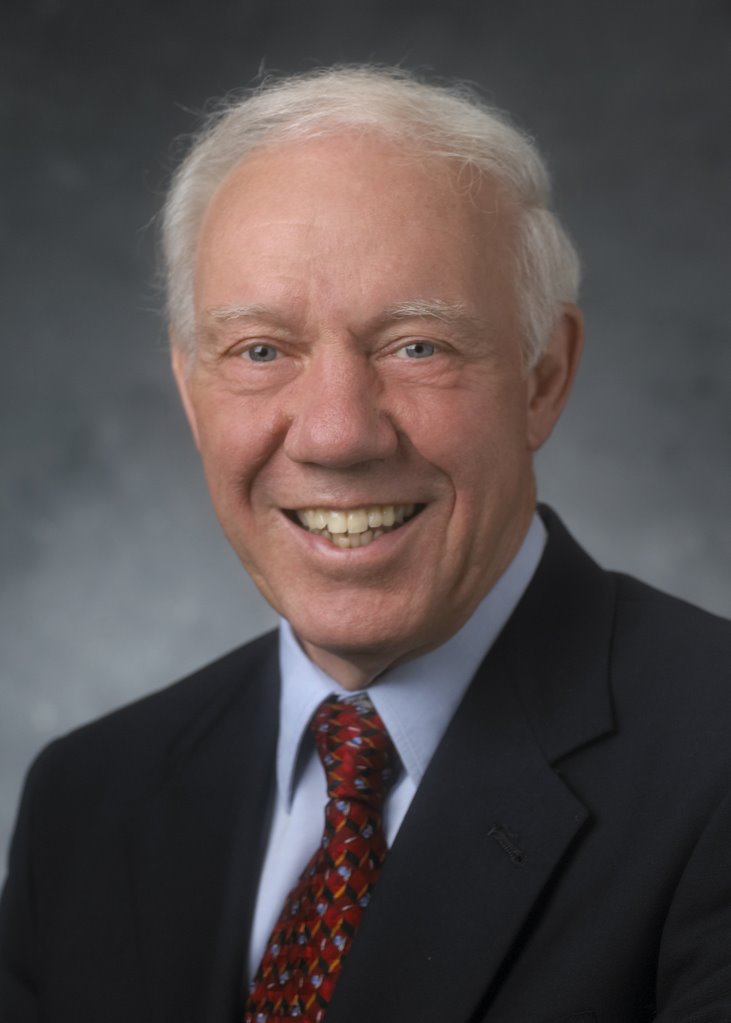
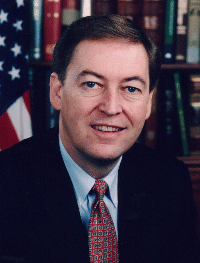
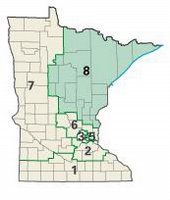
It's been nearly 60 years since a Republican has held northeast Minnesota's 8th Congressional District seat, and incumbent Rep. Jim Oberstar has manned the fort 32 of those years. Despite his experience as a US senator (1995–2001) and representative (1993–1995), challenger Rod Grams has his work cut out for him--and has resorted to some tough campaign tactics to gain a foothold. He was dubbed "best mudslinger in the northeast" by the Cloquet Pine Journal for attack ads, prompting an editorialist to write, "I think he's probably planning to dig up some dirt on Oberstar's dog's travel record"--a reference to Grams' accusation that Chisholm is no longer the congressman's official hometown ("a rotten lie," according to Oberstar).

Despite Grams' longshot--the New York Times dubbed his campaign "quixotic" yesterday--the race has proved more exciting than many pundits predicted, with Grams creating mailers likening Oberstar to a Frenchman and characterizing the congressman's desire to withdraw troops from Iraq as "A Plan to Cut and Run from Islamic Terror." But fiery rhetoric aside, here's a far-from-comprehensive look at how the two candidates stand on key issues that affect the 8th Congressional District.
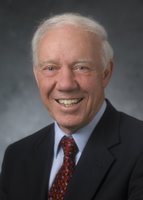
Jim Oberstar, Democrat (incumbent)


Energy: Supports ethanol and alternative fuel development through tax incentives. Opposed construction of new oil refineries. Voted against Bush's national energy policy. Voted for raising corporate average fuel efficiency [CAFE] standards for cars, light trucks, and SUVs. Advocates alternative technologies including biomass and windpower; introduced a bill to install photovoltaic panels on government building rooftops.

Environment: Authored the Clean Water Restoration Act, which would restore federal jurisdiction of wetlands to pre-2001 levels when the Supreme Court restricted federal oversight to “navigable waters.”

Healthcare: Supports universal health coverage. Believes Medicare Part D should be expanded so the government can negotiate lower drug prices and allow drug importation from Canada.

Immigration: Voted against the construction of a wall along the US-Mexico border. Voted for the Border Tunnel Prevention Act. Opposed the Border Protection, Antiterrorism, and Illegal Immigration Control Act "because it did not provide a comprehensive and realistic plan to combat illegal immigration."

Iraq War: Voted against authorizing the use of force in Iraq (October 2002), against declaring the war part of the War on Terror (June 2006), and against the Military Commissions Act. He has called for a withdrawal of US troops "at the earliest practicable point."

Social Security: Opposes privatization.

Taxes: Supports the repeal of tax cuts for people earning over $315,000 per year.

Transportation: A ranking member of the Transportation and Infrastructure Committee, he'll likely become committee chair if re-elected. He has brought millions in federal highway money to his district, while also championing the construction of bicycle paths. If he becomes committee chair, he'll push for more funding to Amtrak and urban transit (light rail, etc.).
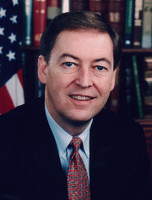


Rod Grams, Republican


Energy: Says he'll seek federal funds to help build the state's first poplar-based ethanol plant. Supports expansion of biodiesel production.

Environment: Opposes the Clean Water Restoration Act, saying it gives federal authorities too much power over local issues. Grams says, "Our environmental regulations are at such a high level, there is no room for jobs." He also questions whether "we are causing the so-called, 'global warming' or if it a natural occurence."

Healthcare: Supports Bush's Health Savings Account (HSAs). Opposes single-payer or government-run healthcare. Wants to allow self-employed workers or those who can’t get policies through work to be able to deduct 100% of policy costs. Supports "government vouchers to enable low income and others the opportunity to purchase the health care insurance that would best suit their needs."

Immigration: While referencing "invading" illegal immigrants, Grams supports a guest worker program. Says our borders must be "air-tight."

Iraq War: Favors sending additional troops. Links the 9/11 attacks to the Iraq War: "The front line is now in Iraq rather than on our shores." Says a withdrawal of troops amounts to a betrayal of US troops.

Taxes: Opposes the repeal of the Bush tax cuts, adding, "NO TAX INCREASE!"

Social Security: Says "all options need to be on the table including some percentage of private accounts to ensure a strong future for social security."


Other issues: While Oberstar opposes gun control and abortion, his voting record is otherwise solidly progressive: he voted against extending George W. Bush's tax cuts, opposed a proposed constitutional amendment to ban flag burning and efforts to ban embryonic stem-cell research. Oberstar opposes a constitutional amendment prohibiting gay marriage; Grams supports such an amendment.

Also running: Unity Party candidate Harry Welty.

[Cross-posted at Minnesota Monitor.]
11.01.2006

One man, many votes: On owner-driven endorsements

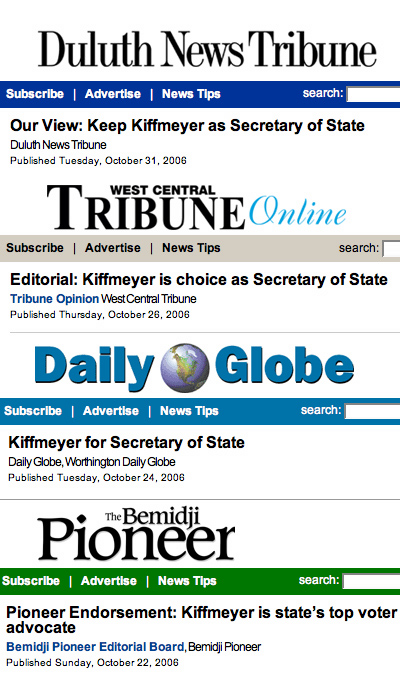
Minnesota's incumbent Secretary of State candidate Mary Kiffmeyer appears to be picking up endorsements right and left: in a single week, she nabbed the nod from the Bemidji Pioneer, the Daily Globe in Worthington, the West Central Tribune in Willmar, and the Duluth News Tribune. And so does her ticketmate, Republican Jeff Johnson, who is running for attorney general: within days, he got noteworthy endorsements from the Detroit Lakes Tribune and the same Willmar and Worthington papers as Kiffmeyer.

But what looks like a Republican groundswell surging across rural Minnesota can be explained more simply: all seven editorials expressed the political preferences of one man, a practice that's more common than you might expect.

William C. Marcil is the president and CEO of a media mini-empire that owns the Fargo-Moorhead Forum, all the newspapers mentioned above, and around 30 other publications--not to mention a half dozen printing houses, three broadcast stations and an internet service provider. But when it comes to political endorsements, the company name, Forum Communications, is a bit of a misnomer: endorsements aren't determined through open debate and discussion by members of a local editorial board; they're decided upon by Marcil in his Fargo office and emailed to papers in Minnesota, the Dakotas, and Wisconsin.

Brad Swenson, editorial page editor of the Bemidji Pioneer, confirmed the policy in an interview yesterday. "Technically, it's part of the job. He owns the paper, he can say who gets endorsed," he says, adding, "Personally, in a lot of those races, I'm not voting that way."

While it's unusual to have such centralized decisionmaking, it's not uncommon for publishers to wield their political or personal philosophies over editorial boards, says Kelly McBride, Ethics Group Leader at the Poynter Institute. "Most editorial boards are a mouthpiece for the publisher," she says, although she believes such practices are a "slight problem."

"I’d prefer to see the more traditional model, a decentralized model where individual publishers in individual newsrooms guide that process," she says. "The thinking is that, although you represent Corporate, you live in this community. You know the community and what’s best for [it] better than some far-flung corporate office would."

This year's slate of Marcil-tapped candidates includes Kiffmeyer and Johnson, Tim Pawlenty (who will be endorsed by the paper tomorrow), and auditor Patricia Anderson. On the Minnesota Transportation Amendment, all Forum-owned papers are instructed to take a "no" stance. Also getting the nod are two Democrats, Amy Klobuchar and Collin Peterson.

It's been this way for a long time. In 1990, The Forum's editorial page editor Jack Zaleski wrote, "An editorial board (at least The Forum's) is not a democracy. Marcil has the biggest vote--the only vote in certain circumstances." A more current verification of this fact comes from Mike Jacobs, publisher and editor of the Grand Forks Herald, which was recently bought by Forum in June after the previous owner Knight-Ridder was purchased by McClatchy. While he wasn't available for comment on this piece, he wrote in the October 29 edition that "all Forum-owned newspapers endorse the same candidates in statewide races and take the same positions on statewide ballot measures." He adds that, after coming out on the losing end of a discussion in which he argued against endorsements altogether, Marcil concluded, "Endorsements are an important responsiblity of newspaper ownership."

But is the responsibility of newspaper owners to local readers or to a political agenda? Marcil's leanings are decidedly Republican--and aside from a few endorsed Democrats over the years--seems to affect his official editorial stances.

According to the Federal Elections Commission, Marcil has given $26,850 in individual political contributions. Of that, $2,000 went to GOP candidates (George W. Bush, Duane Sands, John Dorso), $7,250 went to the Republican National Committee, and the rest was donated to a PAC run by the National Association of Broadcasters, which in the 2004 cycle favored Republicans over Democrats by a nearly two-to-one margin of giving.

If that responsibility is to, say, democracy, how is the citizenry served when a Fargo-based individual opines on the best federal or state candidates in, say, Duluth or Stillwater--or, for that matter, Hudson and River Falls, Wisconsin? Swenson says that while papers are given no copy points for penning endorsements, Forum management has in past years offered to supply verbatim text upon request. For local races or in the 8th Congressional District (where Jim Oberstar is the Pioneer's preferred candidate), editorial boards are free to arrive at their own conclusions.

Things have changed at Forum Communications' flagship paper, Zaleski says: the Forum went from being a paper that "read like a newsletter for the Republican party" to one that this year has publicly sided with Democrats Klobuchar and Peterson (although Swenson retorts, "I challenge you to find a more conservative candidate than Peterson, from either party"). Regardless of the political allegiances or specific endorsements Marcil makes, there's a bigger question. Marcil's opinions are broadcast, sans disclaimer, to newspapers that have a combined weekday circulation--more than 246,000 papers--that surpasses even the Sunday edition of the St. Paul Pioneer Press (245,875), according to Minnesota Newspaper Association documents.

That sizable figure is sure to decrease as the newspaper industry loses readers to other media outlets, like the internet. On top of that, endorsements are meant to spur debate, McBride says, not to influence elections.

"It’s been a long-held understanding that editorial endorsements don’t actually influence a race very often, and they’re not really meant to," she says. "What they’re meant to do is engage an audience in a dialogue. That’s why you have the op-ed page—opposite the editorial page--where you have dissenting voices, a wider variety of voices."

"Part of the problem with the editorial pages in general is: it’s not the process by which they arrive at their product but the product itself -- which is notoriously boring."

Cross-posted at the Minnesota Independent.

Two transformations: tragedy to profit, swords to ploughshares

One deals with hope, the other cynicism.


In the first, a commercial for Chevy Trucks uses images of 9/11, Vietnam, and civil rights icons Martin Luther King and Rosa Parks to boost sales. The New York Times writes that, while consumers are accustomed to GM wrapping itself in the flag, this time around their patriotism "took on a more desperate air, all but setting the flag on fire to honor it."
As the commercial begins, an industrial history rolls out, touching the usual icons of the Statue of Liberty, busy factory workers and Americans at their leisure. But then a more conflicted narrative emerges, quickly flashing on bus boycotts, Vietnam, Nixon resigning, Hurricane Katrina, fires, floods, then the attacks of Sept. 11, replete with firefighters.

All that’s missing is a plague of locusts, until the commercial intones “This is our country, this is our truck” as a large Silverado emerges from amber waves of grain.

The message seems to be that, even though America has been in the ditch several times during its history, it has always managed to pull itself out. And what is true for the country must be true for General Motors. It could be pointed out that Detroit and General Motors are in a ditch mostly because they drove there, ignoring global competition and consumer needs in pursuit of quarterly profits. But the back story of the disaster is obscured by the universal need to rebound.

Critics have attacked the ad, in part because it also invokes Martin Luther King Jr. and Rosa Parks to sell trucks. But something more subtle, perhaps more cynical, may be at work here: the image of America (and its leading auto manufacturer) as victim, mostly of itself, but still worth loving.

“The first time I saw it, I thought, holy mackerel, they are using negative images to generate positive emotions,” said Bob Garfield, the advertising critic of Advertising Age. “I have never seen that in a commercial.”

“I feel a little violated when I watch it,” he said. “I don’t mind when they have a tent sale on President’s Day, but those guys have been dead for 200 years. I’m not sure I’m ready for a Rosa Parks sale-a-bration.”

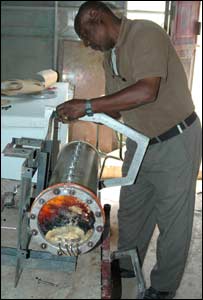
Meanwhile, in Ethiopia, where mortar shells remain embedded in the ground from the 1998–2000 war with Eritrea, one man is taking war's detritus and converting it into useful tools: he's turning burned-out bomb casings into cylinders for coffeepots that brew Ethiopia's famous beans.

About nine years ago, Azmeraw Zekele came up with the idea of using spent shells for coffee machines after seeing them converted into cylinders for washing machines or "for crushing things." Now, he saws off the pointed ends and drills holes to convert the meter-high aluminum cylinders into brewpots.

Given his product's connection to war, Azmeraw often has to overcome resistance from potential buyers. "Sometimes I think about the fact they were used for war but I want to change them to do something good. They could be a symbol of war but I am doing something good out of the bad."

(Thanks, Stephan and Dad.)

From iPod to iFrod.

Apple honcho Steve Jobs famously says we "have to buy a new iPod at least once a year." To be fair, he was referring to the tech-obsessed (and, apparently, money-to-burn) buyer who always wants "the latest and greatest." But if you're like me, you might want a new one to replace the broken one in your junk drawer.

Enter: Stay Free! In a project on planned obsolescence, they're asking, "Why does the portable player widely considered the hallmark of savvy design typically die in little over a year? Are ipods 'made to break'? Or simply, as some critics have suggested, run-of-the-mill e-waste?"

They're looking for broken iPods--your donationed pods are tax-deductible!--for a project that'll be lauched at iFrod.org, plus they'd like iPod artists to transform their impotent units into "something deliciously useless: finger puppet? toy car? coaster?" Email photos of your creations for display on the site.

Details here.

10.31.2006

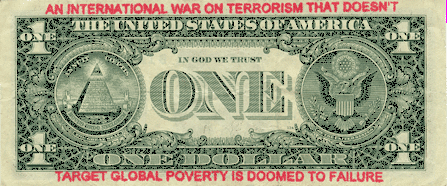
$1 protest


Cook Report: "No Ebb in the Wave"

Comparing the 2006 mid-terms to the 1994 route of Republicans wielding laminated "Contract with America" cards, Charlie Cook of The Cook Political Report predicts good things for Democrats next week:

With the election just eight days away, there are no signs that this wave is abating. Barring a dramatic event, we are looking at the prospect of GOP losses in the House of at least 20 to 35 seats, possibly more, and at least four in the Senate, with five or six most likely.

If independents vote in fairly low numbers, as is customary in midterm elections, losses in the House will be on the lower end of that range. But if they turn out at a higher than normal level, their strong preference for Democrats in most races would likely push the GOP House losses to or above the upper levels.

MN Sec. of State errs on state, campaign sites

It seems the charge leveled by the Minnesota Democratic Party against Mary Kiffmeyer yesterday--that she failed to maintain accurate and updated information on the frequently-asked-questions page on the Secretary of State's website, including adding language approved in May 2005 that addresses voting elegibility for ex-felons--might also apply to the incumbent's campaign site as well.

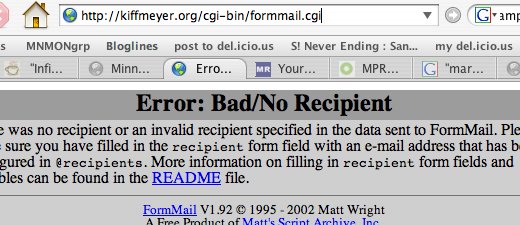
After several weeks without any noticeable changes, Kiffmeyer.org--a site adminstered by her son, James Kiffmeyer--now shows new content on the endorsements page, altered on Saturday. However, since at least mid-September, the function that allows visitors to sign up for Kiffmeyer's e-mail newsletters hasn't worked. It only yields the message, "Error: Bad/No Recipient."


While her challenger, Democrat Mark Ritchie, wouldn't comment on Kiffmeyer's campaign website, he says that her management of the Secretary of State's site transcends mere carelessness.

"I've held several press conferences pointing out inaccurate information, incorrect information, failure to implement laws and failure to implement court orders," he says. "There's a pattern there that I think is inexcusable. It appears to be partisan, and it's unacceptable this close in to an election. I feel like the inaccuracies have been pointed out long enough that their continued presence on the website is intentional and therefore is a deceptive practice. It'll be up to the courts to decide if it meets the test of deceptive practices spelled out in Minnesota law."

James Kiffmeyer has not yet responded to an email asking for comment.

10.30.2006

Unsafe.

At least we're safer than Compton. In a new ranking of safest cities, Minneapolis scores woefully low: 345th out of 371 (St. Louis was the worst, Compton ranked 368. Best: Brick, NJ.) The rankings look at FBI statistics in cities with populations over 75,000. How safe is your city?

10.28.2006

Like talking to a shrub...

In the noisy clutter of TV advertising, the best way to cut through is with a simple clear message. And a new spot by Harold Ickes' 527 group, the September Fund, uses an easy gag to take a swipe at our tin-eared president: getting answers on everything from an Iraq withdrawal to why the hurricane-struck Gulf Coast is so slowly rebuilding--is like talking to an actual bush (rimshot). According to the Washington Post, Democratic organizer Ickes has raised somewhere between $5 and $10 million to air the spots in key states, including the Twin Cities, during the final days before the election. As Republican groups prepare to sink millions on TV placements (and money is tight for Democrats) one last effort to link GOP candidates to the ever-unpopular Bush is probably smart, but to this writer, the ad offers a bit of comic relief amid the increasingly ugly barrage of attack ads.


adMN is an ongoing review of communications created to shape Minnesota's campaigns and culture.

10.26.2006

10.25.2006

Stay the course: Mark Kennedy promises more war


In his newest TV spot, Minnesota Senate candidate Mark Kennedy delivers a "stay the course" message on Iraq--a mantra even George W. Bush appears to be jettisoning--wearing crisp-pressed khakis in an idyllic country setting amid the somber swell of classical music. When Kennedy, a man who never served in the US military, tells of the "harsh reality" of the war (that if the US leaves, the country will become a "breeding ground for new attacks on America") he seems pretty far removed from said realites. He fails to mention the sacrifices of those who are there fighting or, worse yet, offer a single new idea on how to resolve the deadly conflict.


Kennedy seems to be banking on a tone of principled determination in the spot: he's the man tough enough to deliver truths that "may not be what you want to hear." It's a bold strategy--standing unequivocally for an increasingly unpopular war, even as the president admits that Vietnam (the 1968 Tet Offensive, to be precise) might be an apt metaphor for this point in the conflict--but it offers nothing to suggest his determination might yield positive results in Iraq. He rejects diplomacy outright, and chides opponent Amy Klobuchar by saying "securing the peace is a lot harder than wishing for it." But he offers nothing other than wishes for peace himself--and more war.