5.31.2006

Lo-fi metal map

I love this map of the Heavy Metal Family Tree. Via Mindgum.

And: Best line from the New York Times Magazine's profile of doomcore-trance band SUNN0)), by Greg Anderson, one half of the robe-wearing, fog-lurking metalhead duo that's been playing the Knitting Factory and the Walker: "Steve's the arty guy in the band. I'm the guy that likes to stay home and watch 'Seinfeld.'"

DIY miracle

As a longtime food-miracle chronicler, this makes the Jesus-on-toast experience available to all--for just $29.99. The Jesus Pan, for faith and profit.

Speaking of miracles: Pat Robertson says he can leg press 2,000 pounds, thanks to his patented protein shake. Trouble is, the world-record leg press is 665 pounds, and the guy who earned the distinction burst the capillaries in his eyeballs doing it.

5.26.2006

Why can't we all get along?

Republicans/Democrats, Sunnis/Shiites, black/white, Americans/the rest of the world: we all oughta take a lesson from the animal kingdom. A mother lion in captivity gave birth to three premature cubs, but due to low birth weight they all died. When the mother's health started drastically declining due, most likely, to depression, the zoo lined her up with the only orphans they could find--a batch of piglets, cleverly disguised as tiger cubs. [via eyebeam]

And in Germany, a swan demonstrates that love knows no bounds: a black swan in Muenster has reportedly fallen in love with a white, swan-shaped paddleboat many times its size.

How Jenna's boyfriend got into Harvard.

How does a college dropout get into Harvard Business School?

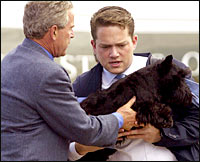
By carrying the president's Altoids:
A 26-year-old college dropout who carries President Bush’s breath mints and makes him peanut butter-and-jelly sandwiches will follow in his boss’s footsteps this fall when he enrolls at Harvard Business School (HBS).

Though it is rare for HBS—or any other professional or graduate school—to admit a student who does not have an undergraduate degree, admissions officers made an exception for Blake Gottesman, who for four years has served as special assistant and personal aide to Bush...
Among the high points of Gottesman's CV are one year at Claremont-McKenna College, experience as an aide to Andy Card and personal assistant to Bush, and... having dated Jenna Bush ten years ago. His duties today range "from dog-sitting the president’s Scottish terriers, Barney and Miss Beazley, to carrying the president’s speeches and giving him the 'two-minute warning' before a speech begins."

RIP Desmond Dekker

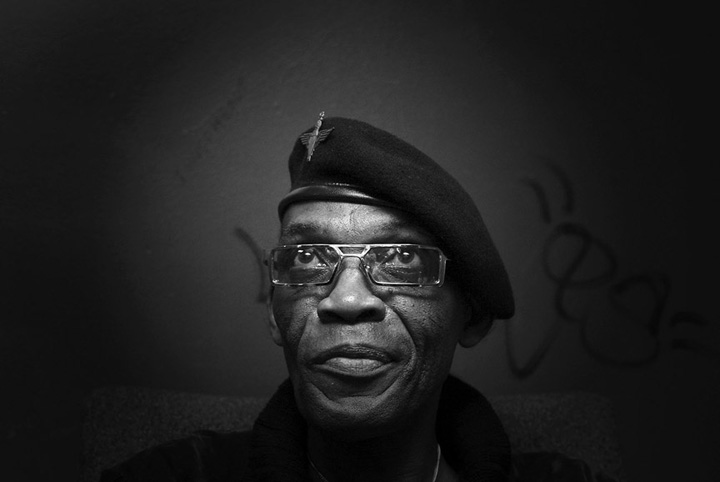
Reggae and ska great Desmond Dekker, born Desmond Adolphus Dacres in Kingston, died of a heart attack Wednesday night at age 64. The first Jamaican artist to have an international hit, he was considered the island's first reggae legend. "When he released 'Israelites' nobody had heard of Bob Marley," says his manager, Delroy Williams. "He paved the way for all of them."

Photo: David Jiro

5.24.2006

"Bring back Dada!"

Charles Marowitz on the Nationial Gallery of Art's Dada exhibition:
We, in the morass of Iraq, daily toting up fatalities and reeling from internecine strife in the Middle East and bitter divisions in our own country, are living in Dadaist times -- except there are no Dadaists around to express our anger and frustration. Instead, we studiously chronicle the atrocities and then "op-ed" them to death. Our films routinely reproduce the sadism, violence, and terror which are the basic preoccupations of our era; our theatre companies churn out documentaries of the appalling events which disturb our "domestic tranquility"; our media-mavens regularly dispense moral indignation and expose the corruptions of which every day brings us some new and grotesque installment. Our dissent is civilized and law-abiding; our demonstrations orderly and "peaceful," our wrath bitterly suppressed.

"Milton thou shouldst be living at this hour" is a cry that should be replaced by "Tzara, thou shouldst be living at this hour!" Where is the renegade art that should decry the lunacy of these renegade times? The artists are as silent as the students, the students as comatose as their parents. Dissent has had to "make do" with nuanced perceptions of injustice and gentle knuckle-wrapping of criminal leaders like Bush, Blair, Putin, and Ahmadinejad, thieving lobbyists, corporate embezzlers, and ghoulish, puritanical, smug and well-placed church-going neocons.

What established American artist today would dare to paint a moustache and goatee on the Mona Lisa, smash out George Washington's wooden teeth, or show Thomas Jefferson copulating with Sally Hemings? No, we content ourselves with the satirical barbs of Jon Stewart and Stephen Colbert, Jay Leno and David Letterman; revel in comic aperçus which show that we Americans can "let our hair down" as well as the next man, "kid" our leaders and "send up" our congressmen. All we seem unable to do is counter the transgressions of our faltering democracy or find candidates without Achilles' heels to elect.

Moral disgust is precisely what engendered the spirit of Dada. Bring back Dada say I!
Via Cursor.

5.23.2006

Building an elephant-proof house

I wrote a short piece for the Twin Cities' monthly The Rake on Cameron Sinclair of Architecture for Humanity. It starts out like this:
Humanitarian architecture: On the glamour meter, the term is right up there with “FEMA trailer.” But during a recent discussion on the topic at a noisy Dinkytown bar, my ears perked up when an “elephant migration specialist” was listed along with soil engineers, architects, and government officials as a crucial collaborator on a relief project in a tsunami-struck Sri Lankan village. Cameron Sinclair, who had just finished a semester as a visiting professor at the U of M, was talking about how designers were granted permission to rebuild several buildings on a vacant lot.

But after meeting with community members, they learned why the lot had stood empty so long: “It was on a migrational route for elephants, and when elephants get really tired, they lean against trees and fall asleep ... They lean on poorly built houses and then the houses collapse.”

The housing was built elsewhere.

While perhaps not truly glamorous, this bit of trivia does offer a glimpse into Sinclair’s work as humanitarian architecture’s foremost advocate...
Read the whole thing.

5.22.2006

Buying overconsumption?

Sarah at Inhabitat:
Danish designer, Mads Hagstrom, director of The FLOWInstitute at Dansk Design Centre, brought a show-stopping installation to ICFF [the International Contemporary Furniture Fair]. FlowMarket sits in the middle of the exhibit floor, enclosed in a sheer white curtain. The booth is set up as a store, but the products on the shelves are empty containers with generic labels addressing the plagues of consumer culture.

Plastic drink bottles read “Clean Tap Water”; Spam-like tins say “100% GMO”; a cold case contains aluminum soda cans labeled “Renewable Energy”; rows of pill bottles say “Valuebased Consumption.” It’s a powerful space - clean and white - with a hanging poster in the middle quoting our friend, Anna Lappe: “Every time you spend money, you’re casting a vote for the kind of world you want.”

What’s a little disconcerting is that this booth isn’t just set up as a store, it is one. You can buy everything you see.

And people were buying! Granted, like a gift shop in a museum, the items you can pick up at FlowMarket are low-cost compared to the pricey, high-design items on display throughout the rest of the building. They are takeaways that act as little reminders of the show, and of they wheel of consumerism we’re all spinning.

Nevertheless, I wonder how the designer reconciles selling disposable packaging as a means of criticizing overconsumption.

e-tuktuk

I love this idea: e-tuktuk takes the ubiquitous three-wheeled motorcycle of Southeast Asia and transforms it into a mobile internet/community radio station. Devised by Kothmale Community Radio (KCR) in Sri Lanka, e-tuktuk is both a mobile broadcast center and a training facility/community megaphone:
The E-Tuktuk contains a laptop computer, battery operated printer, camera, telephone and scanner. Internet access is provided via a CDMA-enabled wireless connection, and electricity is provided via a generator. A roof rack allows the vehicle to carry other equipment such as the KCR's mobile broadcasting unit.

Radio programmes are narrowcast via two loud speakers mounted to the roof rack. The speaker system is used to announce the telecentre's presence when it arrives in a village or designated location. The weekly route of the E-tuktuk is broadcast over the radio to inform listeners about the location and time that it will arrive in their community.
As UNESCO writes, e-tuktuk can reach geographically isolated areas of the Kothmale region, but its goal is to bridge more than geography: KCR seeks to engage those marginalized due to caste, race, gender, and, presumably, education and economics. And by bringing such technology to the people, it makes it less daunting.

“Lots of people in this area don’t even know what the internet is. I think the etuktuk is a really good way to introduce and improve our knowledge about information technology and the narrowcasting gives a voice to local people and all of us in the community,” says Buddhika Darshana of Kothmale CMC.

Via SmartMobs.

5.21.2006

Framing the border.

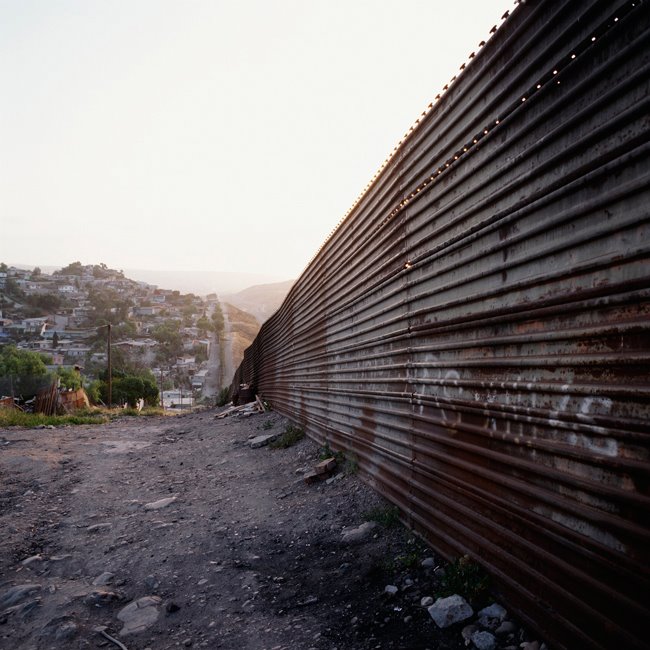
For the Border Film Project, William Howard distributed 100 disposable cameras to minutemen and migrants along the Mexico border. For a project in Polar Inertia, Howard offers his own timely take on the demarcation line between the US and Mexico. "As I photographed the border from the Mexican side I tried to imagine how it must look to immigrants from the south, arriving there for the first time and being able to peer beyond the walls into the United States. What are their hopes and expectations?"

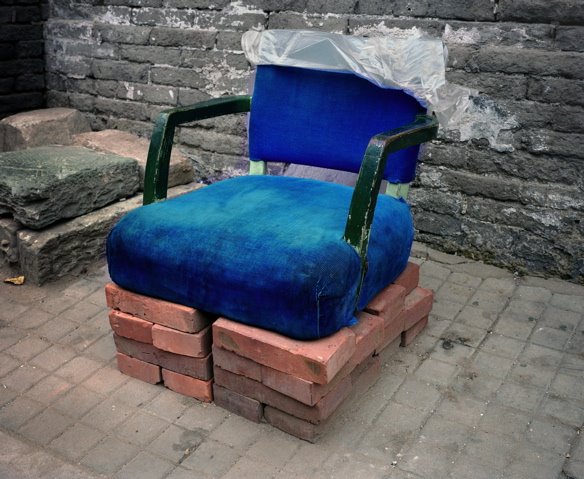
Bastard chairs

Another great project from Michael Wolf is his Bastard Chairs series featuring a range of outcast, modified, and otherwise tricked-out chairs from his travels around the world.

100 x 100

Photographer Michael Wolf photographed 100 residents of Hong Kong's oldest public housing complex. While the rooms are identical 10 x 10 boxes, the variations seem endless.

Dodo stamps.

Pib Burns' fascinating homepage covers topics like cryptozoology and astronomical catastrophism, but I especially like his collection of dodo-themed postage stamps. While the birds have been extinct since 1681, they're the continuing source of fascination by stamp collectors and explorers alike (William Gibbons, upon hearing rumors that dodos were spotted in the island of Maritius in the Indian Ocean, mounted an unsuccessful expedition there in the 1990s). Marituius, Laos, Cuba, and Micronesia have all produced commemorative stamps.

5.20.2006

The question.

Graffiti on the Siah Armajani footbridge in downtown Minneapolis (the text is part of a John Ashbery poem that spans the 16-lane-wide bridge).

Free Republic: PEACE rally is "hate parade"

Last night, the PEACE Foundation held a rally here in North Minneapolis: 1500 people linked hands the length of 26th Avenue, one of the roughest streets in this very poor, mostly black neighborhood, as a symbol of solidarity and a commitment to nonviolence. As the rally was going on, a kid was shot in the back a block away.

How do the rightwingers at the Free Republic interpret this sad story? As a "hate rally." Assuming such a gathering must be an antiwar rally, one commenter wrote:
There haven't been any "Peace Rallies" in this country in years.

They're all "Hate Parades" for people smart enough to walk but too stupid to bath [sic].
Others joked that the victim, a 16-year old boy, must've been carrying a "God Bless Our Troops" sign. PEACE stands for Public Engagement and Community Empowerment and is dedicated to curbing the violence in this neighborhood that claims a life nearly every other week.

5.19.2006

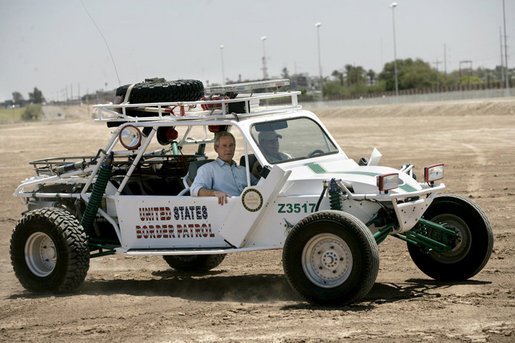
Borderlining.

Bush on the border.
Bush's approval, via The Daily Show.

The Clean Hub

Architect John Dwyer has designed The Clean Hub, housing for areas with insufficient infrastructure. The 10 x 20-foot unit includes a V-shaped roof that collects rainwater, an underground reverse-osmosis filtration system to recycle and store gray water from showers and laundry facilities, and 16 rooftop adjustable photovoltaic panels that can generate up to 2,600 watts of energy. For more on this architectural Swiss Army knife, visit Utne.

5.17.2006

DNR not GNR

While GNR--Guns 'n' Roses--has ended up inked on a fair share of body parts, I'm not sure DNR has. But, 80-year-old Iowan Mary Wohlford, not wanting to become the next Terri Schiavo, has had the words DO NOT RESUSCITATE tattooed on her chest as a directive to doctors and EMTs. The Schiavo controversy, as well as memories of what she's witnessed at her nursing home, were behind the idea, although lawyers are doubtful such a statement is legally binding. Wohlford muses, "I probably should have had it dated, too." Via Sploid.