Showing posts with label media criticism. Show all posts

4.21.2007

Our Own Imus: City Pages Scrubs Editor's Stereotypes from Story

Kevin Hoffman, new editor of the Twin Cities altweekly City Pages, ventured into Don "Nappy-Headed Hos" Imus/George "Macaca" Allen territory this week in a news item that squeezed three questionable ethnic stereotypes into a wee 291-word piece entitled, "New Delhi Star Tribune: Local businesses, meet your new advertising partner, Habib."

Reporting on Star Tribune plans to outsource some 25 jobs to New Delhi, Hoffman's April 18 piece referenced a week at the Star Tribune "that saw new publisher Par Ridder smacked around like a two-bit ho in a lawsuit filed by his former employer." Hoffman also called the Strib's outsourcing plan "Operation: Sanjaya," after the wouldabeen American Idol Sanjaya Malakar, who is an American citizen born to an Italian-American mother and Bengali Indian father in Seattle. Both references -- which can be seen in Google's cache -- have been scrubbed from the paper's online story.

One curious stereotype remains: Hoffman predicts that within six to nine months, the paper's ad designer "will be taking a rickshaw to work." Rickshaws, while used in India, got their name from their country of origin, Japan -- not the home country of "Habib," whose name appears in the CP subhead.

[Crossposted at Minnesota Monitor.]

4.08.2007

Catching Up with The Crasher: Mike Tronnes Discusses Cursor at 10

When Mike Tronnes co-founded the website Cursor.org with Rob Levine, Mike Mosedale and Brad Zellar ten years ago, few of the attention-getting strategies of the internet were at his disposal. Cursor predated Digg and Reddit, RSS was an acronym just being born, and social networking sites like MySpace and Facebook didn't yet exist. He had to resort to desperate measures to promote his site. And, brilliantly, he did so in a highly visible way that simultaneously promoted Cursor's mission of media critique: He'd crash live newscasts, showing up on-screen behind reporters holding signs that cleverly exposed the hype-generating ruses they employed.

The first time I saw Tronnes, he was standing behind WCCO's Randi Kaye as she lead off the evening news with a "LIVE" report broadcast from the field where new governor Jesse Ventura had coached the Champlin Park High School football team... hours earlier. Questioning the newsworthiness of the story -- and its "live" coverage from a venue long emptied out of its newsmakers -- he held up a sign that read
"Can't this wait until the sports news?"

There on the sign was the URL for Cursor, an online source for more criticism of the Twin Cities media scene. In the ten years since, Cursor has expanded its scope to include viewpoints on national media and both national and international politics. It now gets site visits in the five figures every day, and its Media Transparency project, spearheaded by Levine and launched in 1999, has compiled one of the more extensive maps of the conservative philanthropy movement, tracking 40 grantmaking groups on the political right and where their more than $3 billion in gifts are going.

On the site's tenth anniversary and with a fundraiser in progress, Tronnes agreed to discuss Cursor, his time as "The Crasher," and the evolving nature of the progressive blogosphere.


Paul Schmelzer:
What are some of your favorite "media crasher" moments?

Mike Tronnes: When Cursor began in 1997, most of our invective was directed at local TV news. Even then it was hopelessly beyond reform, but it did provide endless opportunity for ridicule. We had a columnist named "Budd Rugg," who skewered the idea of local media celebrity, and whose schtick was that of a pathetic media sycophant. In 1999 I had a brief star turn as "The Crasher," walking onto live remotes of local TV newscasts while brandishing signs that both advertised Cursor and questioned what passes for reporting on TV news. I made my way onto a live remote from a Prince concert with a sign that read, "The program formerly known as The News."

Another trend that was ascendant at the time was synergizing news stories and network programming. It reached its peak -- or nadir, depending on your perspective -- in the summer of 2000 when WCCO-4 turned its newscasts into a promotional vehicle for the just-launched "Survivor." We documented this flagrant violation of the public trust in "Survivoring the News," and in a City Pages cover story that I worked on with Mike Mosedale, a founding member of Cursor, whose gonzo media criticism is archived in "The Moseum."

PS:
When you started Cursor, the online media landscape was completely different. What are the changes you've seen in the realm of blogs and online media, and how is Cursor adapting to this new climate?

MT: Cursor.org began in 1997 as a local media criticism site. In 1999 we started a national version of our "Media Patrol" digest, adding politics to the mix, and after 9/11, expanded it to include international affairs. At that time the blogosphere was dominated by right-wing voices and many now-popular progressive news aggregators didn't exist. Nor did Google News, which is invaluable for seeing where a story's at, and what kind of play it is or isn't getting. Also, there were no sites like Media Matters or Think Progress that provided rapid response to conservative misinformation and the mainstream media's parroting of it.

This proliferation of sources certainly allows us to cover more ground, but it also makes our aggregating function trickier, because a lot of our readers also frequent those sites. And while we're always on the lookout for articles and issues that haven't made their way around the progressive aggregators and blogosphere, much of our effort is spent contextualizing those that have. Now it's less about discovering a story, and more about organizing and advancing it.

PS: Your site Media Transparency, maintained by Rob Levine, was one of the first resource portals to look into the funding of the political and religious right...

MT: Right. When Media Transparency launched in 1999, most people had only heard the term "vast right-wing conspiracy," without knowing much about it or how it functioned. But as conservatives expanded their influence in government -- see The Conservative Movement Moves In -- Media Transparency's research and editorial became invaluable for reporting on the impact that conservative philanthropy has on public policy. We currently track 40 conservative funders in a database that includes 8,000 recipients of 50,000 grants totaling more than $3 billion.

And while Cursor mainly draws from other editorial sources, Media Transparency is a content provider for anyone investigating conservative causes and organizations. Two good examples that I mentioned before are Media Matters and Think Progress. Cursor often links to them, and they in turn regularly link to Media Transparency's research.

PS: With Cursor and Media Transparency, your role is less visible: fundraising, hiring writers, marketing. An new article in The Nation talks about the funding of bloggers, how many news bloggers are volunteers, and how "progressives tend not to put their money where their mouth is." Cursor is a nonprofit that relies on grants and individual donations to survive -- and you're doing a fundraising appeal now. When you pitch potential funders, what's your best argument for the continued (and generous!) support of Cursor/Media Transparency?

MT: Cursor and Media Transparency are incorporated as Cursor, Inc., which is a 501(c)(3), the IRS's designation for non-profits. The majority of our funding comes from foundations, and our general argument to them is that we've successfully developed two Web sites and are an integral part of building what is often referred to as "progressive media infrastructure." We've put together an online fundraising site built around this theme, which includes an archive of articles and editorials about funding progressive infrastructure, called "Work In Progress."

Since most left-of-center foundations don't give grants for general operating support, unlike their counterparts on the right, our proposals have centered on specific projects relating to Media Transparency. The pitch being that with additional funding, we can promote Media Transparency's research to a more mainstream media audience. The goal is to get reporters and producers that cover subjects like school vouchers, Social Security privatization, or faith-based initiatives, to follow the money trail and paint a more complete picture of who's behind the various policy proposals, which are often inaccurately portrayed in the media as being grass roots in nature. The great irony is that while Media Transparency tracks more than $3 billion in conservative funding, we're scrambling to get a piece of the much-smaller pie that's available to progressive organizations.

2.13.2007

Annarama! Anna Nicole Smith and the Experience Newspaper

Where were you when you heard about Anna Nicole Smith's death?

An odd question, for sure, since it seems to put the tragic end of a Playboy/Guess model's life last Thursday in the same category as, say, John F. Kennedy's assassination or the Sept. 11 terrorist attacks.

But seriously, where were you? I was at work, and a friend who gets CNN's breaking headlines via email told me about it. I definitely didn't learn about it by cracking open a newspaper. Yet, 12 or so hours later, when the morning edition of the Star Tribune came out, there was the news I—and the majority of the Web-connected, cable-news-watching, SMS-enabled, or e-mail-alerted world—already knew, right on the front cover.

But on Feb. 9, my morning paper wasn't alone. Of the 300 U.S. papers whose covers are recorded at the site Newseum each day, all but two dozen—not even 10 percent of the papers—deemed it big enough news to merit front-page coverage. Some used the photo to tease readers inside to learn more on Smith's demise, while many began telling of her collapse and death right there, along with the killing of American GIs in Iraq and whatever local happenings were deemed cover-worthy.

Why did the majority of these papers deem Anna Nicole Smith among the most important news of the day? Is a celebrity's death more "newsy" than, say, the power-sharing deal brokered by Fatah and Hamas in Palestine (which appeared on A3 of the Star Tribune that day), or developments in the case of the cab driver who was brutally gunned down in Brooklyn Center (reported on B4)? How come Smith, whose intellectual contributions to culture paled in comparison of those of writer Molly Ivins (who died Jan. 30), got front page placement when Ivins, who began her career as an employee of the Minneapolis paper, didn't?
Before the whys, here's the how-much: On a day that four Marines were killed and the sixth U.S. helicopter in three weeks was shot down in Iraq, Smith gobbled up the majority of cable's news programs. She was mentioned on CNN 522 percent more frequently than Iraq and 708 percent more often on MSNBC, according to ThinkProgress. And both the Los Angeles Times and Washington Post gave cover prominence to the story. The New York Times didn't—but it did purchase a "sponsored link" to "Anna Nicole Smith" on Google.

To state the obvious, America tunes in to lurid tales of rises and falls, rags and riches, T and A—a fact not lost on those who work in media. They just couch it in different terms.

Star Tribune managing editor Scott Gillespie acknowledged that Smith's death was a "talker," the stuff of proverbial water-cooler chat the next day. That talk factor "was helped—helped in a horrible way—by the recent death of her son, which is still mysterious," he said. Kate Parry, the paper's readers' representative, blogged on Thursday afternoon that "it was instantly the top-read story on startribune.com," echoing CNN's Larry King who, en route to capturing the coveted 25- to 54-year-old demographic that night, reported (or prophesied?), "The death of Anna Nicole Smith—it’s the number one story around the world tonight."

But what makes it news? A journalistic judgment on the part of editors or the public's insatiable demand for voyeuristic details? At the Los Angeles Times, Tim Rutten offers an answer: "[M]ainstream journalistic coverage of Smith's death is among the first such stories driven, in large part, by an editorial perception of public interest derived mainly from Internet traffic."

I'd argue with Rutten that this is the first such story: the Star Tribune's focus-group-tested redesign of October 2005 seems to be based in large part on "editorial perception of public interest." The paper partnered with Northwestern University's Readership Institute to reshape its content to better appeal to under-30 readers. Key to its success, they learned, was "intensifying" three experiences of readers: "Gives me something to talk about," "Looks out for my interests," or "Turned [me] on by surprise or humor." Outgoing editor Anders Gyllenhaal explained this so-called "experience newspaper" this way:
"Experiences are a way of converting traditional news judgment from editors’ definitions (what’s most interesting, what’s most important, what you just can’t believe happened) to readers’ definitions of how they react (what makes readers feel informed, what gives them something to talk about, what tells them the paper is looking out for their interests.)”
This trend toward consumer-driven news is what former Pioneer Press writer Jim Walsh seemed to reference in his final column for City Pages, his most recent gig, which ended abruptly when corporate bosses at New Times/Village Voice Media fired him two weeks ago. The piece, which never ran, chronicles the meeting of old-guard Pioneer Press writers at a St. Paul bar, where they lamented the death of journalism as they knew it:
The optimists talked about how there will always be a need for storytellers and good writing, no matter what the format or who/what owns/runs it. The pessimists talked about newspaper management’s desperation to woo younger readers with intelligence-insulting writing, blurbs and big graphics, and corporate ownership that values byline counts over originality, creativity, and flesh-and-blood connection with readers.

The rubbing elbows of it all, in other words, was an honest-to-God example of the human element – which, post-Enron, is the sort of grasp for grassroots credibility that corporations of all stripes are suddenly trying to replicate and fabricate (see: "Our Katie Couric" "My Star Tribune"; "My Starbucks"). And currently lost in the discussion about the corporate takeover of newspapers is how the process is slowly severing the intimate connection between readers and writers. Not to put too fine a point on it, but Annie in Andover doesn’t give a shit about who owns her paper; she cares about reading about what’s happening to her neighbors, including people who write for her newspaper.
While the Star Tribune's choice to give Anna Nicole A1 placement had little to do with what's happening in the neighborhoods of Minneapolis and St. Paul, reader's rep Kate Parry said there was fierce debate about how (and if) to include news about "the death of someone whose only claim to fame is a kind of notorious celebrity." She wrote of their conclusion:
Putting that person on page one as a straight obit could look sort of like gossip sheet fascination. But trying to find a story that explains why this unlikely person became the fascination of much of the country becomes an interesting sort of sociological approach.
Hence, the paper found an AP story that asked, "What so fascinates people about Anna Nicole Smith?" Written by Jocelyn Noveck, the story — which included three photos and almost 30 column inches of text — covered familiar terrain: Smith portrayed as the "perfect pop culture icon," "another sexy, tragic blonde" like Marilyn Monroe, and a "perverse Hollywood Horatio Alger story," while sprinkling in biographical tidbits about her days of topless dancing, teen pregnancy, the unexplained death of her son, and her famous marriage to an "89-year-old oil tycoon" (Tycoon? Is this a newspaper or "The Great Gatsby"?).
That have-your-cake-and-eat-it-too strategy seems a not-so-distant cousin to what the Los Angeles Times' Rutten calls "one of the cheapest journalistic tricks going" (and one this writer just might be engaging in): "[T]o get a piece of a mindless, tawdry media frenzy by denouncing it. The writer gets to wallow profitably in whatever gutter has everybody's attention while still being wry and high-minded. The readers get to join the fun without losing their self-respect. It's a win-win sort of arrangement for a certain knowing-wink-and-sly-nod wing of the media culture."

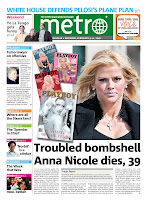
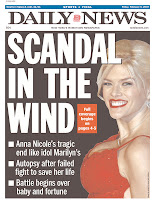
The Strib's coverage, while lengthy, was downright honorable in comparison to New York Spanish language daily Hoy, which devoted nearly its entire cover Friday to an image that featured an unobstructed view of the underside of Smith's breast; the New York Daily News, which included a screaming headline, "Scandal in the Wind"; or Philadelphia's Metro, which showed four Playboy covers and a fifth photo of Smith. (Ever restrained, the Wall Street Journal didn't put Smith on their cover; for contrast, it would've been nice to see Smith rendered in WSJ's trademark pointillist pen-and-ink.)

But compared to others, like West Hawaii Today, the coverage seemed excessive. WHT's editor Reed Flickinger didn't see the story as front-page news at all. "Had she burst into flame, spontaneously, perhaps, but that would be because of the cause of death, not the nature of the deceased," he wrote in an email. "Putting Anna Nicole Smith on the cover is exactly what is wrong with journalism, and to a larger degree, this country, today."

The Strib's managing editor, Scott Gillespie, says this kind of gauging and fulfilling of reader desires isn't new at all. He said, "I think it's wrong to say we at the Star Tribune have just decided in the past couple of years to put 'talker' stories on the cover. We've been doing it for years. In all 15 of the years I've worked here, there's been an effort to find the story people will be talking about."

Call it what you will — Gillespie's "talker," Gyllenhaal's "experience," Larry King's "number one story" — this belief that local audiences are served by papers piling on popular celebrity stories seems to ignore journalism's role to not just provide what readers want, but what they need to know to be active citizens. Editors argue that if diverse content draws readers who, after getting their Smith fix, keep reading about the new ballot initiative or funding for a stadium, the public interest is served. My guess is that while daily papers are enhancing the reading experience with celebrity news, lifestyle tips, and feel-good front-cover fluff, magazines like People and U.S. Weekly won't be reciprocating by upping their local news coverage.
Said Kevin Kaufman, editor of the Boulder, Colo., Daily Camera, where a photo of Smith on the cover ran with a teaser for readers to look inside for more:
I put stories out front that I think are important, newsy, interesting, odd, unusual, etc., and that will attract readers, regardless of whether they involve a U.S. Senate vote on the Bush Iraq plan, the local government moving from parking meters to parking kiosks, recruiting of players for the local college football team, the entertainment industry or an astronaut driving 900 miles in a diaper.
[Cross-posted at Minnesota Monitor.]

Update: This story won a first place Page One Award from the Society of Professional Journalists.

2.07.2007

Fox's "Border War" coverage draws fire from immigrant advocates

A few days after Fox News CEO Rupert Murdoch admitted that his network tried to shape the agenda around the Iraq war and "basically supported the Bush policy in the Middle East", Minneapolis affiliate KMSP began running teasers for a Feb. 5 "Fox 9 Investigators" report on Minnesota National Guard troops stationed at the U.S.-Mexico border. The promos — a blur of camouflage and night-vision goggle views — suggested the piece might again be promoting the Bush administration's agenda: in covering Bush's border-control project Operation: Jump Start, Fox 9 sent reporter Jeff Baillon to be "embedded" with Minnesota troops on the "front line" of the "border war."

War has not been declared against Mexico or illegal immigrants, so naturally the two-segment piece took on a different tenor than promised: It linked illegal border crossings with drug crimes here in Minnesota — to the dismay of area immigrants' rights advocates.

The first segment, "Catch 'Em if They Can" [video], which aired during the 9 p.m. newscast Feb. 5, began with an ominous voice-over: "In the secret underworld of Twin Cities drug trafficking, most roads lead south — to Mexico." Then a man in a suit — he's never identified, but viewers might infer he's with the U.S. Drug Enforcement Agency, the only organization named in the intro — tells of an illegal immigrant who was arrested locally in a recent sting for trying to sell "Mexican-made meth." While he was arrested, a voice-over tells us, "It's only a matter of time before someone else sneaks over the border to pick up where he left off."

Cut to: the Mexican border, where, as Baillon said in overdub, "in some places the only thing separating the two countries is an old cattle fence." Eighty National Guard troops from Minnesota work daily surveilling the border with high-tech equipment. But their days are fairly humdrum: In off hours, they play pool and hang out in barracks where, says one soldier, "contracted cleaners come in and clean everything up for us." They commute two to three hours from their base to their surveillance stations. And should they see an attempted border crossing, they're instructed to call the border control as they have no authority. (One soldier gets in a jab at the Bush administration: "The National Guard is finally doing a national mission. We're not overseas, we're over here taking care of the people we're supposed to be taking care of.")

The second piece, "Cat and Mouse Game" [video], aired during Monday's 10 p.m. newscast, had nothing to do with the Minnesota National Guard, but instead attempted to establish a link between illegal immigrants from Mexico and Minnesota's drug crimes. The unnamed man in the suit appears again in this segment, stating that "75 to 80 percent of the drugs consumed in the state of Minnesota come from across the Mexican or Southwest border. Unlike the first report, in which Baillon referred to illegal immigrants as "illegals" four times, he only did so once in the second, which focused on the tricks both smugglers and border agents use in their "game of chess" to outsmart each other. Minnesota content merely bookended the main story, which outlined the creative ways drug smugglers get their product from Juarez to El Paso and, ultimately, to "our twin towns."

So what's the problem?

For one, that use of "illegals," said Alondra Espejel, communications organizer at the Minnesota Immigrant Freedom Network. "For our community, it's a very derogatory term — like using the N-word is for the African-American community. We are indigenous people from this continent. It wasn't until white settlers came in and made laws that anyone could be considered illegal. But we don't believe human beings can ever be called illegal."

On Tuesday, Espejel issued a "media action alert" on the broadcast to the Freedom Network's list-serv outlining the organization's other concerns, including a lack of balance ("all of the people interviewed represented the voice of the authorities") and a connection between immigrants and drugs backed up only by "unproven and sensationalistic statements." She wrote:

It is stories like this [...] that create more problems in our society by fueling xenophobia and negative stereotypes of our communities. If the story contained any real information for folks to be more informed about, it was unfortunately overshadowed by the combat-style images, the negative stereotyping of immigrants as tied to crime, and the lack of a balanced representation of the subject. Indeed, the very "subject" of this report is still unclear to us as many complex themes were whimsically tied together in a journalistically unresponsible manner.
Indeed, Fox's "Fair and Balanced" motto didn't seem to be in evidence anywhere: No immigrants or immigrants-rights activists were interviewed.

Espejel acknowledged Fox 9 approached her organization, but they declined to be interviewed, because, in part, "television has not been good to our community." She recalled how another local TV station, KSTP, treated immigration attorney Susana de Leon in a June 2006 story. Espejel said de Leon was approached courteously by a KSTP reporter and told what the news segment was to include, but when the camera turned on, the story changed. "The questions were very problematic. They put her on the spot in ways no professional journalist would. They got it all on film and used it to craft a very anti-immigration, sensationalized piece that twisted her words." (KSTP no longer hosts the story on its website, but a version of the piece and the station's response to criticisms are cached here and here.)

Why, she asks, didn't Fox ask for comment from one of the scores of "white ally" organizations that work on immigration issues, groups from Affirm and the Office for Social Justice to the Catholic Church's Hispanic Ministries and the American Immigration Lawyers Association?

While the sensational — and militarized — nature of the story and its promo might have more to do with February sweeps, Espejel says there may be something to the notion that the news program is tied to Bush administration goals. Stories like these, she said, like the recent immigration raids at the Swift Co. plant in Worthington, are "very much tied to this idea that certain parties want to make it seem like something's being done. It's as if the Bush administration is saying, 'The immigration system didn't break under us, but we're doing something for it.'"

But the biggest complaint Espejel has is the most direct — and commonplace. The report used a "sensationalised series of images" to embrace an equation that groups like hers have long fought: "people of color" equals "crime."

"We've been hit over the head with it again and again," she said. "You'd think people in the mainstream media would figure it out."

Fox 9 would not reveal how many complaints the station has received and would not respond to key questions I posed: Who is the unnamed man who serves to vouch for the link between illegal immigrants and Twin Cities drug crime? How do they explain the "border war" promotions or the use of terms like "illegals"? Why didn't the report offer "fair and balanced" coverage by including the perspective of immigrants? Who says 75 to 80 percent of Minnesota's illegal drugs come from south of the border?

Reporter Jeff Baillon didn't reply to Minnesota Monitor's interview request, and KMSP's manager of investigations, Kim Kruger, forwarded a query to Bill Dallman, the station's vice president of news.

His reply, which was relayed through a representative at Fox's New York office, in its entirety:

"Fox 9 stands by its reporting."

[Cross-posted at Minnesota Monitor.]