U.S. congressmen should have to dress like Nascar drivers and wear the logos of all the banks, investment banks, insurance companies and real estate firms that they’re taking money from.Serfican Ozcan in 2010:

And 2006:
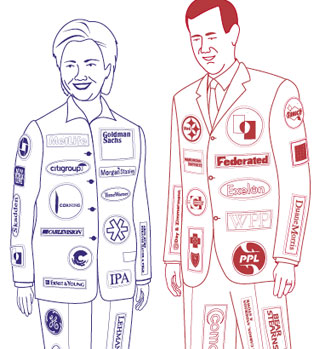
U.S. congressmen should have to dress like Nascar drivers and wear the logos of all the banks, investment banks, insurance companies and real estate firms that they’re taking money from.Serfican Ozcan in 2010:


 In discussing his support for Ai Weiwei earlier this year -- he dedicated his sculpture Leviathan to the then-imprisoned Chinese artist and withdrew from a show in Beijing -- Anish Kapoor hits on a point I've been making for years: That part of the power art has in the realm of politics and social justice comes from its ambiguity. That is, because art is difficult to define, it's harder to dismiss as mere protest.
An art work can be nebulous in relation to the politics of its situation. It can indicate a discomfort without actually articulating it and therefore it’s much harder to pin down. It’s much harder to say: ‘This is subversive.’ It’s hard to define what subversive is –– especially in contemporary language and contemporary visual culture. Ai Weiwei, in that sense, is somewhat more articulated towards a series of events — noting down the number of people killed by corruption and maladministration, or collecting and making monuments with marbled doors of all the houses that have been knocked down and land that’s been taken away from the so-called squatters. It’s still nebulous though. If you look at the work it’s just a bunch of marbled doors. It doesn’t obviously say what we infer from it. Though we know what to infer of course.He also is critical of the art world for its lack of unity on human rights issues:
The art world is extremely fragmented. It is a place that’s also infiltrated by money and other instruments of influence. And it never finds itself in a place where it can shout. I think we need to learn how to do that and find a way to have singular voices. Through the whole period of Soviet repression of artists, which was severe, the art world didn’t say a thing. The avant-garde has held itself away from human rights. It’s been a great struggle for artists of non-European origin. It’s been a great struggle for women artists, quite contrary to the sense that the aesthetic world is an open forum –– it isn’t. It’s extremely doctrinaire and extremely partisan. And I think those battles are still being fought. So it’s not surprising at one level anyway.
I can only explain it by [the fact that] these old instruments of power in the art world are generally male and white, and within a certain aesthetic tradition. All of that has begun to fall apart in the last decade or so. We still haven’t got to the point where, if you like, lone, outsider voices can be properly heard.
 Moustache Man -- New York resident Joseph Waldo -- has friends. After his arrest in June for scrawling the word "moustache" on subway ads, sympathetic graffiti is cropping up -- spelling out in Sharpie the word "solidarity."
 STRICTLY AMERICAN, SCARCITY TERMINAL, Erik Brandt, 2011, part of the MCAD show Supergraphics
As part of the Soap Factory's fall exhibition of Three Artists: Guo Gai, Meng Tang & Slinko, we present a moderated discussion on the subject of Art, Politics and Censorship.More on Guo Gai and Natliya Slinko. Pictured: Installation of Guo Gai's works at the Soap Factory.
Speakers are Professor Edward Farmer and Professor Tom Rose from the University of Minnesota, Eric Lorberer Editor of Raintaxi Review of Books and journalist and blogger Paul Schmelzer from the Eyeteeth blog.
The discussion will be informed and wide-ranging, covering the interlocking issues that Meng Tang, Guo Gai and Slinko address in their work: all artists who have lived and practiced under repressive regimes, and have used their work to negotiate and understand their lives as artists in those societies. The central concept is the intersection of art and politics: the speakers will look at how and why visual art can be censored, for whatever reason, across different cultures and what engagement, if any, should art have in issues that disturb the cultural status quo.
Please join us at 7:00pm for an evening of lively and informed discussion, and be prepared to join the debate.


 Clockwise from top let: Guo Gai, Hopsack Painting Co., Nightmare, Giant Sing Along
Mark your calendar: I'm part of a panel discussion on "the interlocking issues of art, politics and censorship" on Sept. 17 with sculptor and exhibition co-curator Tom Rose, University of Minnesota China historian Edward Farmer and Rain Taxi editor Eric Lorberer.• The Future Presence Gallery, an occasional gallery at 1126 2nd St. NE, Minneapolis, presents Future Presence 3, a group show featuring works by Bryant Locher, Nathaniel, Austin Swearengin, Justin James Sehorn, Joshua Wilichowski, Hannah Hall, Russ Olson, Danielle Voight, Gregory J. Rose, Ben Lansky and Andy Shannon. Aug. 26–28.
Nightmare makes its much-anticipated debut launch from Harriet Island in St. Paul, MN, on Friday, August 26, 2011, at 9:00 pm.
Nightmare will initially travel downriver past the Wabasha Bridge toward Lowertown Saint Paul after the launch, visible only from the Harriet Island side of the river till it turns around. Once Nightmare turns around, it will head upriver toward the High Bridge and Minneapolis, visible only from the downtown Saint Paul side of the Mississippi. It is anticipated Nightmare will be visible from downtown Saint Paul with views of the Mississippi between approximately 9:30 and 10 pm, passing by Upper Landing Park (across Shepard Rd from the Science Museum at Chestnut St.) at approximately 10 pm.

The tragic stabbing death last Friday in front of my Third Place Gallery on 38th & Chicago has been highly charged, provoking a multitude of reactions from paralyzing fear to connective support. It shocks and exposes our bubbled realities.
I've been interacting with many of the mourners keeping a vigil, inviting them into my gallery as the blood stained sidewalk became a growing shrine. To consider all the things that had to happen, the confluence of personal and historical dynamics, in this neighborhood, in this country, to bring this horrible incident to my front door, ostensibly over a pair of shoes, is dizzying and incomprehensible.
How will this corner and beyond respond to this and its rippling currents? The wake is today, Wednesday August 24, 2011. Sometime after 3 pm a large contingent will converge here to pay their respects. A very, very large police force will be here also.
I will be here too. All are welcome to come to The Third Place today and show their support.
Peace.
Wing Young Huie
 Jerome Liebling, Butterfly Boy, New York, 1949


