4.29.2006

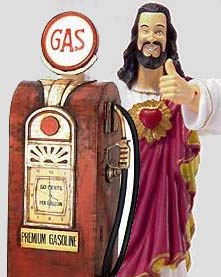
Praying at the pump.

War, terrorism, corruption at the highest levels of government, global warming: with so much weighing heavy on our souls, some Christians are urging us to pray.

For low gas prices.
WASHINGTON, April 26 (UPI) -- A U.S. Christian group has grown tired of escalating gasoline prices and is set to stage a national prayer rally to lower the numbers at the pumps.

Various Christian clergy from around the country will convene around a Washington, D.C., gas station Thursday at noon to pray. For those who can't attend, a live Internet site and toll-free prayer line have been established.

In a release, the Pray Live group said many people are "overlooking the power of prayer when it comes to resolving this energy crisis."

Apart from sending a message to God, the rally had a message for humanity, said Wenda Royster, the group's founder.

"It is our hope that seeing and hearing some of the nation's most powerful preachers gathered around a gas station and the United States capital as a backdrop, will remind everyone who is really in charge of our world -- God," Royster said.

The Web site is at praylive.com. The toll-free phone number is 888-PRAYLIVE.
[image via]

Vietnam, Sr.

Back in January 2003, Donald Rumsfeld predicted that the Iraq war would rack up "something under $50 billion for the cost." Three months later, Deputy Defense Secretary Paul Wolfowitz said, "We’re dealing with a country that can really finance its own reconstruction, and relatively soon.”

Then there's reality. The Independent reports that the US has already spent $320 billion on the war, and that given our pace of spending in Iraq, Bush's endeavor will cost the US more than the eight-year Vietnam War. In today's dollars, Vietnam's pricetag was just under $600 billion. Iraq is expected to cost $700 billion or more. Heckuva job, Rummy.

Then there are the lives: the most violent month of 2006, April saw the deaths of 71 Americans, putting the war's total at 2,399. Iraqi civilians is another matter: while I've seen estimates at 70,000 non-military Iraqis killed, Iraq Body Count puts it at around 38,000--a figure some say "vastly underestimates the number of deaths in Iraq."

Then, of course, there are the injured (graphic imagery).


mp3:
Howard Zinn on impeachment.

4.28.2006

Think...

A bumpersticker we made at the Walker in 2000. Full story here.

Metal Folk Protest

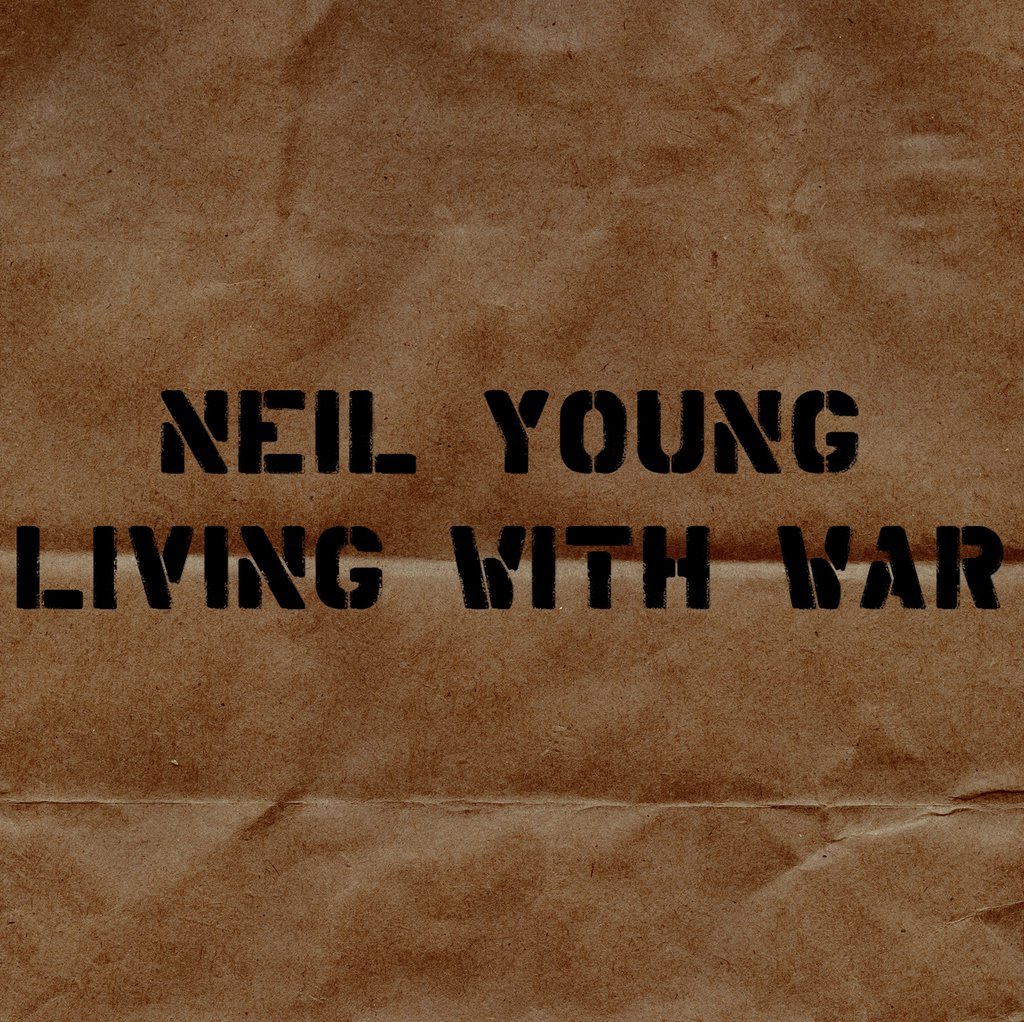
Neil Young's wonderful anti-Bush polemic Living with War is now online for free listening. His "Let's Impeach the President," of course, has been getting all the press, but the entire album is worth a listen. What makes the "metal folk protest" album all the more remarkable is the fact that Young was an early supporter of Bush's Patriot Act.

More at LivingWithWar.blogspot.com, Neil's MySpace page, and NeilYoung.com.

4.27.2006

Priceless.

From the AP:
House Speaker Dennis Hastert of Ill., center, gets out of a Hydrogen Alternative Fueled automobile, left, as he prepares to board his SUV, which uses gasoline, after holding a new conference at a local gas station in Washington, Thursday, April 27, 2006 to discuss the recent rise in gas prices. Hastert and other members of Congress drove off in the Hydrogen-Fueled cars only to switch to their official cars to drive back the few block back to the U.S. Capitol. (AP Photo/Pablo Martinez Monsivais)
Meanwhile, with gas topping $3/gallon in some parts of the country, ExxonMobil posted record profits of $8.4 billion in the first quarter.

Eat local.

In December, I wrote on friends James MacKinnon and Alisa Smith who have been spending the better part of a year experimenting with the 100-mile diet: everything they eat and drink for home consumption must have origins within 100 miles of their Vancouver home. Yesterday, they launched a new website for the endeavor. 100milediet.org. Visit and you can map your 100-mile territory, read about their experiences, or share your thoughts on the project.

Local Food Challenge:
And a shout out to Sarah Alexander of the White Earth Land Recovery Project and her friends at the White Earth Tribal College who are halfway through a similar yearlong project--they'll only eat food produced within 250 miles of their community.

Tibet, 1942-43

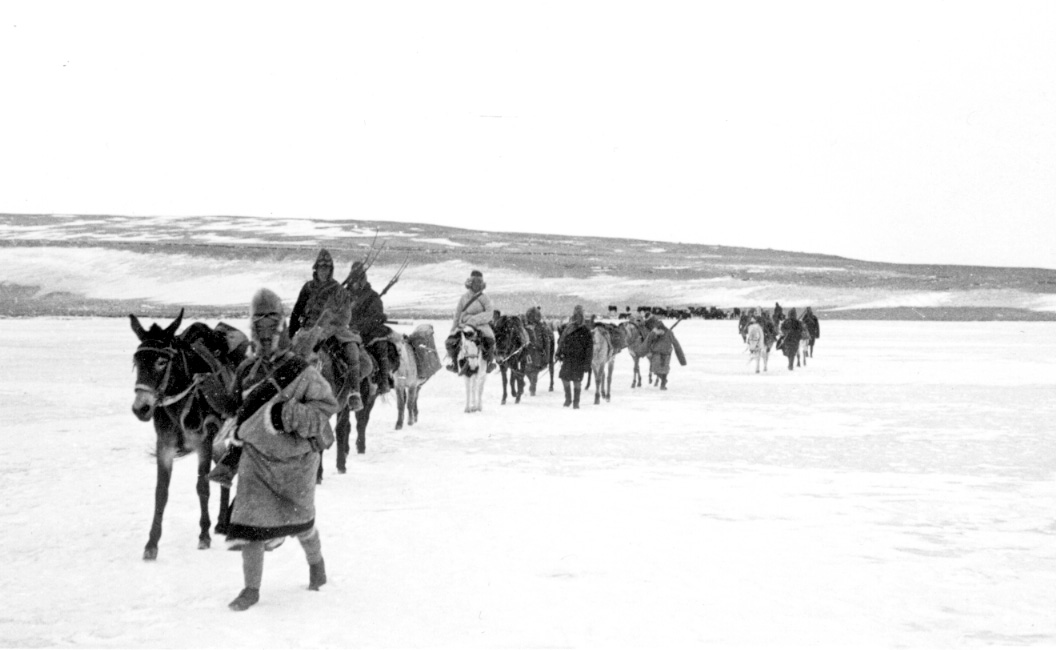
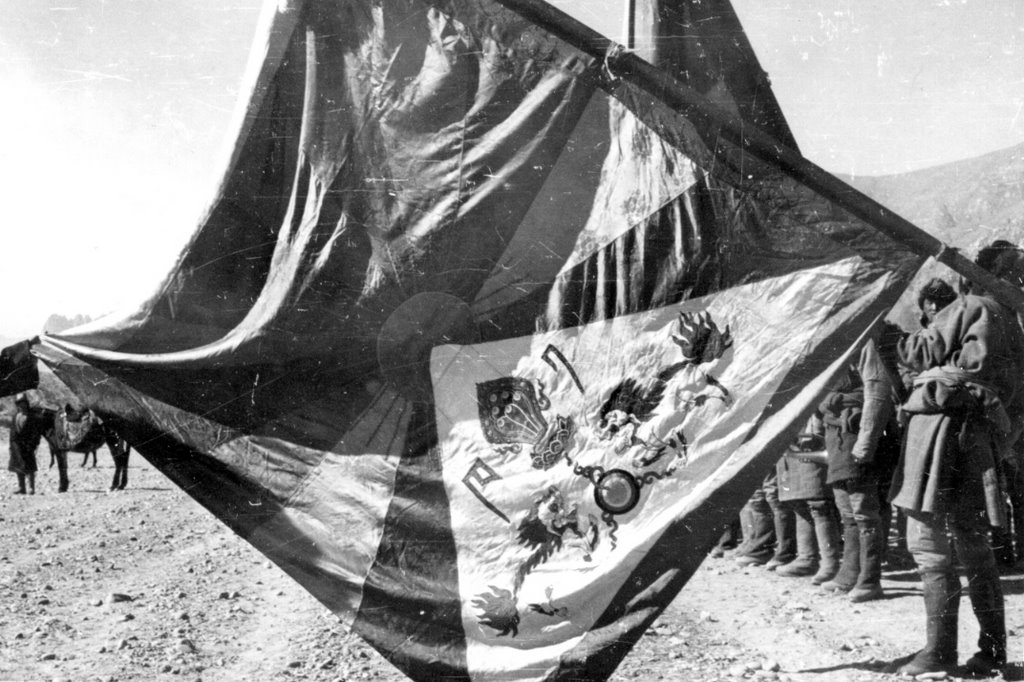
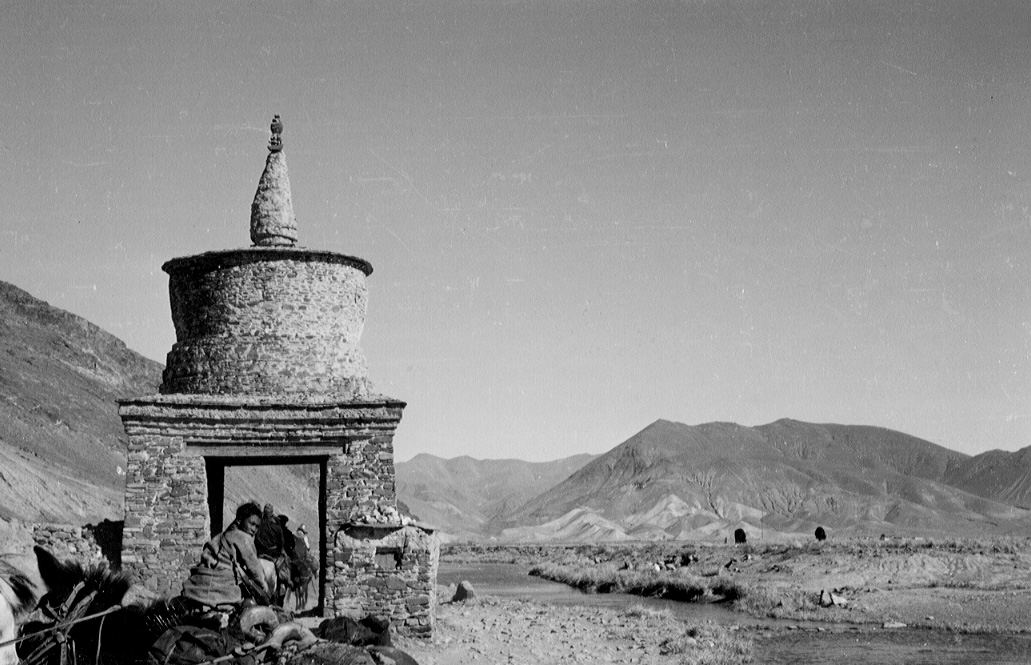
In the early 1940s, two U.S. Army officers, Lt. Col. Ilya Tolstoy and Capt. Brooke Dolan were sent to Tibet from India to explore the possibility of getting military supplies to Chiang Kai-shek's Republican Chinese government through Tibet. The photos of their expedition are remarkable, showing a Tibet that, in some ways, has changed and in others is perpetually the same.

4.25.2006

From paraSITE to P(LOT)

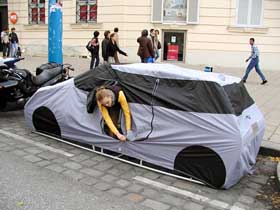
Michael Rakowitz, whose paraSITE project involved inflatable homeless shelters that hook up to HVAC outtake ducts to borrow wasted heat, is at it again: his P(LOT) suggests that public spaces used for automobile storage--aka parking spaces--could be rented for other causes, like housing the homeless. Regine reports:
The acquisition of municipal permits and simple payment of parking meters could enable citizens to, for example, establish temporary encampments or use the leased ground for different kinds of activities. A first initiative turns ordinary car covers into portable tents, available for loan at the MUMOK, the Museum of Modern Art in Vienna. Interested citizens have the choice to use one of five covers ranging from a common Sedan to a luxurious Porsche or motorcycle.
Via Off Center.

Wisdom from elders: Schlesinger and Brzezinski speak out

With a thousand days left in Bush's presidency, two former presidential advisors are speaking out against the Bush Doctrine of preemptive war. JFK's advisor Arthur Schlesinger, Jr., hopes that a third Bush war won't arise:
Observers describe Bush as "messianic" in his conviction that he is fulfilling the divine purpose. But, as Lincoln observed in his second inaugural address, "The Almighty has His own purposes."

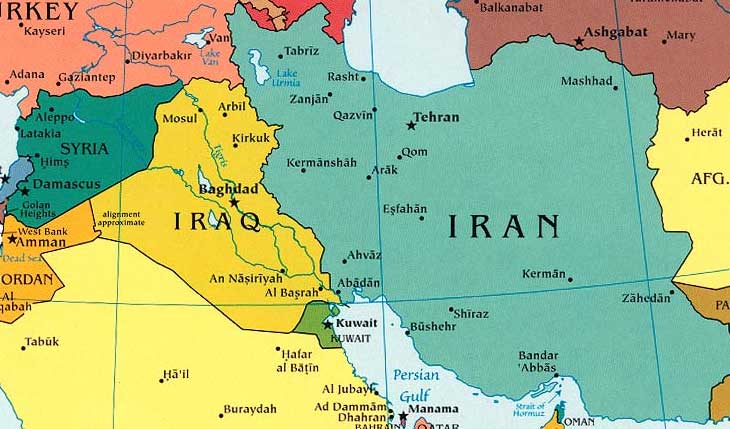
There stretch ahead for Bush a thousand days of his own. He might use them to start the third Bush war: the Afghan war (justified), the Iraq war (based on fantasy, deception and self-deception), the Iran war (also fantasy, deception and self-deception). There is no more dangerous thing for a democracy than a foreign policy based on presidential preventive war.

Maybe President Bush, who seems a humane man, might be moved by daily sorrows of death and destruction to forgo solo preventive war and return to cooperation with other countries in the interest of collective security. Abraham Lincoln would rejoice.
And another presidential advisor, Carter's national security expert, Zbigniew Brzezinski, weighs in on the perils of preemptive war with Iran, predicting that "an attack on Iran would be an act of political folly, setting in motion a progressive upheaval in world affairs. With America increasingly the object of widespread hostility, the era of American preponderance could come to a premature end." Four reasons not to attack Iran:
1. In the absence of an imminent threat (with the Iranians at least several years away from having a nuclear arsenal), the attack would be a unilateral act of war.

If undertaken without formal Congressional declaration, it would be unconstitutional and merit the impeachment of the president. Similarly, if undertaken without the sanction of the UN Security Council either alone by the United States or in complicity with Israel, it would stamp the perpetrator(s) as an international outlaw(s).

2. Likely Iranian reactions would significantly compound ongoing U.S. difficulties in Iraq and in Afghanistan, perhaps precipitate new violence by Hezbollah in Lebanon, and in all probability cause the United States to become bogged down in regional violence for a decade or more to come. Iran is a country of some 70 million people and a conflict with it would make the misadventure in Iraq look trivial.

3. Oil prices would climb steeply, especially if the Iranians cut their production and seek to disrupt the flow of oil from the nearby Saudi oil fields. The world economy would be severely impacted, with America blamed for it. Note that oil prices have already shot above $70 per barrel, in part because of fears of a U.S./Iran clash.

4. America would become an even more likely target of terrorism, with much of the world concluding that America's support for Israel is itself a major cause of the rise in terrorism. America would become more isolated and thus more vulnerable while prospects for an eventual regional accommodation between Israel and its neighbors would be ever more remote.
The Eighth General: Retired Marine Lt. Gen. Paul van Riper is the eighth retired general to call for the retirement of Defense Secretary Donald Rumsfeld [video here]. A registered Republican whose son is fighting in Iraq, van Riper says, "We have to stay, we have to finish it. Let's do it right... If I was the president, I would've relieved [Rumsfeld] three years ago."

Woolen agitprop

The Salvation Army does double duty with this homeless blanket/awareness-raising poster.

Future White House press secretary: Bush "an embarrassment."

This is pretty funny: the guy selected to replace Bush Press Secretary Scott McClellan is none other than Fox News' Tony Snow, but better than that, the guy has been critical of his boss-to-be. Seeing Snow go McClellanesque (that is, repetitive, insincere, and downright dishonest) should be interesting. After all, Snow has said:
– “George W. Bush and his colleagues have become not merely the custodians of the largest government in the history of humankind, but also exponents of its vigorous expansion.” [3/17/06]

– “President Bush distilled the essence of his presidency in this year’s State of the Union Address: brilliant foreign policy and listless domestic policy.” [2/3/06]

– “George Bush has become something of an embarrassment.” [11/11/05]

– Bush “has a habit of singing from the Political Correctness hymnal.” [10/7/05]

– “No president has looked this impotent this long when it comes to defending presidential powers and prerogatives.” [9/30/05]

– Bush “has given the impression that [he] is more eager to please than lead, and that political opponents can get their way if they simply dig in their heels and behave like petulant trust-fund brats, demanding money and favor — now!” [9/30/05]

– “When it comes to federal spending, George W. Bush is the boy who can’t say no. In each of his three years at the helm, the president has warned Congress to restrain its spending appetites, but so far nobody has pushed away from the table mainly because the president doesn’t seem to mean what he says.” [The Detroit News, 12/28/03]

– “The president doesn’t seem to give a rip about spending restraint.” [The Detroit News, 12/28/03]
With Bush's job approval sinking to 32%, according to CNN, maybe they couldn't find anybody with something good to say?

ThinkProgress has more.

GOP's Earth Day

Just hours after Earth Day, George Bush took a bike ride on the Clara Burgess Trail, with views of California's Coachella Valley and Little San Bernardino Mountains. The problem: he was pedaling through prime sheep-mating turf:
Jim Foote, acting manager of the Santa Rosa and San Jacinto Mountains National Monument, said the Clara Burgess trail is also among those monument managers ask people to avoid part of the year to prevent disrupting endangered Peninsular bighorn sheep.

The trail is one of about 10 in the monument under a "voluntary avoidance" program. People are asked to stay off the Clara Burgess trail from Jan. 1 to June 30 during the sheep lambing season, he said.

It was uncertain Sunday night if White House organizers accompanying President Bush knew about the "voluntary avoidance" program.
More Earth Day fun! The House Resources Committee's Earth Day website must've taken content cues from the Republican majority: decrying "'sky is falling' sensationalism of environmental activists [that] lead people to falsely believe that our environment is getting worse when it's actually getting better," the taxpayer-funded site includes a section on "big business," which isn't about how corporations are working to improve the environment, but derides key environmental organizations for the salaries their execs receive. And, oh yes, there's more.

4.23.2006

Save the Internet

Up until now, "net neutrality" has been the Internet's First Amendment, allowing a relatively level playing field for everyone with access. If we use the tired "information superhighway" metaphor, net neutrality means that the roads remain open to everyone, whether they drive a rustbucket or a tricked out Hummer, and they can drive wherever they'd like. But no laws exist to protect this neutrality, and corporate entities are interested in being gatekeepers of internet content. Some ISP's want to give preference to their advertisers on internet search engines, prevent certain sites from loading, and give priority access to content they deem most worthy (or profitable). As Congress sets out to revamp the Telecommunications Act, the just-launched site SaveTheInternet.com is ground zero for efforts to secure a free internet, with ways to take action, learn more, and spread the word.

Via BoingBoing.

4.22.2006

Outsider architecture in Brooklyn

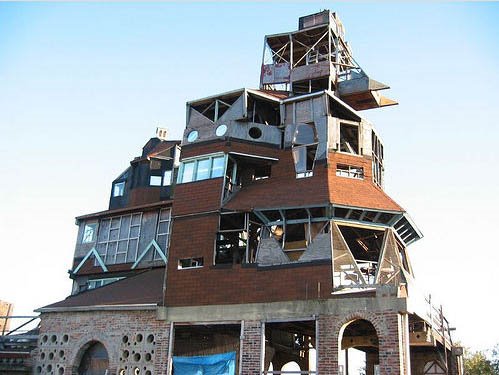
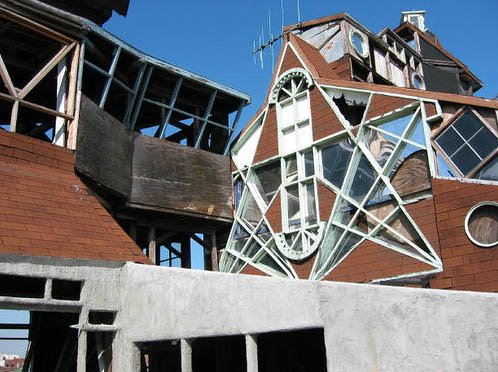
Gothamist writes about Broken Angel, a building constantly being transformed by self-taught architect Arthur Wood in Brooklyn. Wood bought the building for $2,000 in 1971 and has been working on it ever since. A New York Times piece in 2002 likened the house, where Wood and his wife and cats live, to "a blimp impaled on a church or a laboratory from which some mad scientist might launch a pedal-driven flying machine." See more at the Broken Angel Flickr pool.

Bush's Active/Negative Presidency

Former presidential counsel John W. Dean writes that on political scientist James Dave Barber's scale of presidential personality types, George Bush is an "Active/Negative" president, a particularly dangerous form. While Dean postulates about the administration doing whatever they must to salavage this presidency and the GOP's future chances--various "October Surprise" scenarios include retiring Cheney to situate Rudy Giuliani for an '08 presidential bid, attacking Iran, or capturing bin Laden--this part was most fascinating:
Bush's defense of Rumsfeld was entirely substance-free. Bush simply told reporters in the Rose Garden that Rumsfeld would stay because "I'm the decider and I decide what's best." He sounded much like a parent telling children how things would be: "I'm the Daddy, that's why."

This, indeed, is how Bush sees the presidency, and it is a point of view that will cause him trouble.

Bush has never understood what presidential scholar Richard Neustadt discovered many years ago: In a democracy, the only real power the presidency commands is the power to persuade. Presidents have their bully pulpit, and the full attention of the news media, 24/7. In addition, they are given the benefit of the doubt when they go to the American people to ask for their support. But as effective as this power can be, it can be equally devastating when it languishes unused - or when a president pretends not to need to use it, as Bush has done.

Apparently, Bush does not realize that to lead he must continually renew his approval with the public. He is not, as he thinks, the decider. The public is the decider.
Image: Melvin Galapon's Pinhead, a portrait of Bush made entirely out of pushpins.

Paying at the pump, payback at the polls

It doesn't take a marketing expert to devise an effective campaign ad for the Democrats. It takes Greg Saunders:

Gas prices

Oil company stock profits

Campaign contributions

Bomb-shelter modernism

SLLB Architects in London have plans to convert a Cold War A-bomb bunker into a modernist home. But as The Rat and Mouse writes, the firm doesn't yet have clearance for such creative reuse; a council member is reported saying, "There are various conditions to be satisfied which involve the use of appropriate materials and the preservation of important historical features such as the plant room and a central map room surrounded by a circulatory corridor."

(Via Things.)

4.21.2006

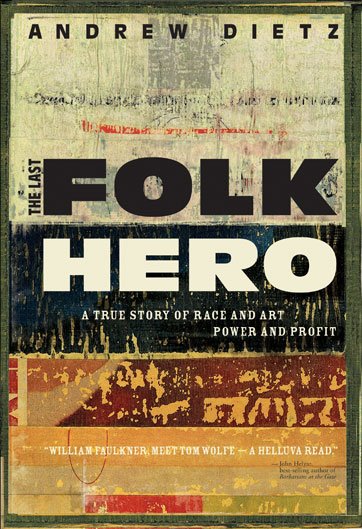
The Last Folk Hero

"Black vernacular art," says Bill Arnett in his inimitably exaggerated style, "is the most important cultural phenomenon of our time. This is like the Italian Renaissance in its scope, breadth, and depth. It's just that the people are the wrong color."

This quote from Andrew Dietz's book The Last Folk Hero begins to capture both the audacity and passion of Arnett, one of contemporary folk art's biggest benefactors and, according to some, its greatest villain. Accused of exploiting self-taught artists like Lonnie Holley, Thornton Dial, and the famed quilters at Gee's Bend through exclusive sales deals, Arnett is also arguably the top promoter of these artists. But after finishing Dietz's book, I'm still unsure who the last folk hero is. Arnett? At times he's presented as an unlikable and pompous boob, as Dietz chronicles him unheroically compiling enemies' lists, stepping on the toes of those in southern museums who can help his cause, and waxing paranoiac about those who are out to get him. At others, he's a charming, impassioned guy with genuine concern for these under-recognized artists.

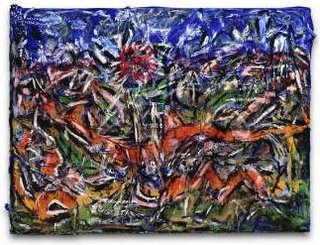
More likely, the heroes are the artists who use housepaint or wire, tree roots or scraps of fabric to create works of art every bit as powerful as those of their schooled contemporaries: Former Whitney director Max Anderson says, "Lonnie Holley and Thornton Dial are the equals of any artists in the United States," and The New York Times' Michael Kimmelman called the Gee's Bend quilts "some of the most miraculous works of modern art America has produced. Imagine Matisse and Klee (if you think I'm wildly exaggerating, see the show) arising not from rarefied Europe, but from the caramel soil of the rural South in the form of women, descendants of slaves when Gee's Bend was a plantation." (Compare Linda Pettway's quilt, below, with Hans Arp's 1916-17 collage Untitled (Collage with Squares Arranged According to the Laws of Chance) and you start to see where Kimmelman's coming from.)
From these tenaciously unconventional artists to Arnett's testy clashes with southern collectors to Dietz's own experiences, The Last Folk Hero is truly an "outsider" journey. At one point Dietz quotes Peter Marzio, longtime director of the Museum of Fine Arts, Houston, who revealed that even on an institutional level, this art is far from accepted. Disappointed that no museums signed on early to tour the quilt show, he said:
The other museum directors just didn't think it was art. This kind of art is threatening to the academy, the traditional art infrastructure. It throws up to them that the creative world can take many routes--outside of the main channels they control. The people of my generation, who were so antiestablishment, are more reactive and defensive culturally now than the nineteenth-century academy was to the advent of modern art.
As I've written before, self-taught and "outsider" art offers us not only an alternative to the fickle machinations and trends of the art world, but also to mainstream consumer culture, where creative autonomy is often packaged as hip consumption--our creativity is demonstrated by our buying choices instead of how true we are to our own visions. These artists, in their eccentric and unswerving dedication to their own expressions, offer a compelling model of true American independence.

Maybe that's why I'm writing so much about The Last Folk Hero. Dietz's project has that kind of autonomous spirit. Written in spare time while running a business and raising two children, he ended up self-publishing the book. He founded Ellis Lane Press, a moniker that combines his daughters' middle names, "to remind them that we cannot wait to be annointed as valid or creative by unseen, random others but rather we need to take the responsibility to validate ourselves and put something positive into this world."

But there's another reason: no one would publish the book.

"I completely lost patience with the big publishers who all said the same thing about the early proposal: 'We love the story; great characters; terrific writing; WE would love to read the book...but...we don't publish books about art because they don't sell,'" he wrote in an email. "Well, I thought that was like saying that Midnight in the Garden of Good and Evil was just a story about antiques in Savannah or Seabiscuit was just about some horses."

Summing it all up, then, is a great quote by George Bernard Shaw that Dietz uses in the book. It's as fitting for Pettway or Dial, Arnett or Dietz, or, hell, any of us who have a vision. Writes Dietz:
"All progress is the result of the unreasonable man." Of course, when I asked Bill Arnett what he thought about that he answered, "Shaw wasn't talking about ME, I never met the man!"
Artwork (top to bottom): Thornton Dial's Ground Zero: Nighttime All Over the World (2002); Linda Pettway's Blocks and Strips, 2003
Condi the Leaker?

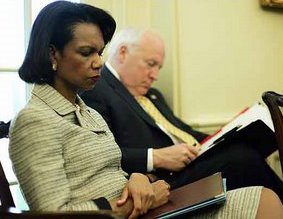
It's hardly worth noting, but how 'bout that hypocrisy? The CIA agent who leaked information on Bush's warrantless (and illegal) domestic wiretapping program has been fired, while the leakers who outed Valerie Plame have, three years later, still to be punished. But here's a bigger bit of irony: Condoleeza Rice is now accused of leaking. The Washington Post: "Secretary of State Condoleezza Rice leaked national defense information to a pro-Israel lobbyist in the same manner that landed a lower-level Pentagon official a 12-year prison sentence, the lobbyist's lawyer said Friday."

And whether Cheney was dozing during a meeting or not, don't

MirĂ³'s family goes after Google

Yesterday's Google logo, inspired by the works of painter Joan MirĂ³, upset the artist's family and Artists Rights Society, the overseer of copyrights for more than 40,000 artists. They requested Google take down the logo, alleging copyright infringement; Google complied.