Showing posts sorted by relevance for query tiravanija. Sort by date Show all posts

7.21.2006

Open-Ended Utopia: The Art of Rirkrit Tiravanija

Ever since Sir Thomas More coined the term utopia in the 16th century, visions of the perfect society have included matching jumpsuits, glass-domed biospheres, or remote islands where harmonic living is realized by placidly grinning beings. But as history has jumped the rails of that idyllic path, if it was ever on it in the first place, can we even imagine today what utopia might look like? Artist Rirkrit Tiravanija can, but he doesn’t create the kind of dreamy art you might expect. He transforms galleries into kitchens that serve up free pad Thai. He turns museums into low-power radio stations, a replica of his New York apartment, a functioning mechanic’s shop, and a studio where “street TV” is broadcast to the neighborhood. He builds chrome-plated kitchen consoles, theatrical stages out of plywood and 2x4s, and replica modernist homes from glass and steel, then invites people in to do... whatever: rehearse with their band, sleep, eat, listen to a DJ, debate topics of the day, read. And he plays informal host at an off-the-grid rice farm in Thailand that’s art only insofar as it fits his definition of the genre as “a space for possibilities.” This kind of art—in which the artist cedes creative control to the people who “complete” the work—looks suspiciously like chaos. And what’s utopian about that?

Everything, says Tiravanija. “I think these previously modeled utopian conditions have always been in a kind of conformity of ideas, which is to say that somehow everyone should become one cohesive structure, one cohesive consciousness, and that would bring with it a sense of freedom,” he explains. Instead, he sees utopia as “understanding difference” and “being able to exist in chaos. To live within a chaotic structure.” He adds, “Chaos for me is life, is change, is moving, we are always living within it.” This sensibility comes as much from his family history— he’s Thai and was raised Buddhist—as from his geography: a diplomat’s son, he was born in Buenos Aires and has lived a nomadic life, making his home in Ethiopia, Canada, the US, Germany, and Thailand.

You could say his art is all about building “chaotic structures.” Then again, it’s about lots of things; his work is so open-ended and departs so radically from the art market’s orientation toward precious objects, that it’s earned many labels, many—like utopian or chaotic—that only tell part of the story. But one that’s stuck, for better or worse, is French theorist-critic Nicholas Bourriaud’s “relational aesthetics,” the idea of judging the social relationships sparked by an artwork instead of merely considering the object. A 1992 exhibition, one that first earned him international attention, exemplified this notion. It was a deceptively simple gesture: after moving the contents of the storeroom at a New York commercial gallery into the main exhibition hall, he turned the room into a social space where he cooked two pots of curry—white and red—for whomever showed up to eat. Echoing Marcel Duchamp’s sentiment that “It’s not what you see that is art; art is the gap,” the only objects left to document the performance were plates dotted with remnant rice, leftover ingredients, a used cook stove, and dirty utensils. The gap between objects, where arguments ensued and bellies were filled, jokes were made and curry spilled, remains mysterious and un-ownable.

Such ethereal art can be understood through the lenses of Thai culture (where familial bonds are reinforced at mealtime) or Tiravanija’s memories (his grandmother had a cooking show on Thai TV), but it’s also informed by his study of Western avant-garde practices and its rich history of institutional critique by Dadaist trickster Duchamp, “social sculptor” Joseph Beuys, and others. By preparing food in a gallery, he inverts some of art’s revered standards. He converts an environment of white walls and whispers into a realm of scent, steam, and sometimes raucous dialogue.

He turns the venerated artist, a high priest of culture, into a humble, apron-wearing servant. And most remarkably, he creates art that, for the most part, can’t be bought or sold, punning with the very idea of the “art consumer.” (Even with these critiques, he remains an art-world favorite: his numerous accolades include the 2004 Hugo Boss Prize, a prestigious honor that comes with a $50,000 check and a solo show at the Guggenheim). As a result, his art is always alive and – because he’s not really controlling its outcomes—unpredictable. “I often work against ways of being museologized,” he says, “of becoming dead in a sense.”

Tiravanija’s most ambitious project is just such a living endeavor. In 1998, he and artist Kamin Lertchaiprasert purchased a rice farm in Sanpatong, a village 20 minutes outside Chiang Mai, Thailand. With no electricity or running water, it’s a clean slate on which to create a dynamic community for an ever-changing cast of farmers, local students, and international artists. It was founded “with anonymity and without the concept of ownership ... to be cultivated as an open space, though with certain intentions towards community, towards discussions and towards experimentation in other fields of thought.”

The pair never intended "the land" as art, but given the vague nature of what it is—an open framework in which things can happen – and the involvement of well-known artists like Tiravanija, Tobias Rehberger, Peter Fischli and David Weiss, Philippe Parreno and others, how could it not be viewed as such? Still, Tiravanija likens the land to something else, “an empty table top that people bring different projects to. They can bring [something] to it, use the top, leave things there or take them away, but it’s basically an empty table.”

Like Tiravanija’s work elsewhere, nearly all the projects to come off this table are functional. Several 2x4-meter stilt houses have been built, including one for Tiravanija that has levels dedicated to each of the “three spheres of human need”: community and sustenance, reading and meditation, and rest. The Danish art group Superflex has installed a system for collecting biogas for cooking fuel from the manure left by the land’s roving water buffalo. Artist Prachya Phintong has designed a fish farm to utilize the water sur- rounding two rice fields maintained by a farmer known as Professor Wei and area art students (rice not used by the community can’t be sold for profit, Lertchaiprasert insists, and is donated to village families living with AIDS). The Netherlands’ Atelier van Lieshout developed a composting toilet system, and artists Philippe Parreno and Francois Roche built a “battery house” called Hybrid Muscle. A futuristic hall for hosting community events, its exterior is covered with plastic “leaves” that hold 20-ton concrete blocks; as buffalo harnessed to a pulley system and a dynamo lift the counterweights, their muscle energy is converted into electrical power.

Vision and whimsy abound at the land—Rehberger’s house was inspired by his favorite German dish, lentil, noodles and broccoli, and Superflex’s biogas system stores fuel in eye-popping orange balloons—but they’re always intercut with both ethereal spirituality and pragmatic reality. As curator Karen Demavivas writes, it is an “ephemeral utopia of cracks, leaks, buffalo waste, termites, big red ants, rainy seasons and mold, a whirl of decay and renewal ... Injected with a Buddhist sensibility, it strives to be a micro-utopia of conscious, daily acts that propagate an equanimous life in the present for the betterment of a community and, more broadly, society.”

While Tiravanija shies away from that last part—the saving the world bit—he reiterates that the land, like all his work, is ultimately social: “We’re not interested in making a sculpture park. We’re much more interested in conditions of living.”

Originally published in the Canadian magazine Geez, Issue 3, Summer 2006.

10.17.2007

Relational Architecture: Rirkrit's Thai House

Some of the ideas that guided Rirkrit Tiravanija's constructed "space-stage" in the 2006 Walker Art Center exhibition OPEN-ENDED (the art of engagement) are behind his new home, an experimental modernist house in Chiang Mai, Thailand. Designed by the young Thai architect (and Tiravanija's former student) Aroon Puritat, the project, like Rirkrit's stage, provided a basic framework on which the architect and the artist's other collaborators could create. This art was dubbed "relational aesthetics" by theorist Nicholas Bourriaud, because it prizes relationships over aesthetics. This architecture, however, seems to cherish both values equally.

"[T]he house was born from a plan without a plan," writes Sant Suwatcharapinun in the Thai magazine art|4|d. "The only requests were to retain, as much as possible, all the trees on the property, to install a bedroom, bathroom, a sitting and relaxation area, living room, kitchen, a work room for his artistic pursuits and a photography studio for his wife Annette Aurell, a photographer from New York."

Beyond that there were no budgetary or conceptual restrictions -- other than not obscuring views for Tiravanija's family or his neighbors. The resulting home -- a U-shaped construction of glass and concrete, with wood and polished concrete floors, plus tile and lighting designed by area artists -- reminds the author of Mies van der Rohe's Barcelona Pavilion, out of context in the northern Thai city of Chiang Mai.

But the collaboration between artist and architect reminds him of Tiravanija's art, which Puritat encountered both as a grad student at Silpakorn University and at "the land," the rice farm/sustainability project Tiravanija and artist Kamin Laitcherprasert founded outside nearby Sanpatong. Aside from open-endedness, a key aspect of Tiravanija's work, and apparently the architecture, is the Buddhist notion of "doing less" -- that is, as Suwatcharapinun writes, "not trying to embellish or make something more than what it is":
From another perspective, it is a new work by Rirkrit who worked in a different medium; from cooking and using musical instruments to that of an architectural structure. Further, those who come across this new structure and those who were involved in the development have changed. It is with certainty that this time, the efforts were subjected to more restrictions and limitations. However, it is more of a reiteration of the ‘Doing Less’ concept. Moreover, if I were to interpret it differently, presuming that it was ‘loosely controlled’, then Aroon and his friends have become a part of the architectural results. However, looking at it from yet another viewpoint, it is a house that was very thoroughly planned and designed. This is something architects dream of - collaborating with a group of people with a sufficient degree of understanding, working closely with the owner of the house and receiving feedback with efficiency.

10.01.2005

Berlin Diary: The Politics of Fun

Installation view of The Politics of Fun with Rirkrit Tiravanija's pad thai station at left.

Alas, my vacation is drawing to an end; I fly back to the States on Monday. The last few days have been amazing, highlighted by an interview I did with Rirkrit Tiravanija and a visit the next day to Das Haus Der Kulturen Der Welt (House of World Cultures), for the opening of the exhibition The Politics of Fun, featuring Tiravanija and artists from across Southeast Asia. The party featured pad thai prepared by Tiravanija and other Thai artists (the historic final meal for this project that launched Tiravanija to art-world fame in the early 1990s), music by the Bangkok band Futon, and a first glimpse of the exhibition, which included works by Araya Rasdjarmrearnsook, Michael Showanasai, KYTV (Kill Your Television), and others. Thailand's Wit Pimkanchanapong had gallery visitors construct garland-selling girls out of paper. Tonight we're going to the launch party for the new issue of Tiravanija's magazine oVER at the gallery Neugerriemschneider.

Pad Thai served in the gallery.

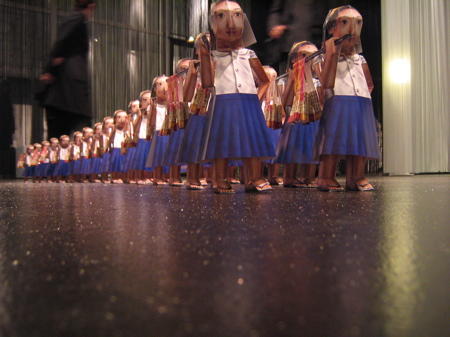
Garland Seller by Wit Pimkanchanapong

Futon

3.26.2006

Tiravanija and Sterling

Sorry it's been so quiet around here. This week I had the chance to interview both Rirkrit Tiravanija and Bruce Sterling. I'll post excerpts of both interviews eventually: Tiravanija agreed to participate in a book I'm working on with Barcelona-based curator Max Andrews for the Royal Society of Art's Art & Ecology program (the book will come out this fall). I talked with Sterling over dinner the night before his dialogue at the Walker with Rirkrit (look for video of it here in a few days). In the meantime, here's a shot of them in Tiravanija's installation at the Walker's just-opened show OPEN-ENDED (the art of engagement).

1.01.2007

2006: The Interviews

A quick look back at interviews posted here or at the Walker blogs:

• Stephanie Kinunnen, cofounder of NEED magazine

• Mark Ritchie, founder of the voter registration project November 2, founding president of the Institute for Agriculture and Trade Policy, and, as of tomorrow, Minnesota's Secretary of State

• Thomas Hirschorn, artist

• Doryun Chong, Walker Art Center curator, on the work of Rirkrit Tiravanija

• James Howard Kunstler, environmentalist and author (The Long Emergency)

• Alec Soth, photographer

• Aiden Enns, publisher of Geez magazine ("Holy mischief in an age of fast faith") and founder of BuyNothingChristmas.org

• Cameron Sinclair, founder of Architecture for Humanity and editor of Design Like You Give a Damn

• Kinji Akagawa, sculptor

• Philippe Vergne and Chrissie Iles, co-curators of the 2007 Whitney Biennial, on "America"

From the archives:

Robert Storr, dean of Yale's art school and curator of the 2007 Venice Biennale
Rirkrit Tiravanija, Thomas Hirschhorn, Hou Hanru, and others, excerpt on the question "Can art change the world?"
Philippe Vergne, Walker chief curator and co-curator of the 2006 Whitney Biennial, with artist Todd Norsten
Jennifer Allora and Guillermo Calzadilla, artists
Kalle Lasn, publisher of Adbusters
Siva Vaidhyanathan, author, communications professor
Robin Rimbaud a.k.a. Scanner, musician/artist
Craig Baldwin, filmmaker/activist

8.04.2006

New Interview: Doryun Chong on Rirkrit Tiravanija

At work today, I posted an interview with curator Doryun Chong on a recent Walker installation by Rirkrit Tiravanija, a "space-stage" inspired by Viennese architect Friedrich Kiesler's Raumbühne. The structure hosted a range of activities during the run of the exhibition, from karaoke battles (below) to a teen "un-prom" fashion show and a primer on surveillance by the Revolutionary Party. A taste:
For me, subversiveness is a problematic term because it's one of those kinds of words we use habitually. I think that's just the legacy of modernism. Impressionists were the first generation of modernists. Before them, the Realists, like Courbet, were completely subversive. In a sense, Modernism is a history of successive subversions: Impressionists followed by Fauvists and then Dada and Fluxus. It's also a kind of a patricidal, Oedipal kind of struggle, that you always have to subvert what comes before you. As this history of subversion accumulates like geological strata, at which point can you not subvert any more? At which point do you come back to the original point? I like to think that Rirkrit's work is completely aware of all the subversions that have happened and tries, perhaps, to swim in it. There's an incredible amount of respect and admiration in it, but it's on a very personal and intimate level. Duchamp and Joseph Beuys and Marcel Broodthaers, all these figures are, in a sense for him, not like statues of Lenin or Saddam that need to be toppled, but are instead more like living spirits that he communes with.

8.15.2005

Can art change the world?

Sam Durant, We Are All Outlaws in the Eyes of Amerika
The current issue of Adbusters continues a long-running investigation on the role of art in social movements. If art can bring change for the common good, how does it work—as a slow burn or an explosive agent? As art editor of the issue, I asked curators and artists from around the world some deceptively simple questions about the social function of art and its potential for catalyzing change. My favorite interview was with Chinese-born, Paris-based curator Hou Hanru, who suggested that directly oppositional art—the in-your-face anti-Bush poster, for instance—may have less lasting power than works that engage the events of the day from a greater distance. Of-the-moment language only lasts as long as it's relevant, he seemed to be saying, but the more metaphysical works of, say, Joseph Beuys or David Hammons continue to intrigue and spin off meaning beyond their immediate context. (Which is not to suggest Hou meant that the art of resistance can't be just as powerful as any other kind of art. Just different roles in terms of immediacy and effect.)

In the spirit of resource-sharing, here are a few of the quotations, some of which don't appear in the print issue:

Robert Storr, critic, curator, artist, Rosalie Solow Professorship of Modern Art at NYU:
I don't think art can change the world. There are moments in history—in the 1930s and the 1920s and since—where very direct address of general social problems by artists has had something of an effect. It's hard to say what it was or how to quantify it, but it's undeniable they spoke for the times and people knew it. There are other times when merely the presence of a voice of dissent or a kind of questioning in public for which art is also a vehicle can do a lot.

I'm also of the view that sometimes people who should be socially active take refuge in art and make art as an alternative to being involved in the sort of nuts and bolts (and oftentimes boring) business of organizing and voting and demonstrating. I think we've been through a period where a lot of people have very sophisticated political ideas based on a whole series of postmodern thinkers but actually they do almost nothing, and they have avoided the full implications of having a political understanding of the world by having such a good rap. I don't know how many students I've spoken to, taught, and dealt with who can tell you all about the crisis of late capitalism but in fact have never done anything political in their lives, or very little, and who can tell you all about what's wrong with other people's political practice but haven't made any mistakes yet… There's a dimension in which a lot of political postmodernism is a kind of shadowboxing, and I think that that is something really to be questioned.
Jennifer González, Assistant Professor in the History of Art and Visual Culture, University of California–Santa Cruz:
I think we desperately need the term art, because it's incredibly useful. Art is a conceptual category that allows for something that's not already defined. So, unlike the notion of the commodity, art allows people to do a lot of different kinds of things that in other parts of culture they wouldn’t be allowed to do: experiments, investigations, formal innovations, mixings of materials, etc. I would say the category art has an incredibly important social function to play...

...Art is about as dangerous as literature. But you could also say: it's about as dangerous as philosophy, which means it’s about as dangerous as Marxism… It’s dangerous in the way literature is dangerous: it raises ideas, it changes minds. ...You can never predict in what ways it will change minds or change culture, which is one of its strengths. Neither can you predict whether a political philosophy will change cultures. What did Adam Smith know when he was writing? Did Marx know what would happen with his writings?
Tim Griffin, Editor-in-chief, Artforum:
For the past 10 years or more, the experience economy—the idea that there is an intangible source of wealth that rotates on notions of branding, of appealing to emotions, of actually making the consumer your product and thereby obtaining some purchase on consciousness itself—creates a situation where art, since emotion and thoughtful interaction have comprised its traditional terrain, is ever more enmeshed in commerce. That means commerce has moved toward art and art has moved toward commerce, or they're overlapping in a fashion that perhaps is still not so familiar to us. Certainly this is one of the reasons why branding becomes a subject of art: that is, one more way the commercial sphere in inscripted in art, which is a trope of the historic avant-garde. But whereas at one point you could have, as an avant-garde position, an outsider status, now the question that is so often hitting artists and writers is: what happens when there is no longer an outside? How do you end up creating some meaningful antagonisms or distances or modes of self-consciousness within this sphere where it no longer makes sense to say that there's an exterior alternative?
Artist Thomas Hirschhorn:
The trap for an artist is not the market, not the business and not commerce, the danger is to lose the mission!

Art does matter today because: with art I can fight resentment, hate, and cynicism, as an artist I am a WARRIOR! I have no time to cultivate doubts. I do not want be self-critical. I do know I will be injured, I will be killed, but I want to work. I want to give! I want to do this in a rush. I do not want complain! What is more important then my doubts is my EMERGENCY, my URGENCY and my NECESSITY and my WILL to give form to them!
Artist Rirkrit Tiravanija:
I say, yes, art can change the world, but I don't know how. [Laughs] It used to be much more clear, what impact the statements and visions and images that artists have made have some impact on the world around it. But I also think it's always working at a different speed than other things. It's a different speed than politics. Even Beuys' Frei University and things like that, they have an impact, and still do, but in a very different speed. The idea that the Green Party is a coalition in the German government has a lot to do with that. I think it does, but I think you have to see it in the long term. We're actually in the space of possibility, so in that sense we have to try to work hard at using it and making it so that it's possible, whether it happens now or not, so it's possible to always have a way to use it.

...I've always thought art was kind of a space for possibilities. With that condition, I see it more as a place for making models, or modeling the possibilities… Art for me is the kind of space where differences can exist. It's a place where we can discuss and show and deal with our ideas. This is a place where it can happen where we can put it up, look at it, discuss it, and have our views on it."
Tiravanija on art activism:
I think I take direct response in relationship to myself. I'm always active alone. I have to do it myself, and if people want to do it, that's good. It’s not like I would say, let's go together and then do it. There are certain things that I would have to do directly myself, and there are certain things that are more of a group thing. But I think I understand that they have different speeds. The one that you directly act on is faster, and ones where you have to work with other people are slower. But I think that they are the kinds of modulations that one needs to have in response to what's going on around you.
Curator-critic Hou Hanru:
Take an example like Joseph Beuys. Of course he was very crazy claiming that he's going to change the world through his art, but I think his way of trying to change things is more metaphysical somehow. It’s not only through manipulating some popular find. In today's context, very often people who are interested in real change somehow have more distance from the popular signs of social communication. Sometimes there are some very strong artists who use a very simple, very abstract kind of gesture to evoke this kind of agenda of social change, rather than simply appropriating the existing signs.

...It always comes back to me that one very strong image is David Hammons. He did this very beautiful action which is very simple: he was selling snowballs. He was selling snowballs in Brooklyn on the street in the winter. He made different snowballs of different sizes, and he was selling them at different prices. This was such a strong critique about the logic of consumption society, and behind it, of course, was the whole notion between white and black and all these social issues. A simple gesture like this can, because the complexity being expressed through a very simple action, the tension between this simplicity and complexity, make a very strong social statement.

4.20.2007

Pogoshovels and Victory Gardens: Amy Franceschini at Gallery 16

The rhetoric of war loses meaning when the enemy's "last throes" are announced years before actual victory, and when the citizen "war effort" involves a presidential plea for more shopping.

So it's refreshing to see artists picking up the shells of apparently discarded terminology and refilling them. Case in point, Amy Franceschini's efforts to revive Victory Gardens, the citizen-maintained gardens of World War I and II that grew some eight billion pounds of food nationwide. On our last day in San Francisco this week, we dropped by Gallery 16 to see a show by Franceschini, a nice counterpoint to her work on view in SFMOMA's current 2006 SECA Art Award show.

A founding member of Free Soil and Future Farmers (she also contributed interviews to the book Land, Art: A Cultural Ecology Handbook and collaborated on the follow-the-money website They Rule), Franceschini's work melds activism, graphic design and community organizing. And gardening. For her Victory Gardens 2007 project, she created a system for San Franciscans to seed their own gardens in backyards, rooftops, and vacant lots through the help of seed banks, training, materials, and the ancillary publicity her art can bring. (Her pogo shovel, a Duchamp-meets-Beuys symbol of the fun of gardening, could be seen as emblematic of the project's goal of connecting pragmatism and play.)

Like Beuys or Tiravanija, Franceschini's work is environmental but also inherently process-based, a fact former (and future?) Green Party mayoral candidate Matt Gonzalez picked up on in a San Francisco Chronicle article (he helped Franceschini get the project off the ground). "Art is not all oil and canvas; it can be about the transformation of an idea," he said. "An artistic idea, which is like a political act, is now re-characterized as art."

Her G16 show features used (and restitched) gloves in pristine museum frames, seed bag labels, and a system the artist and Michael Swaine devised to recycle gray water and harvest rainwater for agricultural use (left). Her section of the SFMOMA show included the Bikebarrow, a flat-green bicycle fused with a wheelbarrow front, allegedly to be ridden by "secret gardeners."

The Victory Garden project has signed up gardeners at plots located in each of San Francisco's three microclimates (sun belt, fog belt, transition belt). Each garden team leader received a starter kit (delivered by a VG2007 tricycle), plus a lesson and follow-up instruction on harvesting and seed-saving. Three gardens is a great start, but well short of San Francisco's World War II Victory Garden production, when 200 gardens were maintained in Golden Gate Park alone.

But as VG2007 web site states, victory isn't about total domination but about connecting communities to each other and to their natural surroundings. It also defines "victory" in terms of "independence from corporate food systems," a definition of freedom presumably at odds with the one used by those prosecuting the war in Iraq.

Related: Practical propaganda: Amy Franceschini reinvents the Victory Garden

12.15.2008

Art made from money

Weburbanist catalogues various art projects using currency as the main medium, from city skylines cut from bills to the piece above by Rirkrit Tiravanija, which offers an ominous (if grammatically strange) analysis of the current economic crisis.

4.17.2011

1001 Chairs for Ai Weiwei protests staged worldwide

Hong Kong

A thousand people in Toronto, 200 in Berlin, a "few hundred" in New York, smaller gatherings in other cities: On Sunday, thousands of activists showed up at Chinese embassies and consulates around the world to protest China's detention of artist Ai Weiwei 15 days ago. 1001 Chairs for Ai Weiwei events took place Dublin, Munich, London, Stockholm, Tallinn (Estonia), Hong Kong (video), Los Angeles, New York (here's Jerry Salz at that protest wearing Rikrit Tiravanija's "Fear Eats the Soul" t-shirt), and elsewhere. The peaceful protests were inspired by Ai's 2007 Documenta installation 1001 Qing Dynasty Wooden Chairs. While that work was exhibited in an orderly grid without occupants in each chair, yesterday's demonstrations were decidedly more chaotic: Instead of ordered rows of nearly identical chairs, these ones appear hastily arranged on sidewalks and filled with people of all stripes, there to bear witness against injustice.

As much as I'm struck by those who filled chairs yesterday (thanks!), I'm also moved by the poignance of a single empty chair -- the one that should be filled by Ai, perhaps. But then I think of Ai's piece in Basel and I'm reminded that those 1001 seats also represent the many other artists, journalists, bloggers and human rights activists who have disappeared in China in recent months and years. Let's keep a chair saved for them: Guo Gai, Liu Xiaoyuan, Liu Zhenggang, Wen Tao, Ms Hu, Xiao Pang, Liu Xiabo, Huang Xiang, Zhui Hun, Cheng Li and countless others.

New York


Berlin


London
Hong Kong

San Francisco


Washington

3.12.2009

The Land, Mar. 1, 2008


Here's a scan of a photo taken at The Land, Rirkrit Tiravanija and Kamin Lertchaiprasert's sustainability/art project near Sanpatong, Thailand, last March 1. It appeared months later in Chiang Mai Magazine. (That's me, front row, third from the right; Kamin is back row center in the white shirt.) More photos from the trip here.

10.21.2010

Meet Latitudes at Midway Contemporary Art tonight


After leaving their temporary home of Minneapolis several years ago, curators Max Andrews and Mariana Cánepa Luna relocated to Barcelona where they've been running their "curatorial office" Latitudes ever since. This week, I'm glad they're coming back.

Latitudes' projects are often, but not always, ecological in theme, and they tend to be boundrary-blurring site-specific public artworks. In recent weeks, for example, they've been producing a weekly newspaper within the New Museum exhibition The Last Newspaper (issue 3, just out, includes a short bit I was invited to write about my employers at the nonprofit American Independent News Network, plus an essay by former Walker curator Doryun Chong on the artwork Vanilla Nightmares by Adrian Piper). Previous projects include Portscapes, a series of commissioned projects using and responding to the expansion of Rotterdam's seaport; No Soul For Sale: A Festival of Independents at Tate Modern this May; an upcoming exhibition in Arhus, Denmark, of energy-related work by Christina Hemauer and Roman Keller; and the 2006 book (edited by Andrews), Land, Art: A Cultural Ecology Handbook, which I'm proud to say includes my interviews with Winona LaDuke, Cameron Sinclair and Rirkrit Tiravanija; to name just a few.
Documentation of the Jan Dibbets' Portscapes project, 6 Hour Tide Object with Correction of Perspective

Tonight at 7 pm the pair will give a talk at Minneapolis' Midway Contemporary Art about their work and the project, Vic Cambrils Barcelona / Verges Cervera Barcelona / Viladamat Castelldefels Barcelona / Vilafranca Cornella Barcelona / Valls Collserola Barcelona... A Library Project:
In response to Midway Contemporary Art Library’s holdings of museum catalogues and from publishing houses in Barcelona, Latitudes has assembled a counter-accession of approximately 50 self- and micro-published books and paper editions by artists. Each publication is the work of an artist, designer, curator, or publishing initiative based in Barcelona or Catalonia since 2005. Although some were produced in conjunction with exhibitions, the books – or in some cases CD editions, newspapers, etc. – tend not to be traditional accompanying catalogues per se, but rather editorial propositions in themselves.

The title of the initiative presents various playful corruptions of the title of Woody Allen’s movie Vicky Cristina Barcelona (2008) by substituting place names from Catalonia, suggesting a local alternative to the hackneyed cultural construction of Barcelona, as well as the depiction of the star artist.
Details about Midway here.

2.23.2009

Seeds not revolution: My first Art21 post on art and social change


Michael Rakowitz's paraSITE

I'm guest blogging at PBS's Art21 blog this week on art and social change, and my first post lays out some of my thinking, including my growing belief that although art might not have the power to radically change the world, its unique role can be in planting seeds. Here it is:

This weekend I went to an opening at The Soap Factory, a scrappy and often-excellent nonprofit art space a block or so off Minneapolis’ riverfront. The description of the work, a Clive Murphy installation called Almost Nothing, was intriguing enough to draw me there: he’d filled the entire space with a series of air-filled tubes created from black plastic garbage bags, mimicking the architectural geometry of the space—which, as its name states, was once a soap-making factory, reeking of lye.

But when I arrived, the piece immediately struck me as so much hot air. Here’s my progression of thought: it’s February in Minnesota. This building is virtually unheated. We’re facing twin catastrophes of economic downturn and human-made climate change. And this guy’s art requires electric air blowers to drone constantly on whenever the gallery’s open?

Murphy's work is what it is—a project influenced by “radical architectural proposals from the sixties” and inflatable carnival games that examine “themes of hierarchy, inter-relationality, and meaning formation”—and I don't knock it for that. But it isn't what I've been looking for lately: contemporary art with immediacy, that pragmatically or poetically addresses the challenges we face today. Not all art needs to do that, but it's what I'm looking for. Something more along the lines of another inflatable-bag art project: paraSITE, in which artist Michael Rakowitz collaborated with homeless people to construct temporary inflatable housing designed to leech warmth from heat outtakes from apartment buildings.

In considering “political” art—especially in a non-election year, especially facing the economic and environmental problems we do—I’m reluctantly coming to believe that art doesn’t have the power I once believed it did for bringing about social change.

Perhaps it’s creeping cynicism. As a journalist covering the Republican National Convention in St. Paul this fall, I saw magnificent, irreverent and funny artworks – from full-fledged contemporary artworks (including Ligorano/Reese’s The State of Things, gigantic ice letters spelling out the word DEMOCRACY, which melted away on the capitol lawn as time passed, or Suzanne Opton’s Soldiers billboard series) to creative protest signs and hilarious chants by nonviolent demonstrators (“You’re hot, you’re cute, take off your riot suit!”). Still, the police crackdown was powerful, unrelenting and sometimes violent—and, if hearing from Republican delegates on the convention floor is any indicator, protesters’ messages didn’t seem to register. The art was dismissed as mere protest.

My doubts also have to do with responses to my oft-asked (and admittedly naïve) question, “Can art change the world?” As an editor at the Walker Art Center and at Adbusters Magazine, I posed the question to a number of people: critic Robert Storr; artists Rirkrit Tiravanija, Sam Durant, and Thomas Hirschhorn; Artforum editor Tim Griffin and independent curator Hou Hanru, to name a few. While they all said they hoped it had that kind of power, few wholeheartedly agreed it did.

But from some of these same people, I found hope for smaller incremental change—one heart (or mind) at a time, perhaps.

During a residency at the Walker, Art21 artist Guillermo Calzadilla told me his take. Art, unlike protest, is difficult to pin down, he said, and therein lies its power. Overt agit-prop is easily to spot, categorize, and therefore dismiss wholesale by opponents of the message it carries. But art is something… else. Something nebulous and multidimensional and hard to get one's brain around.

Before we can dismiss it, we have to figure out what it is.

10.08.2010

Bits 10:08.10


"Crossing the painted road which extends east from the Philadelphia Museum of Art," Sept. 1973, National Archives on Flickr, via Prison Photography

• Thai artist Rirkrit Tiravanija wins the second annual Absolut Art Award "for his ability to rule out conventional categorization."

• The 2nd-place winner at Korea's Incheon International Design Awards is the lovely Spiral Garden System by Spanish team Benet and Saida Dalmau, Anna Julibert and Carmen Vilar: "This spiral contains an ascending garden where native vegetation can coexist with urban orchards, shared and planted for the neighbours for easy maintenance and serving also as a green outdoor walk."

• Audio: Really nice MPR piece on No Assumption: A Collaborative Exhibition of Art in a Residence, a group show in a foreclosed Northeast Minneapolis house that opens tomorrow night. The outside of the house will be wrapped in an inflatable bag, says artist Mirelle Zacharis, who inherited the home after her mother died of cancer last year.

• Minneapolis film-art projection: At 10 pm Saturday night, Minneapolis Art on Wheels presents Seaworthy, a piece about water use that'll be projected on the exterior of Northrop Auditorium.

• Photographer Chris Floyd was shocked to find his photograph of men in a town square in Mexico depicted as illegal immigrants in the U.S. in ads by Republican Senate candidates Sharron Angle and David Vitter: "The fact that these men were Mexican citizens photographed in Mexico kind of negates their claims... At the point that photograph was taken not one of them had ever set foot in America, and I have no idea if they ever did."

• Right back atcha, Erik: A blog you should know about, MCAD designer Erik Brandt's Geotypografika, which brought us this street-art back-and-forth I linked up the other day. (See and suggest other Twin Cities design blogs here.)

"Artisanal Pencil Shapening": He does it the old-fashioned way. By hand, and for $15 apiece you can get the sharpened pencil, shavings, and a "certificate of sharpening" shipped your way. Via Doobybrain.

• Just in time for Halloween: Milk jug stormtrooper helmet (via Cynical-C), and weird skimpy Star Wars-esque costumes for the ladies (via The Daily What).

8.20.2010

Bits: 08.20.10


Urban Nests, by Madrid-based light-art collective Luzinterruptus

• Luzinterruptus has modified the yellow protective covers for scaffolding joints at Madrid construction sites to add 130 birds and lighting "to achieve a warm, cozy atmosphere throughout the scaffolded area, inviting one to remain and contemplate such an unusual habitat." More on Urban Nests here.

• Rirkrit Tiravanija, whose first solo show in his native country the Bangkok Post calls "undeniably a defining moment in the history of contemporary Thai art," on politics: "Thai politics impacts my soul. I feel more qualified talking about the ongoing [socio-political] crisis in Thailand than protesting against George W. Bush [for his decision to go to war with Iraq]." (who’s afraid of red, yellow, and green) runs through August at Bangkok's 100 Tonson Gallery.

• Wired previews artist Trevor Paglen's new monograph Invisible: Covert Operations and Classified Landscapes with an overview of the Berkeley experimental geographer's work (including, ahem, a link to my description of his art being “part Gerhard Richter painting, part Bigfoot sighting."

• And here's Joerg Colberg's review of Invisible.

• Minnesota's own, Bob Dylan opens a show of his paintings at the Denmark Museum of Art (SMK) in two weeks. This first showing of his "Brazil Series" -- previewed in by Rolling Stone here -- opens Sept. 4.

Hammers in art.

• Lebanon, KS, exhibition: The Centers of the USA, by the Center for Land Use Interpretation and the Institute of Marking and Measuring, opened this week. It "describes several of the “Centers” of the United States, such as the geodetic center, in Lucas, Kansas; the geographic center, near Belle Fourche, South Dakota; and the current population center, in Edgar Springs, Missouri."

• Vicious cycle: Minneapolis "Work of Art" contestant Miles Mendenhall landed a New York show for participating in the Bravo series -- from none other than one of the show's judges.

A gallery of vintage Japanese manner posters.

• Finally a political story about governor-wannabe wrestlers that's not from Minnesota.

10.31.2007

How Care Manifests the World

An essay I wrote on Kinji Akagawa for a publication in honor of his designation as 2007 McKnight Foundation Distinguished Artist.
I have two images of Kinji Akagawa in my mind as I sit down to write this.

The first is a memory from my job as editor of the Walker Art Center magazine. I’d interviewed Kinji, and to illustrate our conversation invited him in for a photo shoot. Our photographer had tracked down the scale model of Garden Seating, Reading, Thinking, the bench he was commissioned to create for the 1988 opening of the Minneapolis Sculpture Garden. In the photo, he appears gigantic, a smiling giant gently cradling the delicate bench in thick woodworker’s hands.

The other is from a few weeks ago. In the MCAD 3D Studio, he was showing me his half of a project that will be on view at the Northern Clay Center in fall 2007: an enormous sushi bar, with seating for two, that will eventually be set with ceramic sushi plates, sake cups, and a vase, all made by potter Randy Johnston. As we talked side-by-side on an oak-plank seat, I felt tiny: our feet dangled, unable to reach the ground, as if we were kids granted a spot at the grownup table.

I don’t want to make too much of these mental images, except to say: with Kinji, everything shifts. The master artist becomes a humble servant; the monument is dwarfed by that which it celebrates; and the biggest truths can be found sometimes in small worlds beneath your feet.

When I encounter Kinji’s art, scale is what I notice first. His works are massive, heavy, eminently concrete in the claim they make on reality (rough-cut stone, wood slabs veined with grain along hand-waxed edges). But, unlike some of modern art’s fabled builders of enormous structures, the magnitude of these monuments is not scaled to Kinji’s ego. One who often points out the etymological roots shared by humus (soil) and humility, Kinji admits he’d be happy to see a family so involved with his work — having a picnic on it, say — that they completely ignore it. In his vision, the art and the artist are but two of many elements in what he calls the “ecology of human experience.”

Of course, his materials could be seen as a monument of another sort — to nature. As he told me about the bench in the Walker’s sculpture garden, the materials are familiar, the stuff we Midwesterners feel comfortable around. Made from St. Croix basalt, Minnesota’s acclaimed granite, and locally sourced cedar, it offers both seating and a lectern for reading. “The bench provides psychological rest, intellectual rest, and physical rest,” he said. But this belief suggests something else: that we are comfortable with the materials because we realize we, too, are nature.
This understanding of interconnectedness permeates much of Kinji’s work. He says ecology can no longer be ignored by artists — or anyone else. “For the first time in Western culture, our survival is at stake,” he says. “It’s no longer philosophical. We have interdependent lives, interdependent nature of meanings: It’s all codependent; we are co-creating.”

Recently, Kinji was showing me slides of his work. Among photos of his installations at various parks and universities were images from his class presentations at MCAD, including examples of good and bad designs for public space. What does a playground constructed beside an interstate highway sound barrier say about how we value children? Do state park trash cans made from 55-gallon oil drums reveal our aesthetic approach to green spaces?

It was a simple image that most affected me. It’s telling that before entering one of Japan’s most beautiful sites, the Buddhist temple in Nara, Kinji stopped to shoot photos of the parking lot. Given his beliefs about art, it makes sense: the surface was made from small pieces of stone, interlaced so moss could grow within the grid. Parking there, Kinji quipped, you’ll be sure to make sure your car isn’t leaking oil. Then a comment slipped out of Kinji’s mouth so easily, I almost missed it. “This is care,” he said, “manifesting the world.”

This handful of words did more to help me understand Kinji and his work than all the hours we’d spent discussing Buddhism and Beuys, Tiravanija and Heidegger. Art or design or writing or business, in whatever endeavor we choose, we can create new, albeit sometimes small, worlds. We can manifest new ones.
Photo: Mark Luinenburg

3.07.2008

Alex, Fishing

At "the land," the art project/rice farm co-founded by Kamin Lertchaiprasert and Rirkrit Tiravanija 30 km outside Chiang Mai, Thailand, I met Alex Wang, a 25-year-old American who's participating in the second edition of the One Year Project. Among his challenges at the several-acre, off-the-grid experimental farm and art community is building a floating chicken island (a plant-based chicken cage that floats on the ponds of the farm and has tubes that catch eggs as they're laid, for easy gathering) and mastering net fishing. By the time we arrived, he and Norwegian artist Marius ("Madu" in Thai) Notvik had netted two fish, which both escaped from their underwater cage before dinner could be prepared.

3.17.2009

Bits: 03.17.09


Rirkrit Tiravanija's Less Oil More Courage on view in the Kunsthalle Fridericianum (Kassel) rotunda through June 21

• Andrei Molodkin, whose past sculptures have rendered Jesus and the word "Democracy" in liquid petroleum, is taking that idea a step further: He's developed a way to boil human corpses down into a "yellowish, sweet crude" oil, which he'll pour into clear molds to create sculpture. He's already got two volunteers, a BBC reporter and a French porn star. The latter wants to be turned into a sculptural depiction of praying hands. Molodkin's Oil Evolution is on view at New York's Daneyal Mahmood Gallery into April.

Meet Death, Detroit's long-defunct all-black punk band, which preceded Bad Brains by nearly five years. Listen to an mp3 of their frickin' amazing 1976 song "Politicians in My Eyes."

• In New Orleans, artist Mel Chin is enlisting kids to make "fundreds" of millions of dollars. The goal is to make three million of the symbolic bills -- equivalent to the number of real dollars needed to clean up the toxic lead in the city's soil. In the meantime, the bills are stored in a "safehouse," a home transformed into a symbolic bank. Listen to Studio 360's audio report. [via]

Lion in a sidecar! Plus more on 1930s motordomes.

• Your moment of AIG Guy in a Ché T-shirt.

3.09.2008

sunairi

In our last night in Chiang Mai, we gathered with artists and friends on the sixth floor of our guest house, a rooftop space not yet installed with windows or walls. With a dozen liters of Singha and a bucket of ice brought over from a friend's bar, our after-hours party was powered by tinny music streaming from a Powerbook and a slideshow of images from "the land," the sustainability project/art community some 30 km away near Sanpatong. We stayed at the land one night, sleeping in a bamboo tower made by an artist/massage therapist duo under mosquito netting and waking to the chatter of geckos and birds, the caws of roosters and the occasional ox grunt.

With us on the roof were two artists who are part of the land's One-Year Project 2, American Alex ("Lek," in Thai) Wang and Norwegian Marius ("Madu") Notvik. As photos of farming, fishing, trips to the market and shared meals popped up, one of the two made a comment to this effect: It's so beautiful I hardly recognize it.That's the thing about the land. It's one thing to experience it and entirely another to witness it through mediation. Seeing photos, you can get a romantic view of the place, and it is romantic, in a way. International artists mix with Chiang Mai locals to discuss art and Vipassana meditation, to grow rice (the excess goes to an orphanage for kids with AIDS in Sanpatong), build experimental housing, and test new ideas (Madu is building a wood-fired oven, while Lek is making a chicken coop island which will float on one of the ponds).

But the pictures don't convey the dry heat, the painful pinch of the relentless fire ants, the stink of buffalo poop, or the slippery slime of the klong, a drainage canal kept clean enough for bathing by powerful currents.

None of this is bad; it's just... real. Having stayed there -- and enjoyed myself thoroughly -- I know understand what curator Karen Demavivas meant when she wrote that the land is an “ephemeral utopia of cracks, leaks, buffalo waste, termites, big red ants, rainy seasons and mold, a whirl of decay and renewal."
The question that seems important to off-site critics is whether the project itself "is art" or not. Sure, the concept of the land is a compelling one -- how art can model solutions for sustainability, community, and, in the case of Kamin Lertchaiprasert's meditation, spirituality -- and it's been written about by everyone from Artforum's Tim Griffin to, well, me. But on the ground, the question feels less relevant. The land is a community, first and foremost. And the planting and cooking and brainstorming seem more about living than high-minded ideals about aesthetics or artistic concepts. Whether it is art or whether the community that shapes it sparks future art isn't a point I'm especially concerned with parsing.

What I enjoyed the most about being at a place made famous in part by art stars like Rirkrit Tiravanija, Atelier van Lieshout, Superflex, Philippe Parreno and Francois Roche, was the utter lack of art-world gloss. And my admiration, to be frank, is less for those great artists who pop in, as I did, for a few days, than to the local artists who maintain the place, physically and intellectually, through farming and regular Friday night art talks. In the end, I'm glad, though, that the project falls under the label "contemporary art." While the term sometimes umbrellas values and people I'm not especially fond of, this endeavor is one by good, talented people who strive to imbue art with the very best of ideals.
See more images from "the land" at our Chiang Mai Flickr set.

11.06.2007

More on Rirkrit's Thai pad

Chiang Mai-based architect Aroon Puritat writes in to share another photo of the house he designed for (and with) Rirkrit Tiravanija in the northern Thai provincial capital. And Bangkok-based architect/writer Rachaporn Choochuey offers her perspective on the structure, reminding us of Rirkrit's work in architecture (including his 1997 installation of a 1:2 scale model of Philip Johnson's Glass House in the courtyard at MoMA). She says Rirkrit's is "the first real 'contemporary' Thai house":
Rirkrit told us that the idea of the house is to have very simple concrete building, elevated from the ground - the least touch. The exisiting site has a lot of trees, they did not want to cut any of them. So the building is inserted in the site in a zigzaging manner among the trees around. The main space is this big, simple, rough but very strong courtyard of the house where the main activities (the kitchen, the library and the entrance). The veranda running around the courtyard, connecting everything around together is very crucial part here... Altogether, the space is very relaxing but strong...