"What's your favorite 'Paul Schmelzer,' Paul Schmelzer?" On Sunday, that's the question BBC London's Gaby Roslin posed to me on the air, in regards to my quest to get famous people to sign my name. Listen to our conversation about Signifier/Signed:
9.17.2015

HOME: IMPEACH paints my garage

Over the course of six hours on Labor Day weekend, Twin Cities-based graffiti writer IMPEACH—subject of my recent profile at Medium.com's re:form—created this commissioned mural on my family's south Minneapolis garage. It's an amazing piece of handwork, and so fitting for our growing family in our new home (new big brother Kai, below, approves). Take a look:


3.19.2015
New at re:form: "Keeping Track: The Political Railway Graffiti of IMPEACH"

“While most of us click away on keyboards and phones to spread news of the latest injustice on social media platforms only seen by people that we already know and [who] largely agree with us, IMPEACH grabs those same headlines and covers trains with them,” says [artist, curator, and Justseeds founder Josh] MacPhee. “He’s created an entirely new art form — behemoth metal broadsheets, tracking the news across North America.”

New Artist Op-Ed: Ron Athey on the "Post-AIDS" Body

10.10.2014
Funding, Politics, and ArtPrize: Key Reactions

Hrag Vartanian, an ArtPrize judge in Lambert's category and Hyperallergic founder/editor, applauds the move, but cautions against generalizing about an entire organization's character based on the actions of a funder. He also sees this as a moment for ArtPrize to "prove it deserves an art world spotlight":
[I]f Grand Rapids is serious about embracing art and about the art world embracing them, they will have to prove that they’re committed to helping create an environment where art can flourish — one where all types of people, ideas, and identities are welcome to play, work, and live together. Until that happens, they shouldn’t be surprised if ArtPrize’s mission to be a “radically open” art community is never fully realized. Rick DeVos and ArtPrize, make a statement to demonstrate that your mission isn’t only an idea, but a commitment to something more.Likewise, ArtFCity's Paddy Johnson, who was part of an ArtPrize panel on Grand Rapids TV, both celebrated Lambert's decision and expressed some discomfort over Lambert's "assumption that Rick DeVos necessarily holds all the views of his family or spends his money on the same causes." But she concludes: "He’s not just asking his audience to think seriously about capitalism, he’s demanding that of himself. And that just makes me want to see Lambert’s piece win even more."
ArtPrize, too, responded, with a blog post by Kevin Buist: "In short, we think it’s great." He includes this fact:
...Another reason we welcome this development is Lambert’s choice of where he’ll donate the money. First of all, an artist who is not from West Michigan pledging to use potential winnings to give back to our community is a wonderful and generous thing. But it’s even better than that. The Grand Rapids Community Foundation, the organization behind the Our LGBT Fund, is an ArtPrize sponsor. Earlier this year we were proud to announce the that Community Foundation awarded ArtPrize a $50,000 gift to work to ensure that everyone, regardless of race, ethnicity, gender, sexual orientation, ability, or socioeconomic status, can join the conversation and have their voices heard at the world’s largest art competition.ArtPrize winners will be announced tonight, with a live broadcast of the ceremony beginning at 7:45 Grand Rapids time.
Steve Lambert: Why I'll Give Away My ArtPrize Winnings
ArtPrize 2014 finalist Steve Lambert, as I reported yesterday, has vowed to give away his prize money—either $20,000 or $200,000—should he win at tonight's awards ceremony. His interactive mobile billboard Capitalism Works For Me! True/False is shortlisted in the "time-based" category (along with Mel Chin and others). His designated beneficiary: the LGBT Fund of the Grand Rapids Foundation. Here, in an email interview, he shares his rationale.
Paul Schmelzer: Congratulations on being an ArtPrize finalist. Your artwork/billboard/voting booth Capitalism Works for Me could, well, work for you: you might take home anywhere from $20,000 to $200,000. It seems like the perfect venue for the work, as ArtPrize is largely based on a popular vote among attendees. But with 24 hours to go until the winner is revealed, you decided not to keep the money if you win. Why?
 Steve Lambert: Thanks. It has not been easy.
 The chance to win a prize was not what compelled me to show at ArtPrize. I was curated into a show at the Kendall Museum during ArtPrize which I figured would make for a larger audience of everyday people. I'm excited to have Capitalism Works For Me! True/False shown around the world, especially when seen by non-art audiences—and especially to so many people in Grand Rapids. I believe in the work. And it turns out most of the people at ArtPrize liked the work also. That was great.
Last week I was in Grand Rapids and learned I was on the juror's shortlist, then shortly after, I was also in the top 25 for the popular vote. While I appreciated the nod, as winning the prize became more real, I started to feel this knot in my stomach. I manage myself well, and I am far from a starving artist, but I still have bills to pay, new pieces I'm working to get funding for, I don't own a home, etc. In short, I could definitely use the money. Yet, at the same time, I couldn't imagine accepting the money.
I see a lot of ways I can use the prize to help people in Western Michigan. You know, there's a lot of hostility in Western Michigan toward LGBTQ rights. Millions of dollars come from that area to fund homophobic campaigns around the country. That money could be helping foster an environment of love, compassion, growth, and support, but instead they fund homophobia, campaigns that hurt working people, and attack public schools.
I won't have millions of dollars, but I have more than money. With the Center for Artistic Activism, Stephen Duncombe and I have have helped those fighting for equal rights in Russia and the former Yugoslavia – some of the most homophobic places in the world – so we're prepared for Western Michigan. In that realm, I have something else I can offer.
This award, even if it is the grand sum of $200,000, won't give me the same platform as any billionaire or millionaire funder, but it gives me another chance to join others and fight back.
PS: A few days ago in an email to supporters you shared that you were "conflicted" about accepting the prize money, should you win.
"The DeVos family, who is behind ArtPrize, are the founders of Amway, have put millions into anti-gay marriage efforts, attacking public schools and teachers unions (I am a member of a teachers union), and support the ultraconservative Calvinist Christian Reformed Church," you wrote. "ArtPrize is basically the least offensive thing they do and it buffers some of the criticism of the rest of the work the family does." This reminds me of questions about sponsorship in the arts: are artists sullied when they show at venues supported by corporations they may detest? (Liberate Tate, for instance, opposes BP's sponsorship of the Tate.)
SL: This is a messy area and there are no clear-cut rules. Because of the lack of public funding for the arts, individual artists have to make these judgement calls every step of the way. It is not easy.
My parents were in the church, but religion for them is teaching of love and acceptance. I was also raised to stand up for what you believe in and help those you see in need. I had to ask myself, how much worse would this have to be for me to say "no thank you." And the answer was "it's already pretty bad."
Great art shifts our perspective on the world. Shows us another way to perceive things, broadens our thinking, and reveals other ways the world can be. It makes us more understanding and empathetic. This is why I am an artist. I want to use the prize money towards this end, and the DeVos's seem to use their money for the opposite.
I hope I don't regret it, but right now I already feel better. As an artist, I am confident I will continue to be supported by people who believe in what I do, as long as I continue to believe in what I do.
PS: Some say Rick DeVos's politics aren't as divisive as those of his parents.
SL: I agree, it seems Rick DeVos's views are not as extreme as his parents', and especially his grandfather. However, if that's true, I wish him the courage to be just as outspoken as his family, but on the side of love and acceptance, fighting for working people, ending militarism, and the value of publicly funded education for all. It would be nice to hear from him on that.
In the meantime, when these backward ideas about civil rights and unrestrained capital are over-funded and allowed to go unquestioned and unchallenged, within a family or within our society, it's unhealthy for our culture and our democracy. So again, if Rick DeVos is really so different, I hope he says something soon.
PS: You tweeted that not only would you be donating your winnings, should you win, to the LGBT Fund, but you'll also be returning with colleagues from your Center for Artistic Activism to volunteer with them. Is this a critique of modern political "activism" in which we often allow money to stand in for action?
SL: Ha! I didn't think about it that way, but just giving money didn't feel right, so I suppose so.
PS: What are your thoughts on your decision in light of the themes of the work itself? Capitalism, we're often told, is amoral: money is morally neutral. But, for you, this money has context.
SL: It certainly does.
Update: On his website, Lambert offers further explanation, writing (in part): "What bothers me the most is the DeVos family has, for generations, been on the wrong side of the fight for civil rights for LGBT people. And they back their opinions with millions in political money against civil rights. It’s a long story, but the end is: they haven’t changed."
Update: Lambert was not a prizewinner at ArtPrize. Here's who was.
10.09.2014
Does Capitalism Work for Steve? Lambert Vows to Give Away ArtPrize Winnings

But today—the day before ArtPrize winners are revealed—Lambert took to Twitter to make a four-tweet announcement:


To those who know Lambert, the agonizing shouldn't come as a surprise. Co-founder of the Center for Artistic Activism (with Stephen Duncombe), he's more interested in art's role in making change than in making money.
Lambert hasn't publicly elaborated on his decision yet—although he's agreed to answer my questions about it later tonight—but a clue to his rationale might reside in his choice of the Grand Rapids Foundation's LGBT Fund as recipient of his potential winnings: ArtPrize is the brainchild of Rick DeVos, the grandson of Amway co-founder Rich DeVos, the multibillionare whose family has funded an array of political causes, and son of Amway former president (and Orlando Magic CEO) Dick DeVos and former Michigan Republican Party chair Betsy DeVos. As Matthew Power wrote for GQ in 2012, "the DeVoses have for decades quietly underwritten a mind-boggling array of free-market and evangelical-Christian causes. Pull back the curtain on a hot-button conservative issue, from anti-gay-marriage statutes to privatizing public education to the Citizens United case, and you'll find the extended DeVos family."
It's unclear, as Power states, to what degree the younger DeVos shares his family's conservative values on social issues, and ArtPrize staffers I've discussed the issue with over the past few years say his politics are far milder. His parent's family foundation is listed an as ArtPrize sponsor, and news reports state that ArtPrize finalist prize money has come from the foundation as well. Only Lambert can state whether this link is the key factor in his decision to give away his potential ArtPrize winnings.
Update: Here's my Q&A with Lambert about his decision.
9.18.2014
Back Alley Design Show: Erik Brandt's Ficciones Typografika at re:form
 |
| Erik Brandt, Ficciones Typografika, 641–643 (72”x36”). |
10.01.2013
Low starts a meme: #replacecongresswith

9.24.2013
Bits: Godspeed, Pussy Riot, and Me
 |
| Godspeed You ! Black Emperor. Photo Tom Øverlie,NRK P3, via Flickr |
-holding a gala during a time of austerity and normalized decline is a weird thing to do.• With massive cuts at newspapers over the last decade, museums are turning into media organizations, a topic I was invited to discuss -- along with Sree Sreenivasan, the Met's new chief digital officer -- in this month's Museopunks podcast.
-organizing a gala just so musicians can compete against each other for a novelty-sized cheque doesn’t serve the cause of righteous music at all.
-asking the toyota motor company to help cover the tab for that gala, during a summer where the melting northern ice caps are live-streaming on the internet, IS FUCKING INSANE, and comes across as tone-deaf to the current horrifying malaise.
• Imprisoned Pussy Riot member Nadezhda Tolokonnikova began a hunger strike Monday, protesting inhumane conditions in the prison where she's held and claiming a senior jail official threatened her life. Sentenced to two years for her role in the August 2012 protest "punk prayer" in a Moscow cathedral, she says she'll contintue the strike "until the administration starts obeying the law and stops treating incarcerated women like cattle."
• I recently interviewed Dia Art Foundation director Philippe Vergne about Thomas Hirschhorn's recently closed Gramsci Monument, controversial Times critic Ken Johnson's opinion on the piece, and how Hirschhorn's monument to an Italian philosopher represents both Dia's future and the best of the art world.
• I also previewed Doug Aitken's cross-country art train Station to Station, and then recapped its stop in St. Paul. It was okay.
8.28.2013
Bits: Putin in Panties, Hurricane Perry
 |
| Konstantin Altunin's portrait of Medvedev and Putin in drag. |
• In case you missed it, here's a photo of Tilda Swinton holding a Pride flag in front of the Kremlin last month.
• Artist Mishka Henner uses Google web tools like Street View and Google Earth to open up conversations on transparency, secrecy and surveillance.
• Hurricane Rick Perry: What if hurricanes were named after climate change deniers?
• Yemen's 12th Hour graffiti campaign surfaces political issues on city walls.
• Minneapolis security expert Bruce Schneier on why the UK government did what it did to Glenn Greenwald's partner, David Miranda: "They're lashing out: sending a message and demonstrating that they're not to be messed with -- that the normal rules of polite conduct don't apply to people who screw with them. That's probably the scariest explanation of all."
• Your moment of: Edward Snowden folk songs.
On Kawara tweets: I AM STILL ALIVE
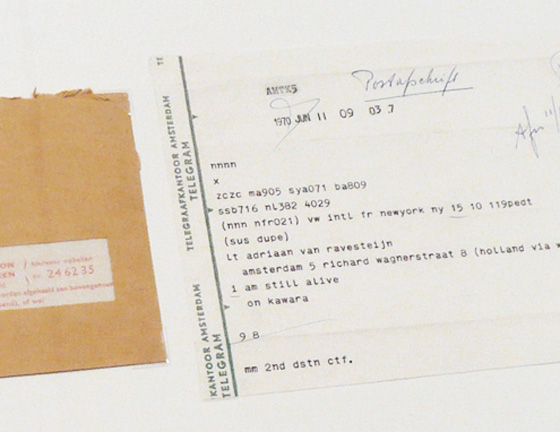
 As you read this, there's a good chance that On Kawara is in the midst of painting today's date: Aug. 28, 2013. Just about every day since since January 4, 1966, he's done so—painted the date, which usually takes all day, on a small canvas, rendering the month in the language of the country this frequent traveler happens to be in—as a meditative act and an ongoing work of conceptual art. The rules: he must complete each "date painting" on the day he started it, and if he fails, he must destroy it. Fascinated by time, On Kawara also has been known to send telegraphs and postcards to friends with the reassuring words, "I am still alive."
"He is like one of those peculiar, driven characters in a Paul Auster story, except On Kawara deserves a better fate than to be memorialised in Auster's overrated fiction," wrote Adrian Searle in 2002. "On Kawara creates his own memorial every day, in the eloquent silences of his works. He exists, and his art is the proof of it."
Via @museumnerd, we learn that On Kawara has been using Twitter since January 2009 to reiterate his existence. Just about every day he tweets "I AM STILL ALIVE #art" (occasionally he breaks form, like he did on April 29, 2009, when he tweeted, "i might die soon ..."). It's a surprising medium, yet a perfect one for the artist. On one hand, the evidence of the artist's hand is missing, his painstaking day-long painting replaced by a few keystrokes on a computer (maybe even aided by cut-and-paste commands and Twitter's tweet-scheduling function). But on the other, it's an apt medium for those obsessed with time, as On Kawara is: beneath each tweet is its timestamp--both day and date—offering more evidence of a moment of living catalogued.
Update 8.28.13: After all that typing, turns out I've been had. Sort of. The On Kawara Twitter account is the work of Pall Thayer, who way back in 2009 revealed this, which is pretty awesome:
On Kawara on twitter is a Perl script that gets automatically run once a day on a server in a cabinet in my living room. I haven't done anything to publicize his activities on twitter. All he does is announce, "I AM STILL ALIVE" once a day. He doesn't follow anyone. Yet, somehow, it seeped out into the twitter community. The "Perl Net::Twitter" client name should be a dead give away.Thanks, Yuki Okumura, for pointing it out.
The interesting thing about this (and my original reason for launching it) is that it blatantly negates the whole idea behind On Kawara's "I AM STILL ALIVE" messages. Whereas those did indeed confirm that he was still alive, this doesn't. It's an automated process that he doesn't even control. Were he to die, he would continue to announce "I AM STILL ALIVE", everday, on twitter. So it really does two things; by falsely confirming that he is alive, it casts doubt on the issue but it also keeps the notion of him actively announcing that he is alive, alive.
So what may sound like a simple prank is actually pretty complex and gets more complex the more you think about it.
8.16.2013
Bits: Žižek, YACHT, Questlove, Drones
 |
| Adrian Piper, Imagine [Trayvon Martin], 2013 |
• The music duo YACHT (Jona Bechtolt and Claire Evans) has put out the protest dance song "Party at the NSA," available for free download, along with a limited-edition shirt (with art by Tim Lahan and designer Sang Mun's OCR-thwarting ZXX typeface), with process supporting EFF. They tell Nothing Major why they made the song a protest "party jam":
It evokes the classic punk-rock satires we grew up loving, like the Dead Kennedys's "Holiday in Cambodia," or the Descendents' "Suburban Home." To have fun at the NSA's expense while simultaneously doing something active, raising money, to fight against it—in our minds, this is a combination that works. A lot of people are subconsciously deterred from involvement in these kinds of issues because the very thought of what is actually happening in this country makes them anxious, and they'd rather ignore it. We want to reframe that impulse, giving people an engaging, spontaneous, expressive context for protest. Poetic terrorism, if you will.• Questlove from The Roots spoke about racial profiling, stop-and-frisk, and Trayvon Martin on Democracy Now this week. Must-watch. Earlier: Questlove's Facebook post that went viral. On the George Zimmerman ruling: "i dont know how to not internalize the overall message this whole trayvon case has taught me: you aint shit."
• From Gizmodo, here's what they're hawking at the world's largest drone fair.
• Also, don't call them drones, says the drone industry.
8.15.2013
Bits: Art Smackdown, Drone Speedtrap, Lego Architecture
 |
| Speed Enforced by Drones, a guerrilla sign project by Stephen Whisler |
• During yesterday's Day for Detroit--which included art blogs and museums (including Eyeteeth and the Walker) posting favorite shots of works from the Detroit Institute of Arts' colleciton that could be threatened if the city moves to sell art to settle civic debts--included a guerrilla action: artist Jerry Vile slapped a "for sale" sign on Rodin's The Thinker and other sculptures at the DIA. Staff quickly took it down.
• Architecture Studio, a new set from Lego, "comes with 1,210 white and translucent bricks. More notable is what it lacks: namely, instructions for any single thing you’re supposed to build with it. Instead, the kit is accompanied by a thick, 277-page guidebook filled with architectural concepts and building techniques alongside real world insights from prominent architecture studios from around the globe."
• ArtPrize's Kevin Buist interviews Creative Time's Anne Pasternak.
• Artist Fritz Haeg and author Michael Pollan talk ethical clothing, specialization, folk microbiology, and reviving the domestic.
• And here's a new video on Fritz's yearlong residency at the Walker Art Center.
8.14.2013
A Day for Detroit
 |
| Marcel Duchamp, Photorelief, 1935 (printed 1953) |
To highlight the DIA's amazing, diverse collection and showcase artworks that may be threatened should such a sale take place, I'm joining with Modern Art Notes and more than a dozen other art sites to observe A Day for Detroit, in which we'll all be sharing our favorite works from the Institute's collection. Here's a list of all the sites that will be participating today.
 |
| Claes Oldenburg, Inverted Q, 1976 |
 |
| Morris Louis, Number 205, 1961 |
 |
| Dorothea Lange, Migrant Mother, Nipomo, California, 1936 |
 |
| Charles Eames, Side Chair, 1951 |
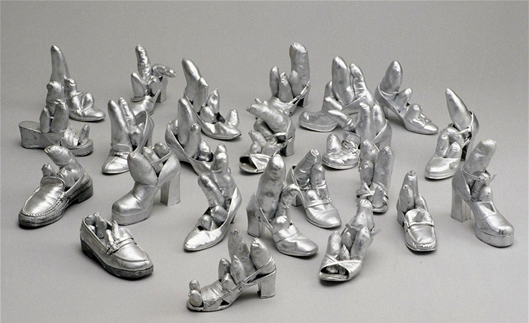 |
| Yayoi Kusama, Silver Shoes (23 objects), 1976/1977 |
 |
| Albrecht Durer, The Four Horsemen, 1497/1498 |
8.13.2013
Bits: Trickle-Down Art, Fast's Drones, Sekula
 |
| Still from Omer Fast's 5,000 Feet is the Best, 2011 |
The claim of such a plan goes like this: Privatize a great art collection owned by the public, and the benefits will trickle down to the people... Will we fall for it again in Detroit? Supplying art masterpieces to a booming luxury-goods market will supposedly mean ponies and party hats for pensioners. Fat chance.• For its inaugural exhibition, the Imperial War Museum's new IWM Contemporary program presents Omer Fast's 30-minute video 5,000 Feet is the Best. On view through Sept. 29, the piece draws its name from an interview the artist did with a Las Vegas-based Predator drone operator, who (under condition of anonymity) shared what he believes to be the optimal altitude for the unmanned aerial vehicles. "It is a lot like playing a video game," he told Fast. "But playing the same video game four years straight on the same level." GOP Sen. Lindsey Graham says the US has killed 4,700 people using these video-game-like weapons. Commonwealth Projects shares a 9-minute excerpt from the video, which blends interview footage with actor dramatizations, while The Guardian offers another.
• With the launch of its Open Content Program, the Getty is "making roughly 4,600 high-resolution images of the Museum’s collection free to use, modify, and publish for any purpose."
• Your moment of private escape--a book read on your Kindle or Nook--isn't so private, writes James Bridle. According to EFF's most recent E-Reader Privacy Chart, "almost every service tracks searches for books, meaning not just what you read, but what you're interested in, is stored" for corporations to use and/or sell.
• Speaking of Bridle, here he is discussing his Balloon Infrastructures workshop with Fabrica.
• RIP Allan Sekula, artist, photographer, educator, writer.
• Your moment of: bullet cross-sections.
8.12.2013
Punks v. Hippies: A Graffiti Call-and-Response
Graffiti reading "Kill the hippies," which appeared on a wall in Minneapolis' diverse (and admittedly lefty) Powderhorn Park neighborhood last month, recently got buffed and re-tagged. Here's the exchange:
 |
| July 2013 |
 |
| August 2013 |
8.09.2013
Bits: Bromides, Tasered for Graffiti, Herzog's PSA
• Miami Beach police tasered to death 18-year-old artist and graffiti writer Israel Hernández-Llach early Tuesday morning. His crime: writing an R -- that's as far as he got in writing his tag, "Reefa" -- on the side of a shuttered McDonalds. “The officers were forced to use the Taser to avoid a physical incident," said the chief of police.
• Werner Herzog takes the dreaded driver-safety PSA into new territory with From One Minute to the Next, a new 35-minute documentary, which offers an unflinching and distinctly Herzogian cautionary tale about texting while driving. He forgoes the genre's usual scare tactics, instead opting for humane portraiture of both victims and perpetrators. It's every bit as engrossing as Grizzly Man or Into the Abyss, making the haunting case that any one of us could find ourselves an unintended killer for checking the iPhone one more time.
• Edward Winkelman posted this remarkable story on Facebook: a Russian man, displeased by the terms of an unsolicited credit card offer he received in the mail, scanned and modified the agreement -- to include terms like a 0% APR and no fees -- and mailed a signed copy back. The back approved a card, apparently without reading the fine print. Long story short, it's now two years later and he's suing the back for $727,000 for breach of contract.
• PJ Harvey's new single "Shaker Aemer" -- available as a free download -- draws attention to the plight of the last British resident in Guantánamo: Held without charge or trial and cleared of any wrongdoing in 2007, Aamer has been locked up for 11 years. The song recounts the 46-year-old's four-month hunger strike and forced feedings.
• Of its Jay Z/Taylor Swift "Picasso Baby" mashup, Pop Culture Pirate writes, "I love that both artists use their status as outsiders to connect with audiences despite being very much ‘insiders.' I think that dichotomy resonates with the art world attendees as well."
• Painter Rich Barlow tells MN Daily about his "Daily Bromides," a series of watercolor postcards he sends out anonymously -- one a day for a month to a random recipient -- depicting William Henry Fox Talbot's Reflected Trees, one of the first photographs ever made.
• Apparently, today is go-armed-to-Starbucks day.
• Werner Herzog takes the dreaded driver-safety PSA into new territory with From One Minute to the Next, a new 35-minute documentary, which offers an unflinching and distinctly Herzogian cautionary tale about texting while driving. He forgoes the genre's usual scare tactics, instead opting for humane portraiture of both victims and perpetrators. It's every bit as engrossing as Grizzly Man or Into the Abyss, making the haunting case that any one of us could find ourselves an unintended killer for checking the iPhone one more time.
• Edward Winkelman posted this remarkable story on Facebook: a Russian man, displeased by the terms of an unsolicited credit card offer he received in the mail, scanned and modified the agreement -- to include terms like a 0% APR and no fees -- and mailed a signed copy back. The back approved a card, apparently without reading the fine print. Long story short, it's now two years later and he's suing the back for $727,000 for breach of contract.
• PJ Harvey's new single "Shaker Aemer" -- available as a free download -- draws attention to the plight of the last British resident in Guantánamo: Held without charge or trial and cleared of any wrongdoing in 2007, Aamer has been locked up for 11 years. The song recounts the 46-year-old's four-month hunger strike and forced feedings.
• Of its Jay Z/Taylor Swift "Picasso Baby" mashup, Pop Culture Pirate writes, "I love that both artists use their status as outsiders to connect with audiences despite being very much ‘insiders.' I think that dichotomy resonates with the art world attendees as well."
• Painter Rich Barlow tells MN Daily about his "Daily Bromides," a series of watercolor postcards he sends out anonymously -- one a day for a month to a random recipient -- depicting William Henry Fox Talbot's Reflected Trees, one of the first photographs ever made.
• Apparently, today is go-armed-to-Starbucks day.
Subscribe to:
Posts (Atom)