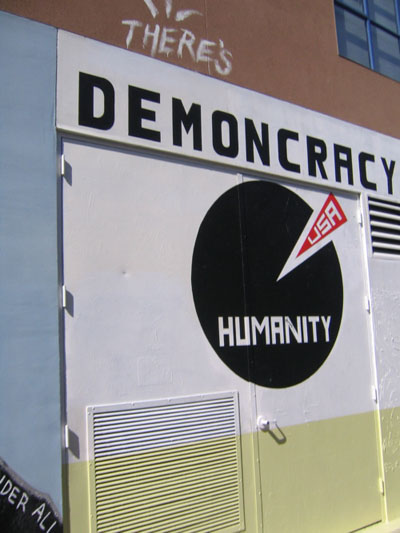
It includes 68 new terms i.e. Preparedness and Freedom Fries as well as terms that have recently been redefined i.e. Torture.
The dictionary also has an interactive dimension. 58 terms are left undefined for the reader to pencil in their own definition. Furthermore, readers are invited to submit their additions to the institute for a possible inclusion in the 2nd edition.
4.23.2007
The new New American Dictionary
4.22.2007
The Voluntary Buyout That Wasn't: Strib Denies Sports Writer's Bid to Keep Working
Ninety-seven seconds before midnight on March 10, Star Tribune sports writer Steve Aschburner emailed his managers telling them he wanted to take a voluntary buyout of his contract. He was on the road, covering a Timberwolves game in Atlanta, and his decision came at the very end of a five-day window in which employees could choose to leave the paper in exchange for a payout for time served.Aschburner quickly regretted his decision, recognizing it as an "impulsive, stressed-out thing" complicated by personal issues and the "ticking bomb" nature of the five-day clause, and within four days he told his editor he wanted to stay. For the past six weeks he's been pleading with Star Tribune managers to let him keep doing a job he loves -- but what he's found is that management sees his buyout as anything but voluntary.
For 13 of his nearly 21 years at the Star Tribune, Aschburner's beat has been the NBA, and the Minnesota Timberwolves in particular, and in that time he has earned praise from fans -- including one who hailed his ability to work the word "vomitorium" into a piece on a Timberwolves' loss -- and colleagues alike (he recently finished a two-year stint as president of the Professional Basketball Writers Association). And while he couched his successes in modest terms, he admitted, "I really loved my job, and I think I made [the Star Tribune's NBA coverage] into a brand."
But in the five days after the Star Tribune sale to Avista Capital Partners was finalized, he found himself facing a "perfect storm" that fueled his decision to leave his job: "The grind of the season, the isolation of the road, some miscommunication with my wife and then the shock and scare of a friend's and peer's death." A sudden heart attack killed his colleague, the seemingly healthy 55-year-old Hartford Courant sports reporter Alan Greenberg, and seeing himself as out-of-shape, he wondered if he was next. Combined, these factors left him "in no position to be making a life-altering decision."
But the long view is this: he loves his job and has no problems with the paper's new management. His desire to stay isn't about a change of heart. Instead, his fleeting wish to leave was a "hiccup" in judgement, but now the paper is viewing that mistake as the norm and his the two decades of eager service as an anomaly, he said. The Star Tribune denied his request to rescind his buyout application, citing budget concerns, according to a letter sent to publisher Par Ridder by members of the paper's Newspaper Guild unit.
Referencing conversations with Aschburner and letters from his doctor, Guild members Jaime Chismar, Pam Miller, and Chris Serres wrote that they believed Aschburner was under "emotional duress" when he indicated his interest in the buyout, and that he was in no condition to "reflect clearly on how leaving the Star Tribune would affect his career and family." They continued:
To deny Steve the opportunity to continue his career at this newspaper, especially in light of the anxiety he was under at the time of the resignation deadline, seems senseless and cruel. We urge compassion and respect for a dedicated journalist who loved the Star Tribune and is prepared to remain a productive contributor for many years to come.Aschburner has also received unexpected and unsought support from sportwriting colleagues. Phil Jasner of the Philadelphia Daily News and Doug Smith of the Toronto Star have both written letters to Aschburner's editor urging his reinstatement.After finishing out the Timberwolves' season, Aschburner's last day of work was Friday, April 20, and he has not yet considered what he'll do next. He said he won't pursue legal action against the Star Tribune and isn't bitter about management's decision, but he still holds out hope for a change of heart.
"Someone is going to have to cover that team and league going forward, and no one on staff wants it or has experience," he said. "I am dying to stay on the job."
In times when the paper is in upheaval after the departures of 23 other newsroom staffers, continuing budget concerns, and the turmoil of a new publisher accused of swiping business secrets and staffers from his old employer, the Pioneer Press, why is the Star Tribune refusing to welcome back a popular, well-recognized and, above all, enthusiastic member of its team?
[Cross-posted at Minnesota Monitor. Photo: Aschburner presents Kevin Garnett the 2005-2006 J. Walter Kennedy Citizenship Award, via Garnett Tribute.]
4.21.2007
Our Own Imus: City Pages Scrubs Editor's Stereotypes from Story
Reporting on Star Tribune plans to outsource some 25 jobs to New Delhi, Hoffman's April 18 piece referenced a week at the Star Tribune "that saw new publisher Par Ridder smacked around like a two-bit ho in a lawsuit filed by his former employer." Hoffman also called the Strib's outsourcing plan "Operation: Sanjaya," after the wouldabeen American Idol Sanjaya Malakar, who is an American citizen born to an Italian-American mother and Bengali Indian father in Seattle. Both references -- which can be seen in Google's cache -- have been scrubbed from the paper's online story.
One curious stereotype remains: Hoffman predicts that within six to nine months, the paper's ad designer "will be taking a rickshaw to work." Rickshaws, while used in India, got their name from their country of origin, Japan -- not the home country of "Habib," whose name appears in the CP subhead.
[Crossposted at Minnesota Monitor.]
4.20.2007
Steve Brandt Yahoogroups post
9a.
On newspapering and public policy
Posted by: "Steve Brandt" sbrandt@startribune.com brandsc4438
Fri Apr 20, 2007 6:54 am (PST)
I realized on the way to work this morning that this coming fall it will be 40 years since I earned my first byline. Even back in the pre-Watergate days, journalism was something that grabbed me because it offered a chance to dig into some interesting areas of public policy. And when Watergate came along as I was finishing college, it seemed like validation of that choice. (For those of you born post-Watergate, it was like "Survivor" except that the White House was the island and the last person voted off was the President.)
Today, I'm wondering. There seems to be little room for serious exploration of issues that affect our communities. Today, I posted a blog entry on the Minneapolis teacher placement issue on our micro-reporting site at: http://www.buzz.mn/?q=node/1151
What's new is that no story was in today's paper out of last night's discussion meeting, organized by the League of Women Voters, at which 90 people listened attentively for two hours as knowledgeable people explored the pros and cons of seniority in teacher placement. It was a good discussion, and I learned some new things even after giving the issue close attention for the last 3-1/2 years.
I made that decision to go blog-only but really it was forced on me. I asked for 20 inches to summarize what I expected to be a serious discussion of an issue that some say affects the education of Minneapolis kids. I chose that length advisedly, taking as my cue the Vikings stadium advance story that was in Thursday's paper. I was offered 10 to 12 inches, an amount of space that raises the why-bother question when dealing with such a serious issue.
Granted, much of daily journalism involves fitting 20 pounds of content into a 10-pound sack. I get that. But asking a serious issue to fit into a five-pound sack is asking too much of those of us who got into this line of work to do more than fill psace [sic] between ads. I didn't want my name on something that superficial.
I mention all this because I believe that the drift of this newspaper is harmful to the communities it serves. As Tim McGuire put it in a letter to the editor this morning, "the Star Tribune and the Pioneer Press always competed on a high level with dignity, passion and a constant concern for the Twin Cities audience." While McGuire had his own ethical blind spots, he's right in suggesting that there's a rot at the top of this institution. He's thinking of the publisher; I'm thinking of how our print readers are getting short-changed, and increasingly, our best coverage will be on the web.
That's it. I finished my blog at midnight, and I'm taking the day off, going to the country, and clearing my head.
Steve Brandt
Star Tribune
Free Thai Cinema: Tropical Malady director censored
Award-winning director Apitchatpong Weerasethakul (Tropical Malady) has shown his films all over the world, including here in Minneapolis for a 2004 retrospective, but with his latest, he can't get a showing in his home country. The Thai director submitted Syndromes and a Century (Sang Satawat) to Thailand's Censorship Board, and was told four cuts had to be made for the film to be released commercially. Saying he treats his "works as my own sons or my daughters," Weerasethakul refused to make the cuts. Now the Thai government says they'll hold onto his film print until the four prescribed deletions are made. Thai artists have begun an online petition -- already signed by more than 4,000 people -- urging the government to return the film print, but also seeking "a long-needed modernization of Thai legislation concerning movie censorship," which is based on a law from 1930. Sign the petition here.
Wal-Mart keeps selling Nazi t-shirts
Pogoshovels and Victory Gardens: Amy Franceschini at Gallery 16
The rhetoric of war loses meaning when the enemy's "last throes" are announced years before actual victory, and when the citizen "war effort" involves a presidential plea for more shopping.So it's refreshing to see artists picking up the shells of apparently discarded terminology and refilling them. Case in point, Amy Franceschini's efforts to revive Victory Gardens, the citizen-maintained gardens of World War I and II that grew some eight billion pounds of food nationwide. On our last day in San Francisco this week, we dropped by Gallery 16 to see a show by Franceschini, a nice counterpoint to her work on view in SFMOMA's current 2006 SECA Art Award show.
A founding member of Free Soil and Future Farmers (she also contributed interviews to the book Land, Art: A Cultural Ecology Handbook and collaborated on the follow-the-money website They Rule), Franceschini's work melds activism, graphic design and community organizing. And gardening. For her Victory Gardens 2007 project, she created a system for San Franciscans to seed their own gardens in backyards, rooftops, and vacant lots through the help of seed banks, training, materials, and the ancillary publicity her art can bring. (Her pogo shovel, a Duchamp-meets-Beuys symbol of the fun of gardening, could be seen as emblematic of the project's goal of connecting pragmatism and play.)
Like Beuys or Tiravanija, Franceschini's work is environmental but also inherently process-based, a fact former (and future?) Green Party mayoral candidate Matt Gonzalez picked up on in a San Francisco Chronicle article (he helped Franceschini get the project off the ground). "Art is not all oil and canvas; it can be about the transformation of an idea," he said. "An artistic idea, which is like a political act, is now re-characterized as art."Her G16 show features used (and restitched) gloves in pristine museum frames, seed bag labels, and a system the artist and Michael Swaine devised to recycle gray water and harvest rainwater for agricultural use (left). Her section of the SFMOMA show included the Bikebarrow, a flat-green bicycle fused with a wheelbarrow front, allegedly to be ridden by "secret gardeners."
The Victory Garden project has signed up gardeners at plots located in each of San Francisco's three microclimates (sun belt, fog belt, transition belt). Each garden team leader received a starter kit (delivered by a VG2007 tricycle), plus a lesson and follow-up instruction on harvesting and seed-saving. Three gardens is a great start, but well short of San Francisco's World War II Victory Garden production, when 200 gardens were maintained in Golden Gate Park alone.
But as VG2007 web site states, victory isn't about total domination but about connecting communities to each other and to their natural surroundings. It also defines "victory" in terms of "independence from corporate food systems," a definition of freedom presumably at odds with the one used by those prosecuting the war in Iraq.
Related: Practical propaganda: Amy Franceschini reinvents the Victory Garden
4.18.2007
4.15.2007
Clarion Alley
After four inspiring days at the Museums & the Web conference (and a lone blog post for it, on Brewster Kahle's opening talk), I took a few extra days to kick around. It's my first trip to the city, so I'm enjoying everything: the amazing architecture, the prehistoric plants we don't see the likes of in Minneapolis, the great food, and art seemingly everywhere. A highlight was Clarion Alley, which connects Mission and Valencia in the Mission District. For the past 15 years, the alley has been repainted with murals by neighborhood artists. A few favorites...


4.12.2007
Vonnegut
At age 84 and seemingly ready, Kurt Vonnegut has died. In Slaughterhouse Five, the ascerbic author doodled a tombstone with the epitaph above. But here's the engraving he said he really wanted:THE ONLY PROOF HE NEEDEDRest in Peace.
FOR THE EXISTENCE OF GOD
WAS MUSIC
[image]
4.10.2007
Museums & the Web
4.08.2007
Catching Up with The Crasher: Mike Tronnes Discusses Cursor at 10
When Mike Tronnes co-founded the website Cursor.org with Rob Levine, Mike Mosedale and Brad Zellar ten years ago, few of the attention-getting strategies of the internet were at his disposal. Cursor predated Digg and Reddit, RSS was an acronym just being born, and social networking sites like MySpace and Facebook didn't yet exist. He had to resort to desperate measures to promote his site. And, brilliantly, he did so in a highly visible way that simultaneously promoted Cursor's mission of media critique: He'd crash live newscasts, showing up on-screen behind reporters holding signs that cleverly exposed the hype-generating ruses they employed.The first time I saw Tronnes, he was standing behind WCCO's Randi Kaye as she lead off the evening news with a "LIVE" report broadcast from the field where new governor Jesse Ventura had coached the Champlin Park High School football team... hours earlier. Questioning the newsworthiness of the story -- and its "live" coverage from a venue long emptied out of its newsmakers -- he held up a sign that read "Can't this wait until the sports news?"
There on the sign was the URL for Cursor, an online source for more criticism of the Twin Cities media scene. In the ten years since, Cursor has expanded its scope to include viewpoints on national media and both national and international politics. It now gets site visits in the five figures every day, and its Media Transparency project, spearheaded by Levine and launched in 1999, has compiled one of the more extensive maps of the conservative philanthropy movement, tracking 40 grantmaking groups on the political right and where their more than $3 billion in gifts are going.
On the site's tenth anniversary and with a fundraiser in progress, Tronnes agreed to discuss Cursor, his time as "The Crasher," and the evolving nature of the progressive blogosphere.
Paul Schmelzer: What are some of your favorite "media crasher" moments?
Mike Tronnes: When Cursor began in 1997, most of our invective was directed at local TV news. Even then it was hopelessly beyond reform, but it did provide endless opportunity for ridicule. We had a columnist named "Budd Rugg," who skewered the idea of local media celebrity, and whose schtick was that of a pathetic media sycophant. In 1999 I had a brief star turn as "The Crasher," walking onto live remotes of local TV newscasts while brandishing signs that both advertised Cursor and questioned what passes for reporting on TV news. I made my way onto a live remote from a Prince concert with a sign that read, "The program formerly known as The News."
Another trend that was ascendant at the time was synergizing news stories and network programming. It reached its peak -- or nadir, depending on your perspective -- in the summer of 2000 when WCCO-4 turned its newscasts into a promotional vehicle for the just-launched "Survivor." We documented this flagrant violation of the public trust in "Survivoring the News," and in a City Pages cover story that I worked on with Mike Mosedale, a founding member of Cursor, whose gonzo media criticism is archived in "The Moseum."
PS: When you started Cursor, the online media landscape was completely different. What are the changes you've seen in the realm of blogs and online media, and how is Cursor adapting to this new climate?
MT: Cursor.org began in 1997 as a local media criticism site. In 1999 we started a national version of our "Media Patrol" digest, adding politics to the mix, and after 9/11, expanded it to include international affairs. At that time the blogosphere was dominated by right-wing voices and many now-popular progressive news aggregators didn't exist. Nor did Google News, which is invaluable for seeing where a story's at, and what kind of play it is or isn't getting. Also, there were no sites like Media Matters or Think Progress that provided rapid response to conservative misinformation and the mainstream media's parroting of it.
This proliferation of sources certainly allows us to cover more ground, but it also makes our aggregating function trickier, because a lot of our readers also frequent those sites. And while we're always on the lookout for articles and issues that haven't made their way around the progressive aggregators and blogosphere, much of our effort is spent contextualizing those that have. Now it's less about discovering a story, and more about organizing and advancing it.
PS: Your site Media Transparency, maintained by Rob Levine, was one of the first resource portals to look into the funding of the political and religious right...
MT: Right. When Media Transparency launched in 1999, most people had only heard the term "vast right-wing conspiracy," without knowing much about it or how it functioned. But as conservatives expanded their influence in government -- see The Conservative Movement Moves In -- Media Transparency's research and editorial became invaluable for reporting on the impact that conservative philanthropy has on public policy. We currently track 40 conservative funders in a database that includes 8,000 recipients of 50,000 grants totaling more than $3 billion.
And while Cursor mainly draws from other editorial sources, Media Transparency is a content provider for anyone investigating conservative causes and organizations. Two good examples that I mentioned before are Media Matters and Think Progress. Cursor often links to them, and they in turn regularly link to Media Transparency's research.
PS: With Cursor and Media Transparency, your role is less visible: fundraising, hiring writers, marketing. An new article in The Nation talks about the funding of bloggers, how many news bloggers are volunteers, and how "progressives tend not to put their money where their mouth is." Cursor is a nonprofit that relies on grants and individual donations to survive -- and you're doing a fundraising appeal now. When you pitch potential funders, what's your best argument for the continued (and generous!) support of Cursor/Media Transparency?
MT: Cursor and Media Transparency are incorporated as Cursor, Inc., which is a 501(c)(3), the IRS's designation for non-profits. The majority of our funding comes from foundations, and our general argument to them is that we've successfully developed two Web sites and are an integral part of building what is often referred to as "progressive media infrastructure." We've put together an online fundraising site built around this theme, which includes an archive of articles and editorials about funding progressive infrastructure, called "Work In Progress."
Since most left-of-center foundations don't give grants for general operating support, unlike their counterparts on the right, our proposals have centered on specific projects relating to Media Transparency. The pitch being that with additional funding, we can promote Media Transparency's research to a more mainstream media audience. The goal is to get reporters and producers that cover subjects like school vouchers, Social Security privatization, or faith-based initiatives, to follow the money trail and paint a more complete picture of who's behind the various policy proposals, which are often inaccurately portrayed in the media as being grass roots in nature. The great irony is that while Media Transparency tracks more than $3 billion in conservative funding, we're scrambling to get a piece of the much-smaller pie that's available to progressive organizations.
4.07.2007
Who Owns the J-Word: Videoblogger's Jailing Raises Questions for Journalists
Local experts, including the St. Cloud-based chair of Wolf's defense fund at the national Society for Professional Journalists, think he is, and they see his case, problematic as it may be, as a key fight to defend journalistic ethics -- and a reporter now defying a handover request from a judge in Mankato, Minn.
On July 8, 2005, Wolf grabbed his video camera to document a rally in San Francisco's Mission district held by local anarchists to coincide with a globalization conference happening concurrently in Scotland. During the protest, a police officer's skull was fractured, and there was allegedly an attempt to torch a police car. Wolf sold some of his footage of the day to local TV stations.
In the investigation that followed, a grand jury subpoenaed Wolf to turn over raw video footage and testify before the grand jury about its contents. (Around 65 subpoenas for journalists have been approved by the U.S. Attorney General since 2001.) Citing the First Amendment, his commitment to protecting the confidentiality of sources, and a belief that the media shouldn't be a tool of law enforcement, he refused -- and wound up in jail.
So. Is Wolf a "journalist" deserving protection under shield laws? Or does his unabashed activism and identification as an anarchist mean he's crossed the line between objectivity, the journalist's professed stock and trade, and advocacy.
Anthony Lappe of the progressive Guerrilla News Network said that Wolf's "oeuvre as a journalist, radical or not, is thin" consisting mainly of "online rants and what I call 'protest porn' -- contextless video of radical protests." And the conservative San Francisco Chronicle columnist Debra Saunders renders verdict in a piece with a title that says it all: "A journalist in his own mind."
She writes:
The editorial board at Saunders' paper disagreed with her assessment. "The fact that Josh Wolf has strong political views does not disqualify him from being a journalist any more than the fact that I am an editorial page editor and have opinions disqualifies me from being a journalist," said John Diaz of the San Francisco Chronicle in an interview with Kevin Sites. "The fact is, he was out at that rally, collecting information to disseminate to the public. I think that makes him a journalist."The issue here is whether Wolf should be protected by shield laws designed to protect real journalists who need to protect their sources. In Wolf's ideal world, he would qualify, not because he follows journalistic practices, but because he disseminates information to the public.
Of course, Wolf's cause appeals to the liberal sensibilities of the Special City. If a kid anarchist is willing to go to jail because he thinks he's a journalist, he must be a journalist. He feels so strongly about it. Damn the consequences.
Except a federal shield law that would protect Wolf also would protect an anti-abortion activist with a camera who attends an anti-abortion demonstration that turns violent and tapes activists as they pummel abortion clinic workers.
I asked Wolf: Should an anti-abortion blogger be able to use a shield law to protect the identity of an activist who beat up a clinic worker? He answered, "There should be some level of protection, yes."
Press freedom groups like Reporters without Borders and the Society of Professional Journalists -- an organization that, through its northern California chapter, nominated Wolf Journalist of the Year -- agree. The SPJ gave $31,000 to Wolf's legal defense, its largest donation ever for such a case, according to Dave Aiekens, a 13-year reporter at the St. Cloud Times and chair of the national defense fund. "The case is far from perfect," he acknowledged, "but they never are."While the SPJ stood firmly behind Wolf, it has no interest in the is-he-a-journalist question.
“The minute you start defining who’s a journalist you go down a tricky path of the government licensing journalists," Aiekens said. "We don’t think the government should have anything to say about it."
He added that because Wolf was shooting video and providing it to TV news stations, and has an established history of doing so, that qualifies him as a journalist.
For the sake of argument, would terrorists who videotape beheadings and bombings and send the footage to broadcast outlets then fall into that category? I'd argue no. While the subjects Wolf has taped often are masked, Wolf isn't. He posts his videos and sells footage to news stations under his own name, and the activities he's recorded -- at least in the case of the disputed clips of the San Francisco rally, which include no imagery of arson or violence -- conceal nothing criminal, as far as I can tell.
The burden of proof should fall on those who wish to disprove Wolf is a journalist. And who should do that? Certainly not the government, as Aiekens said. Jane Kirtley, director of the University of Minnesota's Silha Center for Media Ethics & Law and a board member of SPJ's chapter for Minnesta professional journalists, concurs.
"We don't have government licensing [for journalists] in the US," she said, adding, "There are many situations in which access to some event or other is restricted to 'accredited' journalists. Even the House and Senate Press Galleries engage in trying to decide whether or not someone is a 'journalist' in order to qualify for a press pass-- which is another example of journalists themselves deciding who is 'one of us.' I think we can't blind ourselves to the reality that in the past, there have been occasions when journalists have closed out by other journalists. So I guess the question is, in an ideal world, should anybody decide 'who is a journalist,' other than the 'journalist' him or herself?"
The case highlights a need, said Aiekens, for a federal shield law. Thirty-two states, including Minnesota and California have such laws, but a federal provision was shot down in 1972, when the U.S. Supreme Court voted 5-to-4 against the premise that a "reporter's privilege" to keep sources confidential is implied by the First Amendment. (California has a shield law, but it doesn't apply to Wolf. The alleged arson attempt on the police car makes it a federal case because, in a weird twist of legal logic, the SFPD receives some Homeland Security funds.)
"We felt if we made a big splash with [the SPJ's donation to Wolf's defense] we could get some momentum behind a federal shield law," Aiekens said. The law would "force the government to have a higher standard of evidence" in proving that information about crimes, for example, can only be obtained through reporter's unpublished notes.
He added that this kind of case "can happen anywhere, to anyone."
In fact, in Mankato, Minn., a veteran reporter is resisting requests by a judge and law enforcement to turn over interview notes.
On December 23, four hours into a police standoff with a man in the town of Amboy, Mankato Free Press reporter Dan Nienaber still had no details from police about the nature of the case, which began when police responded to a domestic disturbance call. And, according to the paper, readers were calling in, alarmed at rumors that five people had been murdered.
Nienaber grabbed his cellphone and began calling numbers in the area, ending up, by accident, on the line with Jeffrey Alan Skjervold, the man at the center of the standoff. There weren't five murders; Skjervold told the reporter he'd shot two officers and was bleeding from a gunshot in his stomach. Eventually he turned the gun on himself.
Nienaber mentioned the call in his report, and even though law enforcement agreed that Skjervold took his own life and that no other suspect was being considered in the crime, still sought Nienaber's notes. Prosecutors won't say what they want them for, but the paper said it believes this is an attempt to intimidate reporters and the paper. (Contacted last month, Nienaber said he couldn't comment as the case was "still in the courts.")
I find myself in agreement with everyone I quoted here -- and with Wolf. Lappe is right on when he says Wolf's journalistic cred is a bit flimsy. Kirtley and Aeikens are right that journalists should be free from government definitions of "journalist," and therefore Saunders is right that Wolf is a journalist simply because he says he is. The price of entry, admittedly, is pretty low. But given what's at stake -- news coverage we can trust as independent from the motives of government and law enforcement -- it seems a fair trade.
Maybe that's what Alexis de Toqueville had in mind when he wrote, "In order to enjoy the inestimable benefits that the liberty of the press ensures, it is necessary to submit to the inevitable evils that it creates."
Update: This piece won a 2007 Frank Premack Public Affairs Journalism Award from the University of Minnesota School of Journalism, the first time the prize has gone to an online journalist.
[Cross-posted at Minnesota Monitor.]
Beyond Newspapers: Steve Perry on Web Journalism
Talking about the bright side of newspapers now is like trying to name the cheeriest thing about mass suicide. In its hour of deepest crisis, the industry is gutting its own resources in the interest of next quarter's bottom line. As a friend of mine put it, they're all being run like financial companies when they are in fact manufacturing companies that need to be looking out for their productive resources.Read "Black and White and Dead All Over: Steve Perry on the Pauperization of Newspaper and the Promise of the Internet"
Most of the fun, and the sense of discovery, is on the web. Obviously. I mean, you've got tens of thousands of blogs that engage "the news" in some way. And although the vast majority just cannibalize workaday media and lay on a dollop of partisan cant, blogs have also produced a new generation of voices doing good, distinctive, original political analysis and media criticism, two huge blind spots of mainstream media.
The internet is also pressing newsgatherers to involve their readers in a more dynamic way, to let them in on interpreting and elaborating and sometimes even defining "the news." The challenge is to find ways to do that without letting the inmates run the asylum -- without letting the conversation descend to unverifiable claims, stupid in-jokes, and lumpen flame wars. Unmoderated is bad, n'kay?
The main issue for journalism is still monetizing the web, making a web platform pay for the kind of staffing that can produce useful original reporting. I have no idea how that will happen, but the smartest people I know on the marketing side of the internet think part of the answer will be elements of paid content. I know that's heresy to most users -- who doesn't like content that's all free all the time? But it's not all bad from the readers' standpoint, either. There's nothing like making people pay for content to ratchet up the pressure to make it ambitious.
It's impossible to say what the web is going to be like five years from now. There are political and commercial pressures in play that mainstream media has done an atrocious job of covering. What percentage of Americans has even heard the term "net neutrality," I wonder? How many people know that there's a lobbying movement afoot to create a two-tier internet in which the highest-speed connectivity is reserved for big companies that can pay a premium for it? Far too few. Most people regard the internet as a tool for entertaining themselves and shopping, and assume that the hand of the market will only make it more flashy, more fun, more powerful. They think it's essentially just another consumer product. Even among media critics, there's too little recognition that it's a new communication medium that's still in its Wild West phase, making itself up as it goes.
And beyond the pressures to make it a more exclusive tool of corporate commerce, there is also a lot of political anxiety about how wide-open dialogue and dissent can be on the internet. Do you remember the phrase the late Samuel Huntington coined to describe the political tumult surrounding Vietnam? He called it a "crisis of democracy," meaning there was too damn much democracy, too many voices demanding to be heard. The internet is a continual crisis of democracy in that sense, and it's naive to suppose it will stay as open in the future without political fights. There are those people who deem it unthinkable, or even technologically impossible, to limit American citizens' access to information on the web, but they're just plain wrong. (Every new communications medium spawns this kind of utopianism -- there were people in the '20s who thought radio would bring the revolution, and people in the '50s who thought TV would increase civic participation. Heh.) It's not impossible to hamstring web users. The best thing I've read on the subject is Jack Goldsmith and Tim Wu's book, Who Controls the Internet? Illusions of a Borderless World. You have to read it if you haven't.
So in a sense, any speculation about the future of the web and of news media on the web has an asterisk at the end of every sentence. It's possible, for instance, to revamp the web to give a huge advantage to the usual cartel of well-capitalized media companies, and make it much tougher for small sites, amateur or professional, to draw traffic and to serve multimedia. It's possible, in other words, to more or less restore the old order in a new medium.
But it hasn't happened yet, and it's not entirely inevitable. At minimum, there's a lot of fun to be had in the meantime. Is there a downside to mainstream media's efforts to mimic what bloggers do? Yeah, if not understanding the spirit of the endeavor counts as a downside. I hasten to add that there are now a *lot* of good blogs scattered around daily newspaper sites, but the news business in general remains hampered on the web by the assumptions it makes about reporters as senders and readers as passive receivers. Watching newspapers try to "relate" with readers is still vaguely embarrassing much of the time -- this odd combination of unctuous and patronizing at the same time. Kind of like seeing your grandma in stretch pants, doing The Robot.
Or a Kate Parry column.
4.05.2007
Foosball smackdown: Assisi v. Hitler
If only the battle between good and evil was this clear-cut: Edinburgh's Eleven Forty Company has created a limited-edition foosball table that pits a team of do-gooders (in white, naturally) including Thomas Moore, Mahatma Gandhi, and St. Francis of Assisi against a team made up of Caligula, Vlad the Impaler, Pol Pot, Idi Amin, and Lucifer himself. Only 20 hand-made games were made; the asking price: 14,500 pounds.
4.04.2007
Street-Art: Jihad vs. McWorld Redux
I'm definitely not endorsing the message behind this chilling (and kind of clever) bit of street-art, but it could be the alternate cover to Benjamin Barber's book Jihad vs. McWorld: How Globalism and Tribalism Are Reshaping the World.
Jens Haaning: A Grain of Wheat
In the years of heightened fear and suspicion that followed 9/11, Arabic script is met by many in the U.S. with some trepidation, a fact Danish artist Jens Haaning leveraged in a public art piece he created in New York last fall. Haaning wheat-pasted a series of posters bearing Arabic text throughout the city. The content would be familiar to many in the Middle East, not as a fatwa or a call to prayer, but as a joke -- and an incisive, timely one at that.Here's a translation:
A Grain of Wheat
When Guha lost his mind, he started to believe that he was a grain of wheat. His biggest fear was that a chicken would eat him. His wife became tired and persuaded him to see a doctor, which he did. The doctor sent him to a mental hospital.
After a short while, it seemed as though Guha had recovered and regained his sanity. His wife fetched him from the hospital and walked him back home. On the way home, Guha saw some chickens walking on the road. He became very frightened and tried to hide behind his wife.
The wife could not understand what had got into him as they had just left the hospital and shouted at him: "What the hell do you think you are doing? Don’t you understand that you’re not a grain of wheat anymore?"
Guha replied in anguish, "It doesn’t matter what I think! The important thing is whether these bloody chickens understand that I am not a grain of wheat."
100 to 1.
Politics aside, this photo by the AP's Oded Balilty, showing a Jewish settler resisting police, is definitely worth a 2006 World Press Award.
Embedded with Hate: BBC doc on Phelps Family
4.03.2007
Zine Publisher: "Debt is America's social safety net"
It's a weird kind of fortune that greets Tobin Brogunier's new publication, Creditland. A free tabloid distributed in the Twin Cities and Brooklyn, N.Y., its launch coincides with a spike in awareness of credit debt brought on by a meltdown in the subprime lending market and the premiere of the award-winning documentary film Maxed Out by James Scurlock (showing, until recently, at the Lagoon Cinema in Minneapolis). But the publication's origins have little to do with such luck.A Minneapolis-based documentary photographer, Brogunier was living in Brooklyn five years ago when, saddled by five-digits worth of business-related credit card debt, he filed for bankruptcy. As he worked to rebuild his financial life, he pondered the psychology of lenders who kept extending him credit, even as his ability to pay diminished. Creditland, a chronicle of the practices and effects of America's credit-card companies, is the repository of some of his findings.
The inaugural issue, which hit the streets March 30, includes transcripts of personal stories about debt, a glossary of economic terms used by lenders and short fiction. The design of the four-page publication, like the theme it addresses, seems maxed out: Text is everywhere, jammed to the margins, with little breathing room offered via white space. Brogunier said the design matches the economy of the subject: "Paper is valuable." But much of the content is rich, especially the cover story, an interview Brogunier conducted with "Maxed Out" director Scurlock. (Full disclosure: I first met Brogunier at a February forum on predatory lending, and my recording of the event is the basis for the transcript of state Rep. Jim Davnie's talk at that event, which appears in Creditland).
The next issue will focus on the rebuilding of New Orleans and the struggles of African-American homeowners in the hurricane-struck region. He also hopes to begin collecting first-person narratives on debt (and welcomes "Debtor of the Month" columnists) and verbatim transcripts of phone calls with representatives from credit-card companies.
Brogunier hopes the publication will reach people affected by credit-card debt -- whether they are the visible urban poor or the seemingly well-to-do but secretly over-extended borrowers in wealthier suburbs -- and demonstrate the shared effects of the "mindless consumption binge" he says America has been on for 25 years.
"Some people do well in that system," he said. "They make enough money that they can buy things and it works and the global economy keeps going, and that’s great. Other people aspire to do that, and if they’re aspiring to do that and they don’t have the cash, credit cards come in as a stopgap measure. In an ownership society — as George Bush calls it — you end up being compelled to keep up with the Joneses, and what you end up owning is a lot of debt."
The social critique embedded in Creditland is aimed as much at the U.S. government as at the opportunistic credit-card companies, Brogunier said. "Debt I consider to be America’s version of a social safety net," he said. "We don’t cover health care, we don’t cover child care, so when the expenses get to be too much, it’s credit debt that comes in. It’s like a government subsidy, except it’s not the government, it’s privatized."
But while Creditland has built-in criticism, he emphasized that the publication's title shouldn't be read as an indictment of America, but instead as a call to ethics, which he defines as "doing the right thing."
"I have no problem with America. America is a very enterprising place. If you have an idea, America is the place to produce it," he said. "This country is extremely rewarding of ideas that work, and I want this to be an idea that works. This is an American magazine that way."
You could say Creditland is un-American in another way, though: while Americans are reaching record debt levels -- in 2006, we owed $12.8 trillion in mortgage and consumer loans (135% of disposable income) -- Brogunier says he won't use credit to keep the ad-supported magazine going.
Practicing what he preaches, he doesn't even own a credit card.